

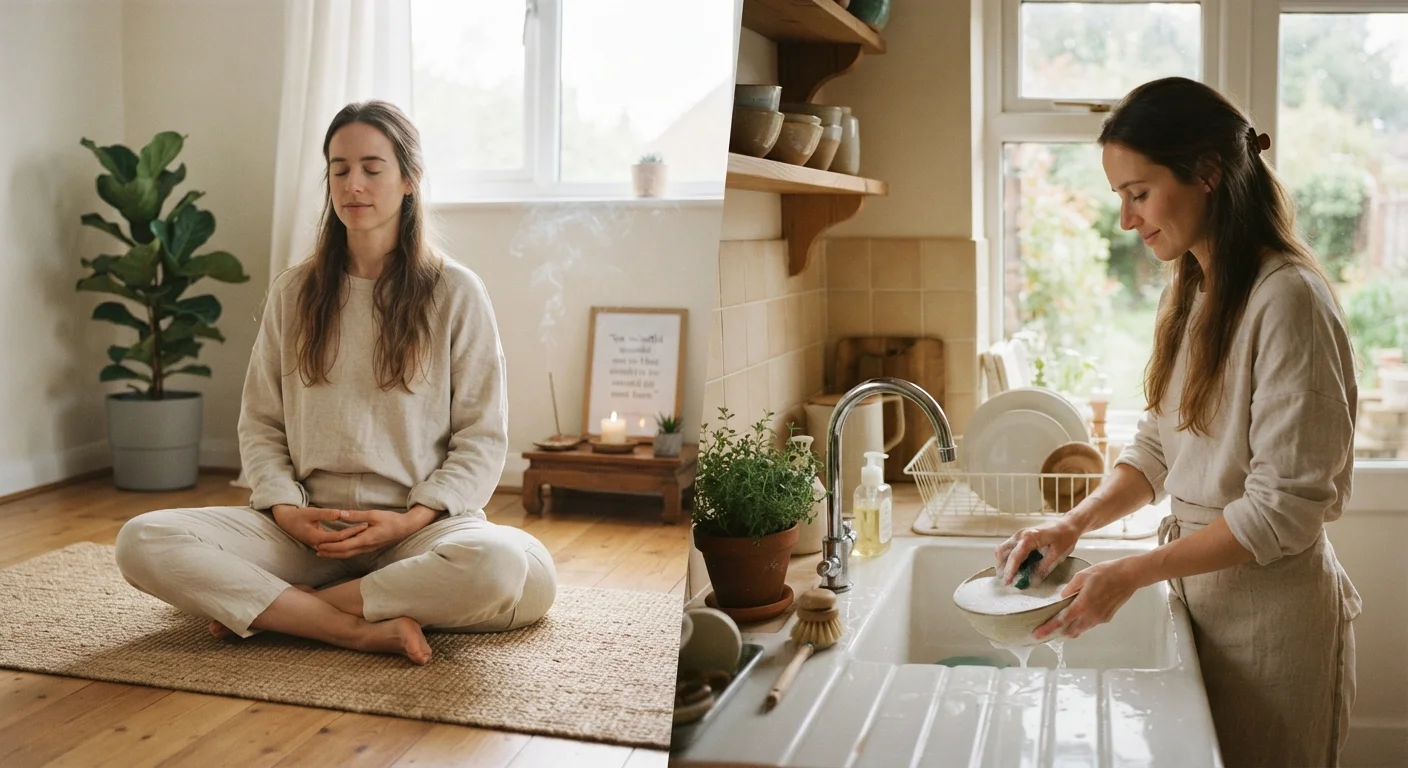
Option A
Mindfulness
A quality of awareness you can apply anywhere, anytime.
Best for: People who want to reduce stress gradually by changing how they relate to everyday experiences.
Option B
Meditation
A structured, intentional practice that trains attention over time.
Best for: People ready to set aside dedicated time to build focused mental habits and deepen self-awareness.
What Each Term Actually Means
The words mindfulness and meditation are often used interchangeably, but they describe two different things. Understanding the distinction can help you use each one more intentionally — and take the pressure off feeling like you're doing either one "wrong."
Mindfulness is a quality of attention: a deliberate awareness of the present moment, without judgment. You don't need a cushion, an app, or a quiet room. You can be mindful while folding laundry, eating lunch, or listening to a friend — the practice is about how you engage, not where you are. For a deeper look at what this term really covers, see what mindfulness actually means.
Meditation is a deliberate, structured practice — a set of techniques you perform during a dedicated block of time. Most meditation techniques involve focusing attention on a specific object (breath, sound, a phrase) and gently redirecting the mind when it wanders. It is, in effect, a training session for the attention skills that mindfulness draws on.
A helpful analogy: mindfulness is like physical fitness — a quality of the body. Meditation is like going to the gym — a structured way to build that quality. You can move more skillfully through daily life (fitness) without ever running on a treadmill, but consistent workouts tend to produce deeper, more durable results.
How They Compare Side by Side
Looking at the two practices across key dimensions makes the practical differences clear.
| Criterion | Mindfulness | Meditation |
|---|---|---|
| What it is | A quality of present-moment awareness | A structured practice or technique |
| When it happens | During any activity, anytime | During dedicated, set-aside time |
| Time required | No extra time needed | Typically 10–45 minutes per session |
| Learning curve | Low — can begin immediately | Moderate — technique guidance helps |
| Primary goal | Present-moment engagement and awareness | Training and strengthening attention |
| Research base | Promising, harder to study formally | Extensive clinical literature (e.g., MBSR) |
| Requires quiet space | No | Generally yes |
It's worth noting that meditation uses mindfulness — virtually every secular meditation technique asks practitioners to notice what the mind is doing without harsh self-criticism. So the two are not opposites; meditation is one of the most reliable vehicles for developing mindfulness. That said, relaxation and mindfulness are not the same thing — and neither practice is primarily about feeling calm in the moment.
What the Research Actually Shows
Both practices have genuine research support, though the evidence base for formal meditation programs is larger and more consistent, simply because controlled studies are easier to design around a structured intervention.
Mindfulness-based programs — particularly Mindfulness-Based Stress Reduction (MBSR), developed in clinical settings — have been associated with reductions in perceived stress, improvements in emotional regulation, and modest benefits for anxiety and depression symptoms, according to multiple systematic reviews. Informal mindfulness practices are harder to study rigorously but show promising results in daily-life stress management.
If you're weighing these approaches against other evidence-based options, the comparison of CBT and MBSR is worth reading. And if you're unsure whether what you're experiencing is stress or something more like anxiety, understanding the difference between anxiety and stress can sharpen how you interpret your own experience.
~30%
Reduction in perceived stress
A meta-analysis published in JAMA Internal Medicine found mindfulness meditation programs associated with roughly a 30% reduction in self-reported stress symptoms.
8 weeks
Typical MBSR program length
The standard Mindfulness-Based Stress Reduction program, developed at the University of Massachusetts Medical School, runs eight weeks with weekly group sessions and daily home practice.
10 min/day
Common beginner meditation duration
Research on brief daily meditation suggests that even short, consistent sessions can produce measurable improvements in attention and self-reported well-being.
This article is for general informational purposes only and is not a substitute for professional medical or mental health advice. If you are experiencing significant anxiety, depression, or other mental health concerns, please consult a qualified healthcare provider.
Practical Ways to Start With Either (or Both)
You don't have to choose one and abandon the other. Many people find that informal mindfulness is a natural on-ramp to formal meditation — and that regular meditation makes everyday mindfulness feel more effortless over time.
Starting with mindfulness
- Pick one daily activity — morning coffee, brushing teeth, a short walk — and commit to doing it with full attention for one week.
- When your mind wanders (it will), simply notice that it has and return your attention. No judgment required.
- If you want structure, breath-focused and body-scan techniques offer two beginner-friendly entry points.
Starting with meditation
- Begin with five to ten minutes of breath-focused sitting. Longer sessions are not inherently better for beginners.
- Consistency matters more than duration — a short daily session generally outperforms occasional longer ones.
- If persistent myths are holding you back — like the idea that you need to "empty your mind" — it may help to read about common meditation misconceptions before you start.
Both practices fit within a broader approach to mindfulness and rest that supports mental clarity and emotional resilience over time.
The content on this site is for informational purposes only and is not a substitute for professional advice. Always consult a qualified professional for guidance specific to your situation.