

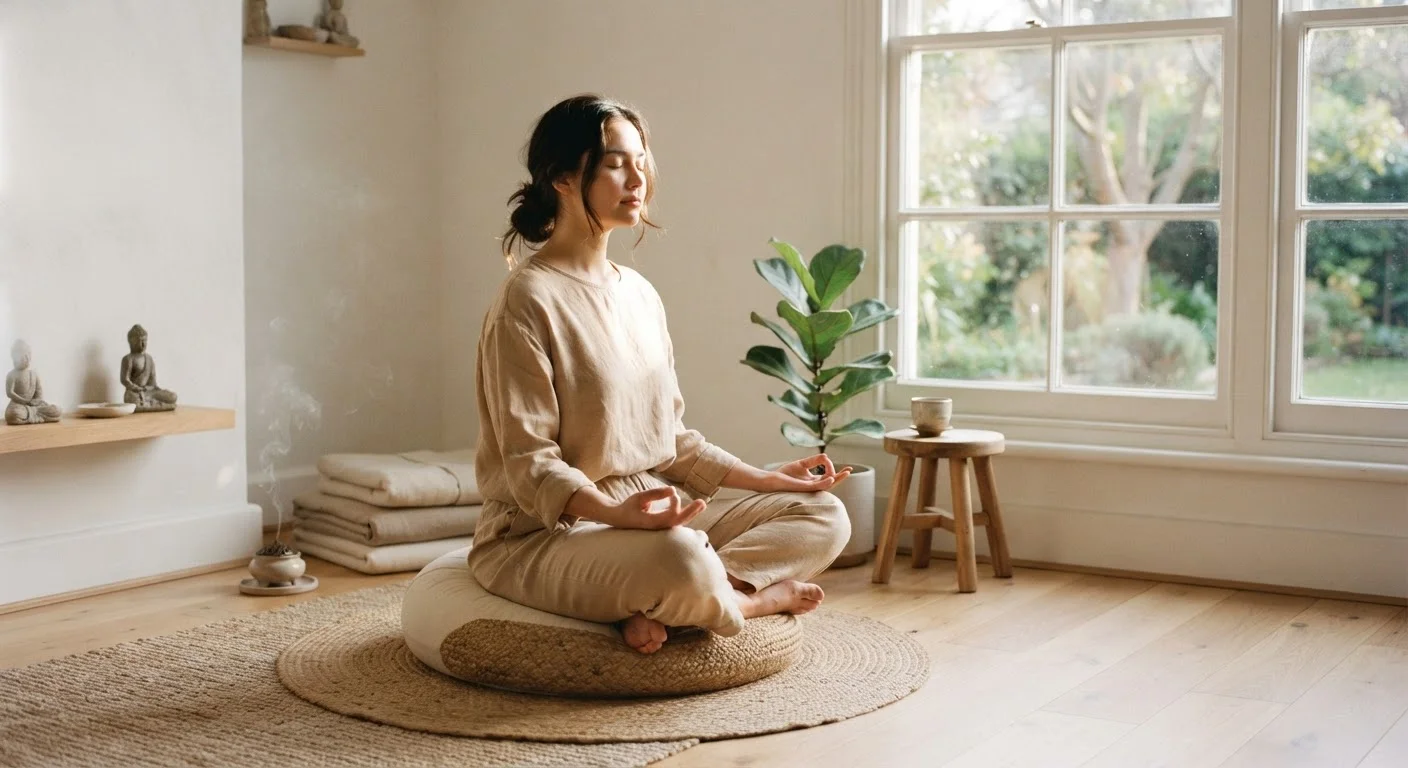
Option A
Breath-Focused Meditation
The anchor practice for a wandering mind.
Best for: People who need a simple, portable anchor for attention and want to build focus or manage acute stress.
Option B
Body-Scan Meditation
The deeper dive into physical and emotional awareness.
Best for: People who carry tension in their body, struggle to wind down at night, or want to reconnect with physical sensations.
What Each Practice Actually Involves
At their core, both techniques are forms of mindfulness meditation — they train you to pay deliberate, non-judgmental attention to present-moment experience. But where they direct that attention differs meaningfully. To understand the broader relationship between mindfulness and these specific practices, see our overview of mindfulness vs. meditation.
Breath-focused meditation uses the physical sensations of breathing — the rise and fall of the chest, the feeling of air entering and leaving the nostrils — as a single point of focus. When the mind drifts, as it inevitably will, the practice consists of gently noticing that drift and returning attention to the breath. That act of returning, repeated many times in a session, is what builds attentional control.
Body-scan meditation moves attention sequentially through different regions of the body — typically starting at the feet or the top of the head and progressing slowly through each area. Rather than holding focus at one point, you observe whatever sensations are present in each region: warmth, heaviness, tingling, tightness, or numbness. You're not trying to change anything; you're noticing with curiosity. Sessions commonly run 20 to 45 minutes and are often done lying down.
| Criterion | Breath-Focused Meditation | Body-Scan Meditation |
|---|---|---|
| Primary focus | Breath sensations | Sequential body regions |
| Typical session length | 2–20 minutes | 20–45 minutes |
| Ideal position | Seated or any comfortable posture | Lying down or reclined |
| Portability | Very high — no setup needed | Moderate — requires quiet space |
| Primary goal | Attentional focus and calm | Body awareness and tension release |
| Best time of day | Any time, including work breaks | Evening or before sleep |
| Guide or audio needed? | Optional | Often helpful |
| Evidence emphasis | Focus, stress, anxiety reduction | Chronic pain, sleep, MBSR outcomes |
The Evidence Behind Each Approach
Both practices have meaningful research support, though their evidence bases emphasize slightly different outcomes.
Breath-focused meditation is a cornerstone of numerous clinical programs and has been associated with reductions in perceived stress, improved attentional regulation, and lower physiological markers of anxiety in research settings. Its simplicity makes it one of the most studied forms of mindfulness practice.
Body-scan meditation features prominently in Mindfulness-Based Stress Reduction (MBSR), an eight-week program developed at the University of Massachusetts Medical School. Research on MBSR — which uses body scans as a central component — has shown associations with reduced chronic pain perception, decreased anxiety, and improved sleep quality. For a detailed look at how MBSR compares with other evidence-based approaches, our article on CBT vs. MBSR explores their methods side by side.
It's worth noting that research quality varies across individual studies. Most findings reflect associations rather than definitive causal proof, and results differ by individual. No meditation practice is a substitute for professional mental health care.
8 weeks
Standard MBSR program length using body scans
The Mindfulness-Based Stress Reduction program, developed at UMass Medical School, uses body scans across an eight-week structured curriculum.
~5 min
Minimum effective breath-focus session length cited in research
Several mindfulness studies have observed measurable attention benefits from breath-focused sessions as brief as five minutes, supporting micro-practice approaches.
2–3×
Weekly practice frequency associated with noticeable well-being change
Research on mindfulness programs generally suggests practicing two to three times per week as a threshold for building a consistent, beneficial habit.
Practical Differences That Shape Daily Use
How each technique fits into your routine is just as important as what happens neurologically. Breath-focused meditation wins on portability: you can practice at a desk, on public transit, or in a parked car, with no equipment and no special position required. Sessions can meaningfully start at just two to five minutes. For ideas on weaving short practice moments into an ordinary day, see moments in the day you can use for informal mindfulness.
Body-scan meditation typically asks more of your schedule and setting — a quiet space, a mat or bed, and at least 15 to 20 uninterrupted minutes. Many people find guided audio helpful for staying on track through each body region; our comparison of mindfulness apps vs. guided audio can help you choose a format that suits how you learn.
If breath awareness alone feels limiting or you'd like to complement it with other breath-based tools for emotional grounding, our reference on breathing techniques for emotional grounding covers practices like box breathing and diaphragmatic breathing that pair naturally with a meditation routine.
For a broader look at how both practices fit into a complete wellness framework, visit our complete overview of mindfulness and rest.
This article is for general informational and educational purposes only and is not a substitute for professional medical or mental health advice. If you are experiencing significant stress, anxiety, chronic pain, or any other health concern, please consult a qualified healthcare professional.
The content on this site is for informational purposes only and is not a substitute for professional advice. Always consult a qualified professional for guidance specific to your situation.