

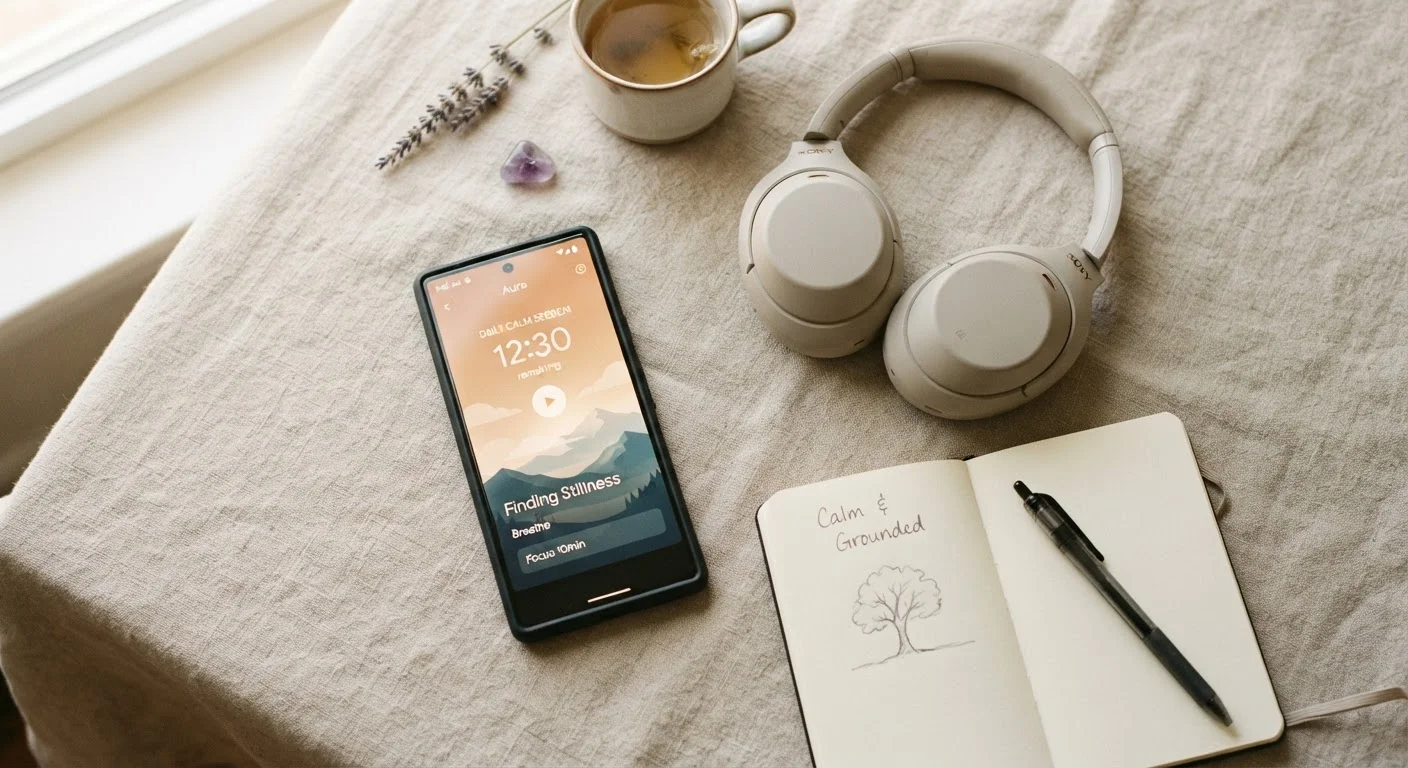
Option A
Mindfulness Apps
The structured, interactive digital companion.
Best for: Learners who want progress tracking, variety, and guided programs in one place.
Option B
Guided Audio
The focused, distraction-free listening experience.
Best for: People who prefer simplicity, portability, and deep immersion without screen engagement.
What Each Format Actually Does
Mindfulness apps are software platforms — typically installed on a smartphone — that bundle guided sessions, educational content, reminders, and progress metrics into a single interface. They are designed to scaffold a habit: the app tells you what to do next, when to do it, and how far you have come. For many busy Americans, that hand-holding is genuinely valuable at the start.
Guided audio, by contrast, is a recording of a teacher or narrator walking you through a practice — a body scan, a breathing exercise, a loving-kindness sequence — with nothing else attached. It might live on a downloaded file, a podcast feed, or a streaming library. You press play, close your eyes, and follow the voice. The format has existed for decades, long before smartphones, and its simplicity is both its strength and its limitation.
Before choosing a format, it helps to be clear on what mindfulness itself involves. Our overview of mindfulness versus meditation unpacks these foundations so you can set realistic expectations for whatever tool you pick up.
Head-to-Head: Key Differences
The table below compares the two formats across the dimensions that tend to matter most to everyday learners.
| Criterion | Mindfulness Apps | Guided Audio |
|---|---|---|
| Structure & progression | Built-in courses with clear stages | Listener-directed; no set path |
| Distraction risk | Higher — same device as notifications | Lower — eyes closed, screen-free |
| Accountability tools | Streaks, reminders, stats | None built in |
| Content variety | Wide — sleep, stress, focus, movement | Depends on source; often narrower |
| Cost | Often subscription-based | Frequently free or low-cost |
| Offline access | Limited without premium tier | Full — downloadable files |
| Depth of immersion | Moderate — interface present | High — single sensory channel |
| Best for beginners | Yes — scaffolded guidance | Yes, if a clear session is chosen |
One point worth highlighting: apps require you to interact with a device that also carries email, social media, and news. Even with do-not-disturb enabled, the psychological pull of a screen can undercut the very stillness you are trying to cultivate. Guided audio sidesteps this tension almost entirely.
Where Apps Have a Genuine Edge
The case for apps is strongest around habit formation. Research on behavior change consistently shows that implementation intentions — knowing exactly when and how you will do something — improve follow-through. Apps operationalize this: they send a reminder at 7 a.m., offer a five-minute session if that is all you have, and log your streak so missing a day feels noticeable. For someone who has repeatedly told themselves they will start meditating and hasn't, that friction-reduction matters.
Apps also tend to offer variety within a single platform — sleep meditations, stress-response practices, movement-based sessions, and short check-ins. This breadth means you are less likely to plateau or get bored. Some platforms include psychoeducation segments that explain the neuroscience of stress or the basics of attention training, which can deepen motivation.
That said, apps are not a substitute for personalized support. For a balanced look at both the promise and the gaps of digital tools, see our article on the upsides and limits of using apps for anxiety and stress management.
Where Guided Audio Quietly Wins
The most underappreciated advantage of guided audio is presence by design. When the only thing in front of you is a voice and perhaps a soft ambient sound, your attention has fewer places to wander. Experienced practitioners often report that audio-only sessions feel qualitatively different — more immersive, less performative — precisely because there is no interface to check or complete.
Audio is also genuinely portable and low-barrier. A downloaded MP3 works on a long flight, in a hospital waiting room, or during a power outage. Many high-quality guided sessions are available free through public libraries, university wellness centers, and reputable nonprofit health organizations, meaning cost is rarely a barrier.
If you are curious about which types of guided practices suit different temperaments, our comparison of breath-focused versus body-scan meditation can help you identify the right starting point regardless of format.
This article is for informational purposes only and is not a substitute for professional medical or mental health advice. If you are experiencing significant anxiety, depression, or other mental health concerns, please consult a qualified healthcare professional.
The content on this site is for informational purposes only and is not a substitute for professional advice. Always consult a qualified professional for guidance specific to your situation.