

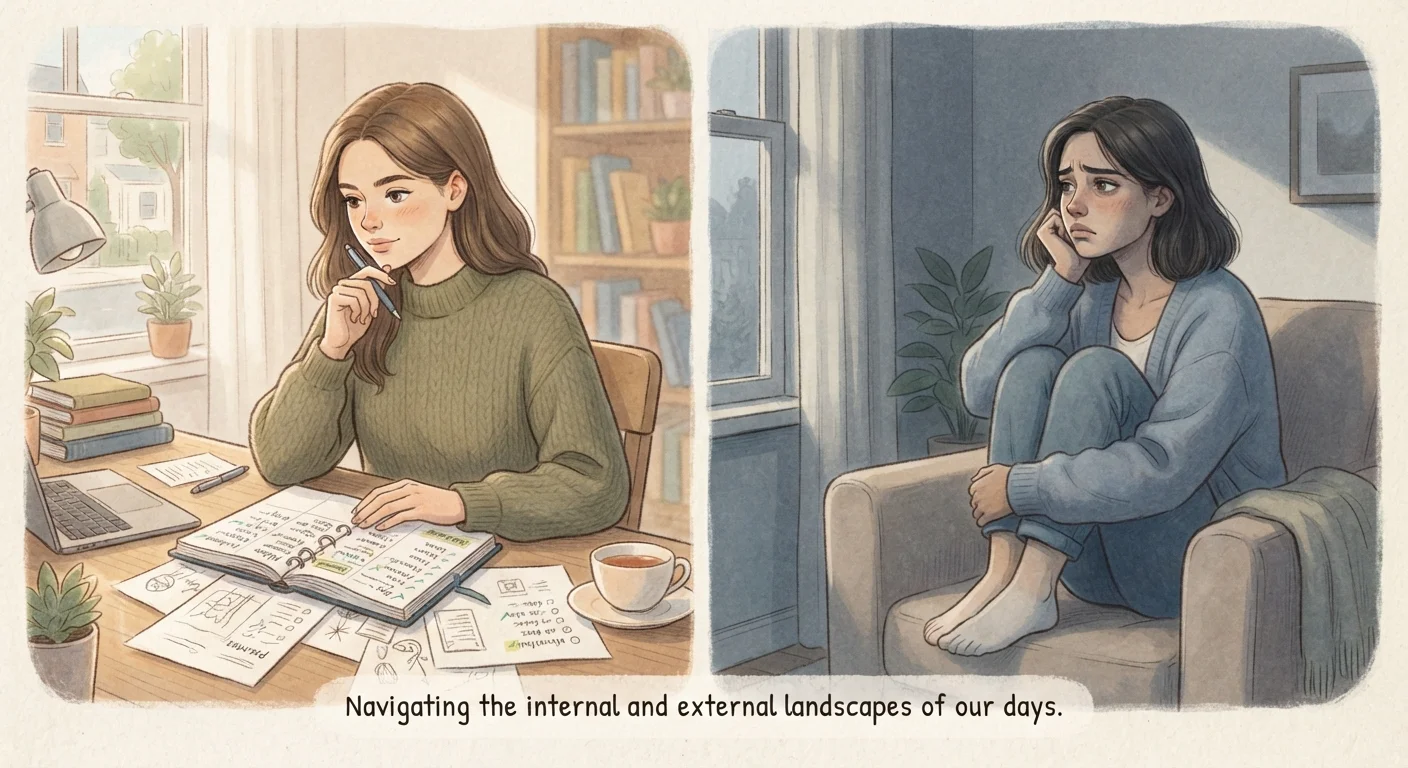
Option A
Stress
The body's response to an identifiable external pressure.
Best for: Understanding your reaction to concrete, time-limited demands like deadlines, conflicts, or major life changes.
Option B
Anxiety
A persistent inner state of worry that often outlasts its trigger.
Best for: Recognizing when worry has become self-sustaining and may benefit from targeted support or professional guidance.
Why People Confuse the Two
Stress and anxiety share a lot of the same territory — racing thoughts, a tight chest, trouble sleeping, irritability. It's completely understandable that many people use the words interchangeably. But from a psychological standpoint, they describe different experiences with different patterns, and that distinction genuinely shapes how you might respond.
Think of stress as a reaction to something happening outside you, and anxiety as a state that lives more inside you. When a project deadline looms, traffic makes you late, or a difficult conversation is coming up, stress is the pressure you feel in response to those real, identifiable demands. When the deadline passes and the tension doesn't, or when worry jumps to the next topic before the last one is resolved, that's often anxiety at work. For a deeper look at what's physically happening during either state, see our overview of stress physiology.
Stress: A Response With a Source
Stress is situational. It's your nervous system signaling that something in your environment is demanding more from you than feels manageable right now. Once that external demand is removed — the exam ends, the conflict resolves, the move is over — stress typically eases. That's a key feature: stress is usually proportionate and time-limited.
That doesn't make it harmless, though. Stress that accumulates without relief can wear down the body and mind in significant ways. Understanding the difference between short-lived and ongoing stress is worthwhile on its own — our article on acute vs. chronic stress explores exactly that. Practical stress management strategies can make a real difference when demands feel relentless.
| Criterion | Stress | Anxiety |
|---|---|---|
| Primary cause | Identifiable external trigger | Internal; may lack clear trigger |
| Duration | Eases when situation resolves | Can persist beyond the trigger |
| Focus of worry | Specific, concrete problem | Often diffuse or shifting |
| Physical symptoms | Tension, fatigue, irritability | Similar, plus restlessness, avoidance |
| Resolves with problem-solving | Often yes | Not reliably |
| May require professional support | If chronic or severe | More commonly, especially if disabling |
Anxiety: When the Alarm Keeps Ringing
Anxiety differs from stress in that it doesn't require an obvious external trigger to persist. It often involves a sense of dread or unease that feels disproportionate to the situation — or that continues long after the situation has passed. Where stress tends to focus your attention on a problem, anxiety can feel more like a loop: your mind keeps returning to worst-case scenarios even when there's nothing concrete left to act on.
Anxiety exists on a spectrum. Occasional anxious feelings are a normal part of life. Anxiety disorders — such as generalized anxiety disorder, panic disorder, or social anxiety disorder — are clinical conditions diagnosed by qualified mental health professionals. If worry is persistent, hard to control, and getting in the way of daily life, that's important information worth sharing with a healthcare provider. You might also find it useful to explore key terms and concepts in plain language to better understand what you're reading about your own experience.
Why the Difference Shapes Your Response
Naming what you're experiencing matters because it points toward different kinds of help. Stress often responds well to practical problem-solving: breaking tasks into steps, setting boundaries, resting, or talking through a situation. Many mindfulness and relaxation practices also support stress relief — though it's worth knowing that mindfulness and meditation are not the same thing, and each works differently.
Anxiety, particularly when it's persistent, can sometimes be worsened by avoidance. It might feel like a relief to skip the situation causing worry, but avoidance can quietly reinforce the anxiety loop over time — something our article on why avoiding stress triggers can backfire addresses in detail. Evidence-based approaches like cognitive behavioral therapy (CBT) are often recommended by mental health professionals for anxiety disorders, though treatment decisions should always be made in partnership with a qualified provider.
This article is for general informational purposes only and is not a substitute for professional medical or mental health advice. If you are concerned about anxiety or stress affecting your daily life, please consult a licensed healthcare professional.
The content on this site is for informational purposes only and is not a substitute for professional advice. Always consult a qualified professional for guidance specific to your situation.