

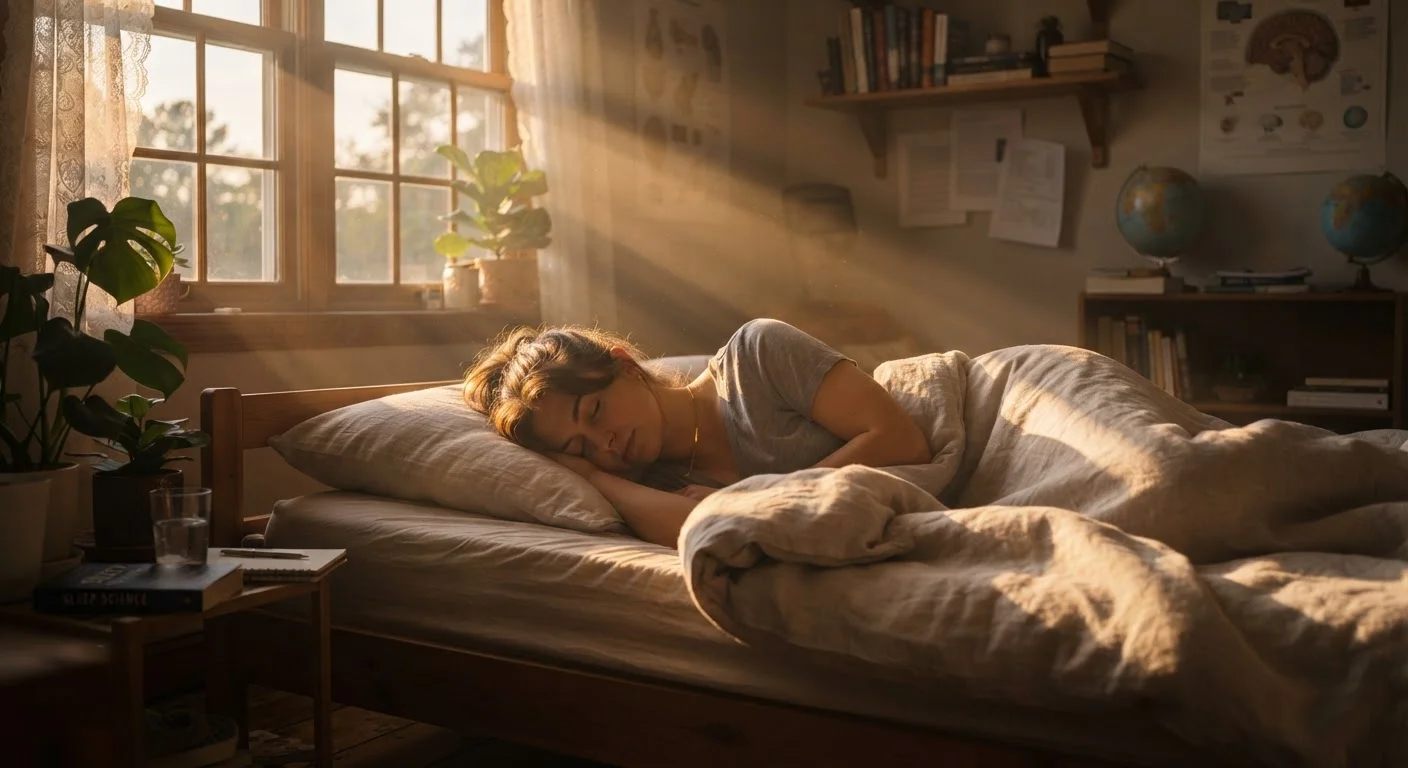
Your Brain Has a Clock — and Light Runs It
Every cell in your body follows an internal rhythm tuned to roughly 24 hours. But cells drift without correction. The brain's master clock — a small paired structure called the SCN — keeps everything synchronized, and it takes its primary cue from light.
When light enters your eyes, a distinct population of retinal cells called intrinsically photosensitive retinal ganglion cells (ipRGCs) sends signals directly to the SCN via the retinohypothalamic tract. Unlike the rods and cones used for vision, these cells are specialized for circadian timekeeping. They are especially sensitive to short-wavelength, blue-enriched light — the kind abundant in daylight — but respond to a broad range of illumination levels.
The SCN then orchestrates a cascade of downstream effects: regulating the release of melatonin from the pineal gland, adjusting core body temperature, and coordinating alertness hormones like cortisol. Together, these signals tell your body when to be awake and when to prepare for sleep. Understanding this pathway is fundamental to understanding why your sleep schedule can feel fragile when your light environment changes. See how this interacts with the body's other sleep-regulating system in our article on circadian rhythm vs. sleep pressure.
Timing Matters: How Light Advances or Delays Your Clock
Light doesn't affect your clock the same way at all hours. Researchers describe this variability using a phase response curve — a map of how your circadian timing shifts depending on when light exposure occurs.
- Morning light (shortly after natural waking) advances the clock, pulling sleep and wake times earlier.
- Evening light (in the hours before your usual bedtime) delays the clock, pushing sleep and wake times later.
- Middle-of-the-night light produces the largest phase shifts and can severely disrupt circadian alignment.
This is why shift workers, frequent travelers crossing time zones, and people who stay up late in bright environments are particularly vulnerable to circadian disruption. Their light exposure is chronically misaligned with the timing their biology expects. When this mismatch becomes chronic or structural, it can contribute to the circadian rhythm disorders that go well beyond ordinary fatigue.
~10,000 lux
Typical outdoor daylight intensity
Outdoor daylight commonly reaches 10,000 lux or more, compared to 100–500 lux for most indoor environments, according to lighting research literature.
~90 min
Melatonin onset delay from evening light
Studies published in sleep medicine journals have found that bright evening light can delay melatonin onset by roughly 90 minutes compared to dim-light conditions.
~1–2 hrs
Optimal post-waking window for morning light
Circadian research identifies the first one to two hours after natural waking as the period of greatest sensitivity to clock-advancing light signals.
Artificial Light, Melatonin, and the Evening Problem
Before widespread electric lighting, humans experienced sharp transitions between daylight and darkness. Today, that transition is blurred. Indoor lighting, televisions, and screens extend artificial light exposure deep into the evening, sending the SCN conflicting signals.
The most immediate measurable consequence is melatonin suppression. Melatonin — produced by the pineal gland in the absence of light — is a key signal for sleep readiness. Research has consistently shown that exposure to bright or blue-enriched light in the evening delays melatonin onset and reduces its duration. Even light levels well below outdoor intensity can produce a measurable effect in sensitive individuals.
Screens are a widely discussed source of evening light, though the full picture is more nuanced than blue light alone — timing, duration, and total brightness all play roles. For a deeper look at what the evidence says, see our piece on screen time before bed and sleep biology.
This article is for informational purposes only and is not a substitute for advice from a qualified healthcare professional. If you have concerns about your sleep or circadian health, consult a licensed clinician.
Practical Implications: Working With Your Light Environment
Understanding the biology suggests several evidence-informed directions for optimizing your light environment — though individual responses vary and no single approach guarantees specific outcomes.
Prioritize outdoor morning light. Natural daylight is far brighter than typical indoor lighting — often 10 to 100 times more intense — and delivers the strongest possible clock-advancing signal. Even a brief period outside in the first hour or two after waking can help anchor your circadian timing.
Manage evening brightness. Dimming indoor lights and reducing bright screen exposure in the two to three hours before your target bedtime reduces the clock-delaying effect of artificial light. This is one element of a broader sleep environment strategy covered in our guide to building a sleep environment that works with your biology.
Maintain consistency. A stable daily light-dark pattern reinforces a predictable, well-entrained circadian rhythm. Irregular sleep timing weakens this entrainment and makes the system more susceptible to disruption. Learn more about the biological effects of regularity in our article on what a consistent sleep schedule does to your circadian biology.
Frequently Asked Questions
Significant phase shifts can begin within one to two days of consistent new light exposure, but full adaptation to a major schedule change typically takes several days to over a week. The rate depends on the intensity, duration, and timing of the light signal.
Yes. Even ordinary indoor lighting can influence circadian timing, particularly if it's bright or blue-enriched during evening hours. Exposure to indoor light in the hours before bed can suppress melatonin and delay sleep onset, even without a screen being involved.
Light exposure within the first one to two hours after natural waking has the strongest clock-advancing effect. This window coincides with a period of high circadian sensitivity, making outdoor morning light particularly useful for reinforcing an earlier sleep-wake schedule.
Blue-wavelength light is the most potent driver of the circadian system, but it isn't uniquely harmful in isolation. The timing and overall brightness of light matter as much as its color. Evening exposure to any bright light — regardless of wavelength — can delay your clock.
Blocking early morning light can help people who are sensitive to light-induced waking or who need to sleep later than sunrise allows. Research supports reducing light intrusion during sleep as part of a broader sleep environment strategy.
The content on this site is for informational purposes only and is not a substitute for professional advice. Always consult a qualified professional for guidance specific to your situation.