

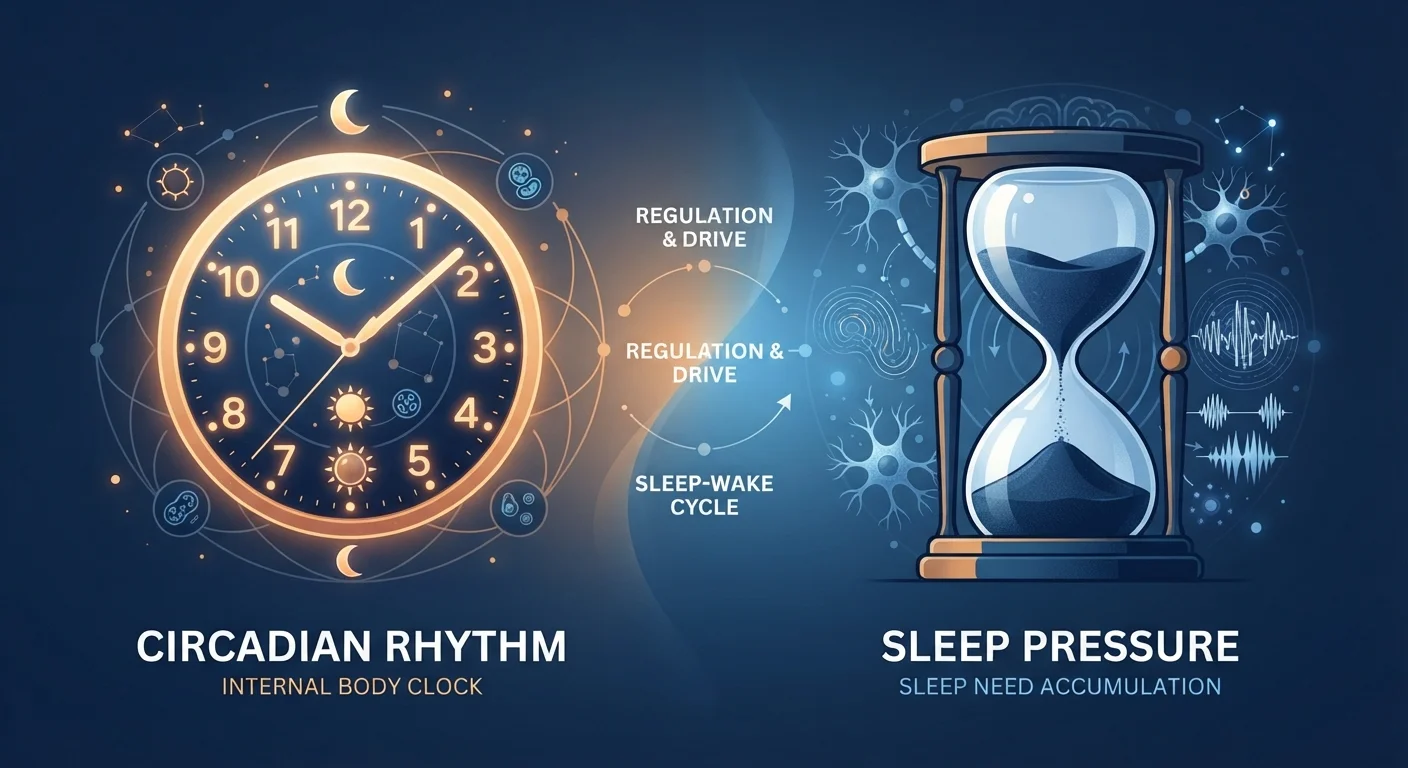
Option A
Circadian Rhythm
The internal clock that times your alertness to the day.
Best for: Understanding why you feel alert or drowsy at predictable times regardless of how much sleep you've had.
Option B
Homeostatic Sleep Pressure
The accumulating drive that rewards wakefulness with deeper rest.
Best for: Explaining why fatigue intensifies the longer you stay awake and why recovery sleep feels so satisfying.
Two Systems, One Purpose
Most people assume they feel tired simply because they haven't slept enough. That's partly right — but it's only half the story. Sleep scientists describe sleep regulation through a two-process model, first formalized by researcher Alexander Borbély in the 1980s. According to this model, the timing and depth of your sleep are jointly controlled by two distinct biological forces: your circadian rhythm (Process C) and homeostatic sleep pressure (Process S).
Understanding the difference between these two systems doesn't just satisfy scientific curiosity — it explains puzzling everyday experiences, like why you can feel exhausted yet oddly alert at 11 p.m., or why a short nap sometimes energizes you without affecting nighttime sleep much at all. For a deeper look at how external cues shape one of these systems, see how light exposure shapes your internal clock.
Circadian Rhythm: Your Body's 24-Hour Clock
Your circadian rhythm is an internal biological clock that cycles over approximately 24 hours. It is generated by a cluster of neurons in the brain's hypothalamus called the suprachiasmatic nucleus (SCN). This clock regulates not just sleep and wakefulness but also body temperature, hormone secretion, metabolism, and dozens of other physiological processes.
The circadian system works by sending alertness signals that rise and fall across the day. In most adults, alertness climbs through the morning, dips slightly in early afternoon (the post-lunch dip), then surges again in the evening before dropping sharply near habitual bedtime. Critically, these shifts happen on schedule — driven primarily by light exposure and social cues — regardless of how much sleep you got the night before.
This explains a well-known phenomenon: if you pull an all-nighter, you may actually feel briefly more alert around 8 a.m. the next morning than you did at 4 a.m. Your circadian clock is sending a wake signal timed to daylight, temporarily overriding mounting sleep pressure. Consistent sleep timing matters greatly because it keeps this clock well-calibrated.
| Criterion | Circadian Rhythm | Homeostatic Sleep Pressure |
|---|---|---|
| Mechanism | Internal biological clock (SCN neurons) | Adenosine accumulation in the brain |
| Driven by | Time of day, light, environmental cues | Duration of continuous wakefulness |
| Pattern | Cycles on a ~24-hour schedule | Rises while awake, falls during sleep |
| Reset by | Light exposure and consistent routines | Sleep (any duration) |
| Disrupted by | Irregular schedules, jet lag, shift work | Sleep deprivation, fragmented sleep |
| Effect of missing sleep | Clock stays on schedule; alertness signal unchanged | Pressure compounds; deeper rebound sleep needed |
Homeostatic Sleep Pressure: The Debt That Demands Repayment
Homeostatic sleep pressure operates on a completely different mechanism. Rather than running on a fixed schedule, it accumulates in direct proportion to how long you've been awake. The primary molecular driver appears to be adenosine, a chemical byproduct of neural activity that builds up in the brain throughout the day. The longer you stay awake, the more adenosine accumulates — and the sleepier you feel.
Sleep clears this adenosine. That's why a full night's rest leaves you feeling refreshed: your brain has essentially drained the tank. Caffeine, incidentally, works by blocking adenosine receptors — it doesn't reduce actual sleep pressure, it just prevents you from feeling it temporarily.
Unlike the circadian clock, sleep pressure doesn't care what time it is. It rises continuously from the moment you wake and falls as soon as you sleep. This is why sleep deprivation compounds quickly: each night of insufficient sleep leaves residual adenosine that the next night must clear. Research suggests that recovery from significant sleep debt takes more than a single night. See sleep consistency vs. sleep duration for more on why repayment isn't as simple as sleeping longer one night.
How the Two Systems Interact — and Conflict
Under normal, well-rested conditions, the two systems cooperate beautifully. Sleep pressure rises steadily through the day while the circadian alertness signal holds fatigue at bay. By bedtime, pressure is high and the circadian signal begins to withdraw — the result is a strong, well-timed drive to sleep. During the night, sleep pressure falls as adenosine clears, and by morning the circadian clock ramps up alertness again.
Problems emerge when the two systems fall out of alignment. Shift workers, frequent travelers crossing time zones, and people with highly irregular schedules often experience a mismatch: their circadian clock expects wakefulness while their body tries to sleep, or vice versa. The result is fragmented, unrefreshing rest even when total sleep time looks adequate on paper.
Stress adds another layer of complexity. Elevated cortisol and hyperarousal can suppress the transition into sleep even when both systems are signaling for rest. How stress and sleep feed into each other explores this interference in detail. Additionally, sleep needs and the balance between these processes shift across life stages — as covered in sleep across a lifetime.
This article is for informational purposes only and does not constitute medical advice. If you have concerns about your sleep health, please consult a qualified healthcare professional.
The content on this site is for informational purposes only and is not a substitute for professional advice. Always consult a qualified professional for guidance specific to your situation.