

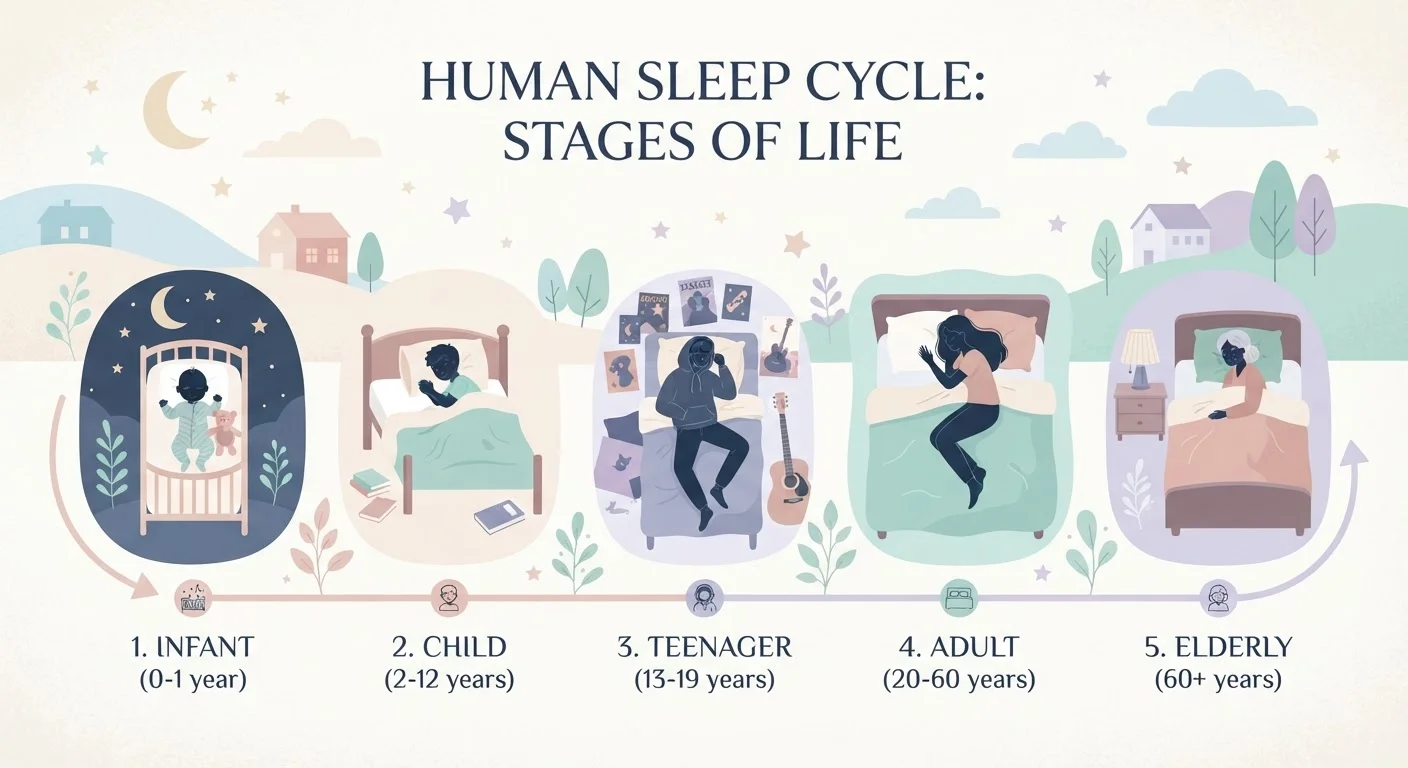
Why Sleep Changes at Every Stage of Life
Sleep is not a fixed biological constant. The amount, structure, and timing of sleep shift continuously across a lifetime — shaped by brain development, hormonal cycles, circadian biology, and the gradual changes that accompany aging. Understanding these shifts helps explain why an infant needs nearly twice the sleep of a healthy adult, or why a teenager genuinely struggles to fall asleep before midnight.
At the core of these changes is sleep architecture — the cycling pattern of sleep stages that repeats throughout the night. As we age, the proportion of time spent in each stage changes considerably. For a deeper look at how these cycles work, see Understanding Sleep Architecture.
| Newborn sleep need | 14–17 hours/day (American Academy of Sleep Medicine) |
| Infant REM proportion | ~50% of total sleep (Sleep medicine research consensus) |
| School-age recommendation | 9–11 hours/night (American Academy of Sleep Medicine) |
| Teen recommendation | 8–10 hours/night (American Academy of Sleep Medicine) |
| Adult recommendation | 7–9 hours/night (National Sleep Foundation) |
| Adult REM proportion | ~20–25% of total sleep (Sleep medicine research consensus) |
| Deep sleep decline onset | Begins in young adulthood (Sleep architecture research) |
| Older adult circadian shift | Advanced sleep phase (earlier timing) (Circadian biology research) |
Infants and Toddlers: Maximum Sleep, Polyphasic Rhythms
Newborns sleep between 14 and 17 hours per day, according to guidelines from the American Academy of Sleep Medicine — though this is distributed across many short episodes rather than one consolidated block. This polyphasic pattern (multiple sleep-wake cycles per day) reflects an immature circadian system that has not yet synchronized with light and dark cues.
A particularly notable feature of infant sleep is the very high proportion of REM sleep, which can account for roughly 50% of total sleep time in newborns, compared with around 20–25% in healthy adults. Researchers link this elevated REM activity to rapid neural development — the brain is building and pruning connections at an extraordinary rate. By age two or three, sleep consolidates into a nighttime anchor with one daytime nap, and REM proportion begins its lifelong gradual decline. Learn more about what REM and deep sleep each contribute in REM Sleep vs. Deep Sleep.
Note: Parents and caregivers of infants and young children should consult a pediatrician regarding safe sleep environments and any concerns about sleep patterns.
School Age, Adolescence, and the Circadian Shift
School-age children (6–12 years) typically need 9–11 hours of sleep and generally show strong, consolidated nighttime sleep with robust slow-wave (deep) sleep — the stage most tied to physical growth and immune function. Their circadian timing is relatively early, meaning they fall asleep and wake early naturally.
Adolescence brings one of the most striking biological changes in sleep across the lifespan: a circadian phase delay. Puberty triggers a shift in the timing of melatonin release, pushing the natural sleep window later — often well past 11 p.m. Combined with social pressures and early school start times, most teenagers accumulate significant sleep debt. The recommended range for teens is 8–10 hours, yet surveys consistently show many fall short. This deficit has well-documented associations with mood, academic performance, and metabolic health.
Adults: Stability With Gradual Structural Change
For most adults, the recommended sleep duration is 7–9 hours per night. Sleep architecture in this period is relatively stable but not static. Slow-wave sleep begins declining gradually from young adulthood onward — a process that accelerates in the 30s and 40s. This means that even when total sleep time remains unchanged, the restorative depth of sleep may quietly diminish over the decades.
Lifestyle factors — screen exposure, irregular schedules, shift work, alcohol use — can compound these biological trends. Research increasingly highlights that when you sleep matters alongside how long, a distinction explored in Sleep Consistency vs. Sleep Duration. For practical strategies to protect sleep quality, Better Sleep Habits offers evidence-based guidance.
Older Adults: Lighter Sleep, Earlier Timing, and Common Disruptions
From roughly age 60 onward, several changes become more pronounced. Sleep tends to become lighter overall, with less time in deep slow-wave sleep and increased nighttime awakenings. The circadian clock advances — meaning many older adults feel sleepy earlier in the evening and wake earlier in the morning, a pattern called advanced sleep phase.
Total sleep time may remain in the 7–8 hour range for healthy older adults, but sleep efficiency (the percentage of time in bed actually spent asleep) often declines. Conditions more common in later life — chronic pain, sleep-disordered breathing, medication effects — can further fragment sleep. These changes are biological, not simply a matter of poor habits, though habits remain meaningful. Why Sleep Feels Different as You Get Older examines the mechanisms driving these shifts and evidence-based approaches to managing them.
This article is for informational purposes only and is not a substitute for personalized medical advice. If you have concerns about your sleep at any life stage, consult a qualified healthcare professional.
The content on this site is for informational purposes only and is not a substitute for professional advice. Always consult a qualified professional for guidance specific to your situation.