

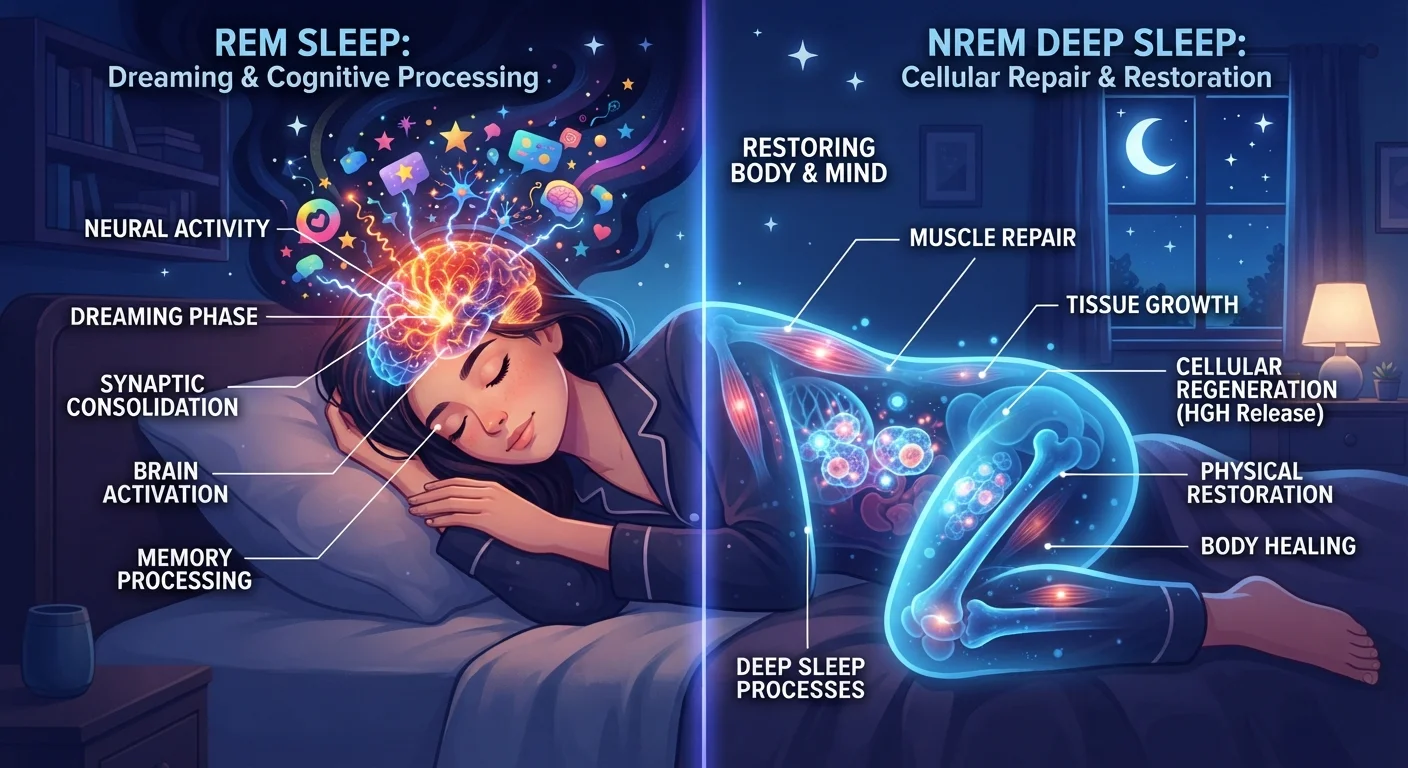
Option A
REM Sleep
The brain's nightly workshop for memory and emotion.
Best for: Consolidating procedural and emotional memories, emotional regulation, and creative problem-solving.
Option B
Deep Sleep (Slow-Wave Sleep)
The body's prime window for physical repair and immune defense.
Best for: Tissue regeneration, growth hormone release, immune strengthening, and declarative memory consolidation.
How the Two Stages Fit Into Your Sleep Architecture
Sleep is not a single uniform state. Each night, your brain and body cycle through distinct stages roughly every 90 minutes, collectively forming what sleep scientists call sleep architecture. These cycles include light NREM sleep, deep NREM sleep (also called slow-wave sleep or SWS), and REM (rapid eye movement) sleep. For a fuller picture of how these cycles connect, see The Science Behind Sleep Cycles.
The distribution is not even across the night. Deep sleep is heavily concentrated in the first half — your body prioritizes physical restoration early. REM sleep, by contrast, becomes progressively longer in the second half, meaning a shortened night disproportionately cuts into REM. Understanding this timing matters when you think about which stage a given habit might be protecting or undermining.
| Criterion | REM Sleep | Deep Sleep (Slow-Wave Sleep) |
|---|---|---|
| Brain wave activity | High — similar to wakefulness | Low — slow, high-amplitude waves |
| Primary restoration target | Brain and emotional processing | Body and physical repair |
| Timing in the night | Increases toward morning | Concentrated in early cycles |
| Memory consolidation type | Procedural and emotional memory | Declarative (facts and events) |
| Key hormone activity | Acetylcholine, norepinephrine suppressed | Growth hormone peaks |
| Immune function role | Limited direct role | Cytokine production increases |
| Muscle activity | Temporary paralysis (atonia) | Deeply relaxed but not paralyzed |
| Disrupted by | Alcohol, short nights, sleep apnea | Stress, fragmented sleep, aging |
What REM Sleep Actually Restores
During REM sleep, your brain is remarkably active — in fact, brain-imaging studies show neural activity patterns that closely resemble wakefulness. The eyes move rapidly beneath closed lids, and most skeletal muscles enter a temporary paralysis, likely preventing you from physically acting out vivid dreams.
The restorative work happening in REM is primarily neurological. Research in sleep medicine consistently links REM to:
- Emotional memory processing: REM appears to help the brain recalibrate emotional responses to stressful experiences, essentially separating the raw emotion from the memory's factual content.
- Procedural and associative memory: Skills learned during the day — from a musical instrument to a complex work task — are reinforced and integrated during REM-stage replay.
- Cognitive flexibility: REM promotes the kind of creative, divergent thinking that supports novel problem-solving.
Chronic REM disruption — from alcohol, certain medications, sleep apnea, or simply cutting the night short — is associated with impaired emotional regulation, reduced learning efficiency, and mood disturbances. As noted in What Actually Happens to Your Body During Rest, these cognitive processes are far from passive.
What Deep Sleep Actually Restores
Deep sleep, or slow-wave sleep, is defined by its characteristic slow, high-amplitude brain waves detectable on an EEG. The brain quiets significantly, and the body shifts into its most intensive physical repair mode.
Key biological functions concentrated in deep sleep include:
- Growth hormone release: The pituitary gland secretes the majority of its nightly growth hormone during deep sleep, driving muscle repair, cellular regeneration, and fat metabolism.
- Immune system reinforcement: Cytokine production — proteins that regulate immune response — increases during slow-wave sleep, supporting the body's ability to fight infection and inflammation.
- Declarative memory consolidation: Facts, events, and explicit knowledge are strengthened during deep sleep, complementing (rather than duplicating) REM's role in procedural memory.
- Metabolic regulation: Deep sleep also plays a role in glucose metabolism and appetite-regulating hormones, though research in this area continues to evolve.
Athletes and individuals recovering from illness or injury have a particularly high stake in protecting deep sleep. Sleep Across a Lifetime explores how deep sleep naturally decreases with age — a shift with meaningful consequences for physical health.
Protecting Both Stages: What the Evidence Supports
Because REM and deep sleep serve genuinely different functions, there is no practical way to compensate for a deficit in one by getting more of the other. The most consistent finding in sleep research is straightforward: adequate total sleep duration is the foundation that preserves both.
Several well-established habits support this goal, as outlined in Better Sleep Habits:
- Consistent sleep and wake times reinforce your circadian rhythm, which governs the timing of both deep and REM sleep.
- Alcohol avoidance close to bedtime is particularly relevant for REM — alcohol suppresses REM in the first half of the night, often producing a disruptive REM rebound later.
- Managing sleep disorders such as obstructive sleep apnea is critical, as apnea repeatedly fragments both REM and deep sleep without the person necessarily being aware of it.
- Minimizing unnecessary early alarms preserves the REM-rich final sleep cycles.
Sleep Needs Vary — and Shift Over Time
The proportion of REM and deep sleep a person obtains naturally shifts with age. Children and adolescents spend significantly more time in deep sleep, while REM patterns also differ across the lifespan. If you notice changes in how rested you feel as you age, these shifts in sleep architecture may be a contributing factor worth discussing with a healthcare provider.
This article is for general informational purposes only and does not constitute medical advice. If you have concerns about your sleep quality, sleep disorders, or related health symptoms, consult a qualified healthcare professional.
The content on this site is for informational purposes only and is not a substitute for professional advice. Always consult a qualified professional for guidance specific to your situation.