

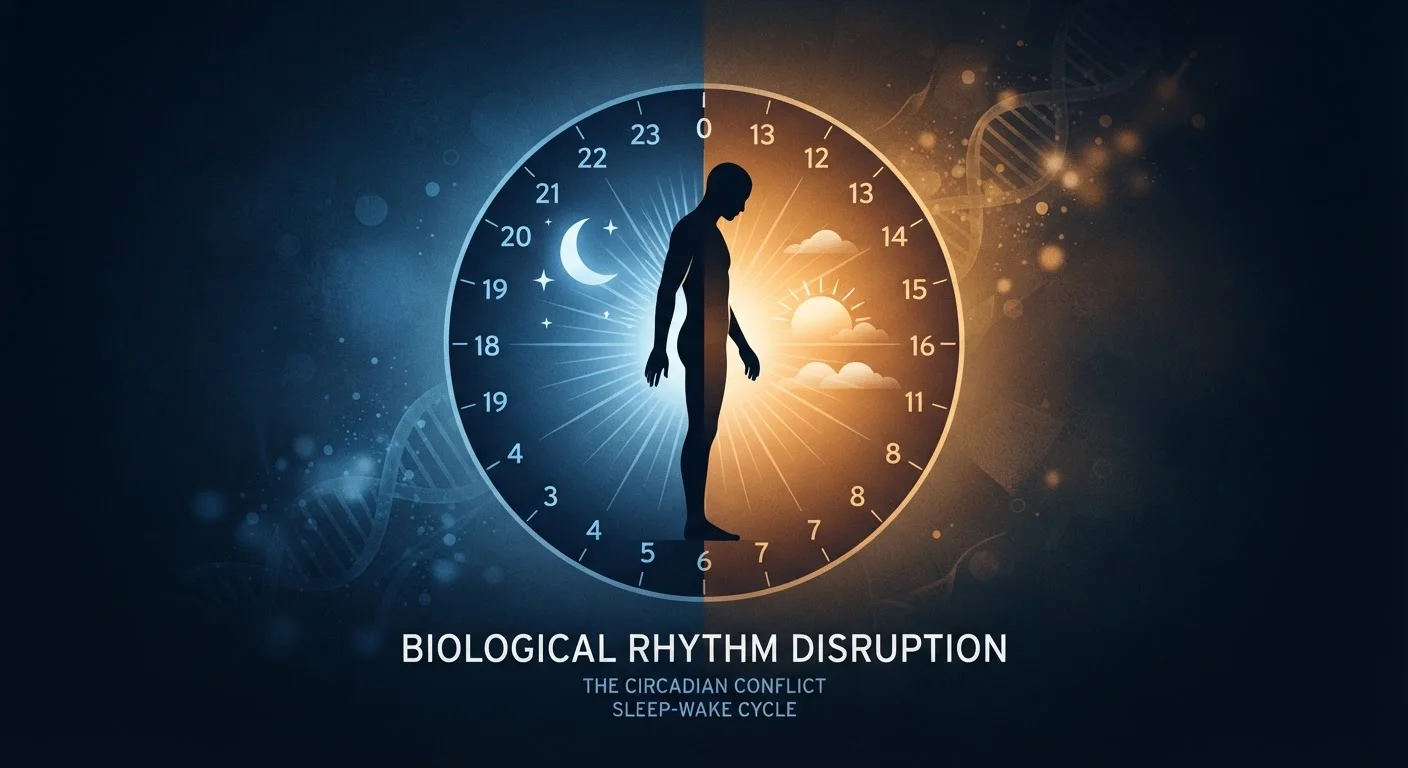
The Internal Clock: More Than a Sleep Timer
Most people think of the body's internal clock purely in terms of feeling sleepy or awake. In reality, the circadian system — derived from the Latin circa diem, meaning "about a day" — governs a sweeping range of biological processes on a roughly 24-hour cycle. Core body temperature, cortisol secretion, digestion, and immune activity all follow circadian rhythms.
The master pacemaker sits in the brain's suprachiasmatic nucleus (SCN), a tiny structure in the hypothalamus. It synchronizes to environmental cues called zeitgebers (German for "time givers"), with light being the most powerful. When light enters the eyes in the morning, it signals the SCN to suppress melatonin production and ramp up alertness. Darkness in the evening triggers the reverse. To understand how this clock interacts with the separate force of sleep pressure, see how circadian rhythm and homeostatic sleep pressure differ.
When the internal clock becomes misaligned — whether shifted, erratic, or running at the wrong speed — everyday functioning pays the price. That misalignment is what defines circadian rhythm disorders.
The Main Types of Circadian Rhythm Disorders
Circadian rhythm disorders are not a single condition. Sleep medicine recognizes several distinct types, each with its own pattern and affected population.
Not Every Evening Preference Is a Disorder
People exist on a spectrum of natural chronotypes — from strong morning types to strong evening types — and most fall somewhere in the middle. A mild preference for staying up late or rising early is not, on its own, a disorder. Circadian rhythm disorders are diagnosed when the timing misalignment is severe, persistent, and causes significant distress or impairment in daily functioning. If you are unsure where your experience falls on this spectrum, a healthcare professional is the right resource.
- Delayed Sleep-Wake Phase Disorder (DSWPD): The sleep window is pushed significantly later — often 2 to 6 hours beyond conventional timing. Falling asleep at 2–4 a.m. and waking naturally in the late morning is typical. Common in teenagers and young adults.
- Advanced Sleep-Wake Phase Disorder (ASWPD): The mirror image of DSWPD. Sleep onset occurs very early (e.g., 6–8 p.m.) and waking happens in the early morning hours (e.g., 2–5 a.m.). More prevalent in older adults.
- Non-24-Hour Sleep-Wake Disorder (N24SWD): The internal clock runs slightly longer than 24 hours and fails to anchor to the light-dark cycle. Sleep timing drifts progressively later each day. Most common in people who are totally blind and lack light input to the SCN.
- Irregular Sleep-Wake Rhythm Disorder: Sleep is fragmented into multiple short episodes across the 24-hour period with no consolidated nighttime block. Associated with neurological conditions and dementia.
- Shift Work Disorder: Occurs when a person's work schedule — nights, rotating, or early-morning shifts — chronically conflicts with their natural circadian timing, causing insomnia during intended sleep periods and excessive sleepiness while working.
- Jet Lag Disorder: A transient disruption following rapid travel across multiple time zones. Unlike the others, it resolves on its own as the clock re-entrains to the new environment.
Each type carries distinct challenges and responds to different management approaches. For a broader orientation to sleep conditions, see how sleep disorders are categorized and why they matter.
Causes and Risk Factors
Circadian misalignment arises from the interplay of biology, environment, and behavior. Genetics play a meaningful role — variants in so-called "clock genes" such as PER2 and CRY1 have been linked to extreme morning or evening chronotypes and to formal circadian disorders. Age is another factor: the circadian clock shifts toward eveningness during adolescence and toward morningness in older adulthood.
Environmental and lifestyle factors compound genetic tendencies. Irregular light exposure — particularly abundant artificial light at night from screens and indoor lighting — can suppress melatonin and delay the clock. Inconsistent sleep-wake schedules prevent the clock from anchoring reliably. Shift workers and frequent long-haul travelers repeatedly force their biology to adapt to timing that conflicts with their clock's natural setting.
Certain medical conditions, including blindness, neurodegenerative diseases, and some psychiatric conditions, also increase susceptibility to circadian disruption. Behavioral patterns that seem like choices — such as staying up late on weekends (sometimes called "social jet lag") — can accumulate into chronic misalignment over time. Common recovery traps like inconsistent wake times can quietly worsen circadian stability without the person realizing it.
How Circadian Disorders Disrupt Daily Life
The consequences extend well beyond feeling tired at inconvenient times. People with circadian rhythm disorders frequently report impaired concentration and memory during their required waking hours, mood disturbances, social and occupational difficulties, and strained relationships. A teenager with DSWPD who cannot fall asleep before 3 a.m. faces chronic sleep deprivation when school begins at 7:30 a.m. — and that deprivation compounds nightly.
Chronic circadian misalignment is also associated in the research literature with metabolic disruption, cardiovascular risk, and immune dysregulation, though it is important to recognize that association does not establish simple causation, and individual outcomes vary widely. What is clear is that these are not trivial inconveniences. They represent genuine medical conditions that affect quality of life and warrant professional attention.
Maintaining a consistent sleep schedule has measurable effects on the hormonal and neurological underpinnings of circadian health — a principle that applies to prevention and management alike.
This article is for informational purposes only and does not constitute medical advice. If you believe you may have a circadian rhythm disorder or any sleep condition, please consult a qualified healthcare professional for evaluation and guidance.
Frequently Asked Questions
Delayed Sleep-Wake Phase Disorder (DSWPD) is among the most commonly recognized, particularly in adolescents and young adults. It causes a person's natural sleep window to shift significantly later than conventional schedules allow, making early morning obligations very difficult.
Many circadian rhythm disorders can be managed effectively with behavioral strategies, light therapy, and clinical guidance, but outcomes vary by type and individual. Some conditions, such as Non-24-Hour Sleep-Wake Disorder in totally blind individuals, require ongoing management rather than a one-time fix. A sleep specialist can help develop a personalized plan.
Jet lag is a transient circadian disruption caused by rapid travel across multiple time zones. It shares features with chronic circadian disorders but is temporary and self-resolving in most people. Chronic circadian rhythm disorders persist without a clear triggering event.
Yes. Research associates chronic circadian misalignment with increased risk of metabolic issues, mood disturbances, cardiovascular concerns, and impaired immune function. This is why these disorders are taken seriously by sleep medicine clinicians and researchers.
If your sleep timing is consistently out of step with your daily responsibilities, causing distress or impairing daytime functioning, it is worth discussing with a healthcare provider. A sleep specialist can distinguish a circadian disorder from other sleep conditions and recommend appropriate evaluation.
The content on this site is for informational purposes only and is not a substitute for professional advice. Always consult a qualified professional for guidance specific to your situation.