

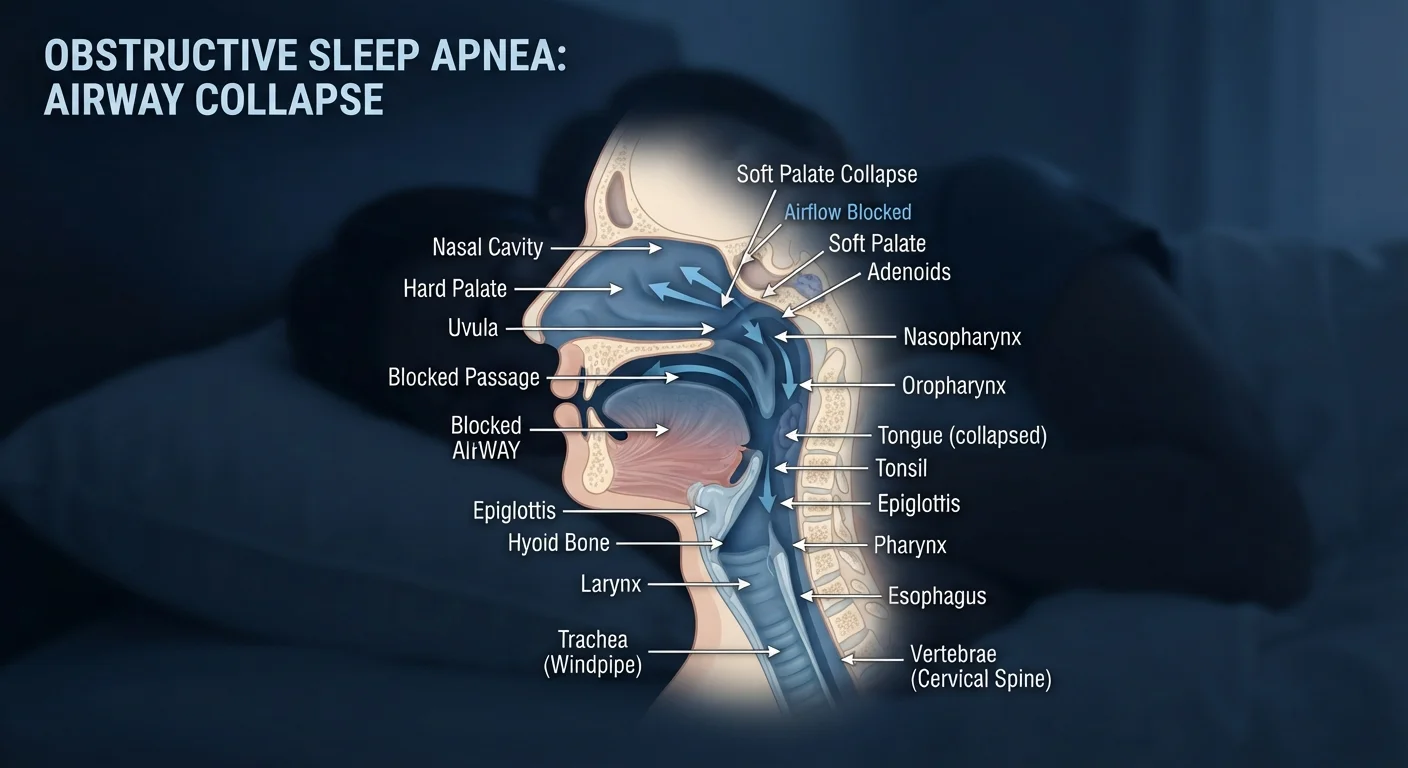
What Actually Happens in the Airway
During normal sleep, the muscles of the upper airway relax slightly — this is expected and harmless. In obstructive sleep apnea, however, that relaxation goes further than it should. The soft palate, uvula, tongue, and surrounding throat muscles lose enough tone that they partially or fully collapse inward, blocking the passage through which air must travel to reach the lungs.
When the airway closes, airflow stops. Blood oxygen levels begin to fall. Carbon dioxide builds. Within seconds, the brain detects the imbalance and sends an urgent signal that briefly rouses the body — just enough to restore muscle tone, reopen the airway, and resume breathing. This micro-arousal often takes the form of a snort, gasp, or body movement. The person typically does not fully wake up and has no memory of the event come morning.
This cycle can repeat five to over thirty times per hour across a single night. Each interruption prevents the brain from completing full, restorative sleep cycles. Slow-wave deep sleep and REM sleep — the stages most critical for physical repair and memory consolidation — are particularly disrupted.
OSA Is Distinct From Central Sleep Apnea
Obstructive sleep apnea involves a physical blockage of the airway despite the brain sending normal breathing signals. Central sleep apnea (CSA) is a separate condition in which the brain temporarily fails to send those signals at all, so the muscles never attempt a breath. Mixed apnea involves elements of both. This article focuses specifically on the obstructive form, which accounts for the large majority of sleep apnea cases.
Special Populations Require Tailored Guidance
Children, pregnant individuals, and older adults with OSA may present differently and require evaluation approaches tailored to their circumstances. If you are concerned about sleep-disordered breathing in a child or in someone with complex medical conditions, consult a physician rather than applying general adult frameworks.
Recognizing the Warning Signs
Because OSA plays out during unconscious sleep, the clearest evidence often comes from a bed partner or household member who observes loud snoring, visible pauses in breathing, or gasping episodes. However, many people live alone or sleep separately and have no external witness to these events.
Internal warning signs — symptoms experienced by the person themselves — are equally important to recognize:
- Excessive daytime sleepiness despite spending a full night in bed
- Waking with a dry mouth or sore throat, a consequence of breathing through an open mouth to compensate for obstruction
- Morning headaches, often linked to elevated carbon dioxide levels overnight
- Difficulty concentrating or memory lapses throughout the day
- Irritability or mood changes associated with chronic sleep deprivation
- Frequent nighttime urination, which research has increasingly linked to OSA-related pressure changes in the chest
None of these symptoms alone confirms OSA — many conditions share them. But a pattern of several together, especially alongside witnessed breathing pauses, is a strong signal to seek evaluation. OSA is part of a broader landscape of sleep disruptions covered in our overview of sleep disorders.
Why OSA Is More Than a Snoring Problem
It is tempting to view OSA as simply a noisy inconvenience — one that bothers a partner more than the sleeper. The reality is more consequential. Each apnea event forces the cardiovascular system to work harder. Blood pressure spikes momentarily with every arousal. Oxygen saturation dips repeatedly through the night. Over months and years, this cumulative physiological stress is associated in research with elevated rates of hypertension, heart arrhythmias, type 2 diabetes, and stroke.
Cognitive effects are also well-documented. Sustained sleep fragmentation impairs attention, working memory, and executive function. Some research has examined links between long-term OSA and accelerated cognitive decline, though the precise relationship remains an area of active study.
OSA also carries a meaningful safety dimension. Daytime sleepiness from untreated OSA has been associated with increased risk of motor vehicle accidents and occupational errors.
Among the most prevalent sleep disorders in American adults, OSA stands out for both its frequency — affecting an estimated 26% of adults between ages 30 and 70, according to sleep medicine research — and its underdiagnosis rate. Many cases go unrecognized for years.
Who Is at Risk — and What Drives It
OSA has a well-established set of contributing risk factors, though none is an absolute prerequisite. Understanding these factors helps contextualize why evaluation matters even for people who do not fit a stereotyped profile.
- Anatomy
- A narrow upper airway, recessed jaw, large tongue, enlarged tonsils or adenoids, or a thick neck circumference all reduce the structural margin available before tissue can obstruct airflow.
- Muscle tone and aging
- Airway muscle tone naturally decreases with age, which is why OSA prevalence rises in older adults. This is separate from body weight.
- Body weight
- Excess adipose tissue around the neck and throat can narrow the airway. However, as discussed in common sleep disorder misconceptions, many individuals with OSA are of average weight.
- Sleep position
- Sleeping on the back allows the tongue and soft palate to fall rearward under gravity, which worsens or triggers obstruction in many people.
- Alcohol and sedatives
- These substances further relax throat muscles, increasing the likelihood and severity of obstructive events.
- Sex and hormonal factors
- Males are diagnosed with OSA at higher rates, but the risk for females increases significantly after menopause, suggesting hormonal factors play a role in airway muscle tone.
~26%
U.S. adults aged 30–70 estimated to have OSA
According to estimates cited in sleep medicine literature, roughly one in four adults in this age range has OSA at some level of severity.
80%
Estimated proportion of OSA cases that go undiagnosed
Research has consistently suggested the large majority of people with OSA have not received a formal diagnosis, highlighting a significant gap in detection.
2–3x
Increased hypertension risk with untreated OSA
Studies in sleep medicine have found that untreated OSA is associated with substantially elevated rates of high blood pressure compared to non-apneic individuals.
Getting Evaluated and What Comes Next
OSA cannot be reliably diagnosed through symptoms alone, no matter how characteristic they appear. Confirmation requires objective measurement of breathing during sleep. A physician may recommend either an in-lab polysomnography — a comprehensive overnight sleep study — or a home sleep apnea test, depending on clinical circumstances. Understanding what a sleep study actually measures can help reduce anxiety about the process.
If OSA is confirmed, several management approaches exist, ranging from positional therapy and oral appliances to positive airway pressure (PAP) devices, which are considered the most established treatment for moderate-to-severe cases. Sleep apnea treatment approaches vary in design and suitability, and a healthcare provider will guide the appropriate path based on severity and individual circumstances.
The key first step is recognizing that fragmented, unrefreshing sleep is not something to simply endure. If recognized warning signs are present, a conversation with a physician is the appropriate next move.
This article is for informational purposes only and does not constitute medical advice. If you are experiencing symptoms that concern you, consult a qualified healthcare professional for evaluation and guidance appropriate to your individual situation.
Frequently Asked Questions
Snoring and OSA often coexist, but they are not the same thing. Snoring is caused by vibrating soft tissue and can occur without any actual airway obstruction. OSA involves complete or near-complete blockage of breathing. Not everyone who snores has OSA, and not everyone with OSA snores loudly.
Yes. Because the arousals that restore breathing happen in seconds, most people with OSA do not consciously wake up or remember the events. Many are alerted to a potential problem only after a bed partner notices gasping or pauses in breathing, or after they notice persistent daytime fatigue despite adequate sleep time.
No. While excess weight — particularly around the neck — is a recognized risk factor, OSA also occurs in people of healthy weight due to anatomical factors such as a narrow jaw, enlarged tonsils, or the natural positioning of the tongue during sleep. This is a common misconception explored in more depth in discussions of sleep disorder myths.
OSA is diagnosed through a sleep study — either an in-lab polysomnography or a home sleep apnea test ordered by a physician. These tests measure breathing patterns, oxygen levels, and sleep stages. A self-reported checklist or symptom pattern alone is not sufficient for a clinical diagnosis.
Untreated OSA is associated with elevated risks for high blood pressure, heart disease, type 2 diabetes, stroke, and impaired cognitive function. The repeated drops in blood oxygen and sleep fragmentation place sustained stress on cardiovascular and metabolic systems. These are associations established in research — individual risk varies and should be discussed with a healthcare provider.
Anyone experiencing persistent daytime sleepiness, witnessed breathing pauses during sleep, frequent morning headaches, or waking with a choking or gasping sensation should consult a physician. These symptoms are not diagnostic on their own but are strong enough indicators to warrant a professional evaluation.
The content on this site is for informational purposes only and is not a substitute for professional advice. Always consult a qualified professional for guidance specific to your situation.