

Why a Doctor Might Order a Sleep Study
A referral for polysomnography usually follows a pattern of symptoms that a clinical interview or basic physical exam can't fully explain. Loud snoring paired with witnessed breathing pauses, excessive daytime sleepiness despite adequate time in bed, or unusual nighttime behaviors — such as acting out dreams — are among the most common triggers for an order.
Understanding what sleep disorders are and why they matter helps frame why this level of measurement is necessary. Many conditions that disrupt sleep produce no obvious daytime signs beyond fatigue, making objective overnight data essential for an accurate picture.
A sleep study isn't reserved for worst-case scenarios. It is a routine diagnostic tool — comparable to ordering an EKG to evaluate heart rhythm — designed to give clinicians precise, objective information rather than relying solely on a patient's self-reported experience.
What Polysomnography Actually Records
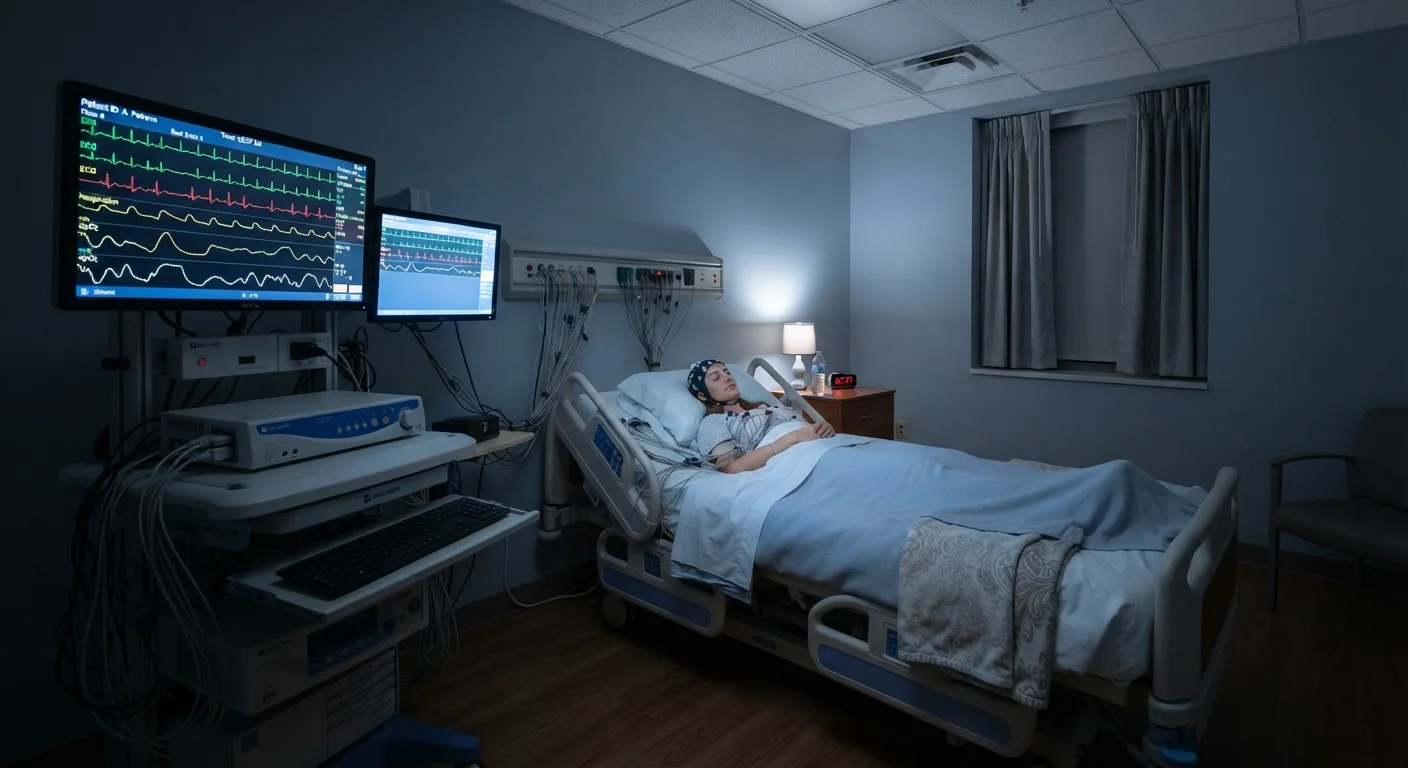
PSG is defined by the sheer breadth of what it captures simultaneously. Each channel of data targets a specific physiological system:
- Electroencephalography (EEG): Electrodes on the scalp record electrical brain activity, allowing technologists to identify each stage of sleep — from light NREM to slow-wave deep sleep and REM.
- Electrooculography (EOG): Sensors near the eyes detect eye movements, which are critical for distinguishing REM sleep from other stages.
- Electromyography (EMG): Chin and leg electrodes measure muscle tone and activity, flagging events such as teeth grinding or periodic limb movements.
- Electrocardiography (ECG): A single-lead heart monitor captures heart rate and rhythm throughout the night.
- Respiratory monitoring: Airflow sensors at the nose and mouth, along with chest and abdominal belts, measure breathing effort and detect pauses or abnormalities.
- Pulse oximetry: A small clip on the finger continuously measures blood oxygen saturation, a key indicator of breathing disruptions.
Together, these channels allow a clinician to see exactly what is happening in the brain and body at every moment of the night.
~30M
Americans estimated to have obstructive sleep apnea
The American Academy of Sleep Medicine has estimated that roughly 30 million U.S. adults have obstructive sleep apnea, many of whom remain undiagnosed.
7–10+
Physiological channels recorded simultaneously in PSG
A standard polysomnography study captures at minimum seven distinct data channels, with clinical labs often recording ten or more in complex cases.
~80%
Of moderate-to-severe sleep apnea cases undiagnosed
Research published in sleep medicine literature consistently estimates that a large majority of clinically significant sleep apnea cases in adults remain unidentified.
The Night of the Study: What to Expect
Patients typically arrive at the sleep lab one to two hours before their usual bedtime. A trained sleep technologist applies the sensors — a process that takes roughly 30 to 60 minutes — and explains what each one measures. Once setup is complete, the lights go off and recording begins.
The technologist monitors all data channels from an adjacent room throughout the night. If a sensor shifts or a reading is unclear, they may briefly enter to make an adjustment. Patients can get up to use the bathroom; the equipment is designed with this in mind.
In the morning, sensors are removed, and patients are free to go. The raw data — often spanning hundreds of pages when printed — is then scored by the technologist and reviewed by a sleep medicine physician before results are communicated to the patient and referring provider.
It is worth noting that most people sleep less perfectly in a lab than at home, a phenomenon sometimes called the first-night effect. Fortunately, even a night of somewhat disrupted sleep usually generates enough data for a valid clinical interpretation.
How PSG Differs from Consumer Sleep Trackers
Wearable devices and smartphone apps have made sleep data more accessible than ever, but they operate on fundamentally different principles. Consumer trackers typically infer sleep stages from movement (accelerometry) and, in some newer devices, heart rate variability — they do not measure brain waves directly.
Sleep tracking tools have real limitations that are important to understand: they can estimate when you are asleep or awake with reasonable accuracy, but their stage-level data carries significant error margins. They also cannot detect respiratory events, oxygen desaturation, or leg movements with clinical precision.
This distinction matters when symptoms are present. A wearable that reports poor sleep quality is a useful prompt to discuss concerns with a clinician — but it cannot replace the diagnostic resolution of polysomnography when a medical evaluation is warranted.
This article is for informational purposes only and is not a substitute for professional medical advice, diagnosis, or treatment. Always consult a qualified healthcare provider with questions about your sleep health or any medical condition.
Frequently Asked Questions
Polysomnography is non-invasive and painless. Sensors and electrodes are applied to the skin and scalp using a conductive gel or mild adhesive — nothing punctures the skin. Some people find the setup process slightly tedious, but most patients sleep well enough to generate usable data.
A standard in-lab study spans a full night, typically from around 10 p.m. to 6 a.m. This duration gives clinicians enough data across multiple sleep cycles. You are generally free to leave shortly after waking, once sensors are removed.
PSG is commonly used to evaluate obstructive sleep apnea, central sleep apnea, narcolepsy, REM sleep behavior disorder, periodic limb movement disorder, and parasomnias. A physician orders the test based on your specific symptoms and medical history.
Always follow your ordering physician's specific instructions about medications before a sleep study. Some medications affect sleep architecture or the measurements being recorded, so your care team will advise accordingly.
A home sleep apnea test (HSAT) is a simplified portable device that measures breathing, oxygen levels, and airflow — but it does not record brain waves or staging data. PSG provides a far more complete picture and remains the standard for complex or ambiguous cases.
A board-certified sleep medicine physician reviews and interprets all PSG data. The raw recordings are scored by a trained sleep technologist, then formally read and signed off by the physician, who discusses findings and next steps with the patient.
The content on this site is for informational purposes only and is not a substitute for professional advice. Always consult a qualified professional for guidance specific to your situation.