

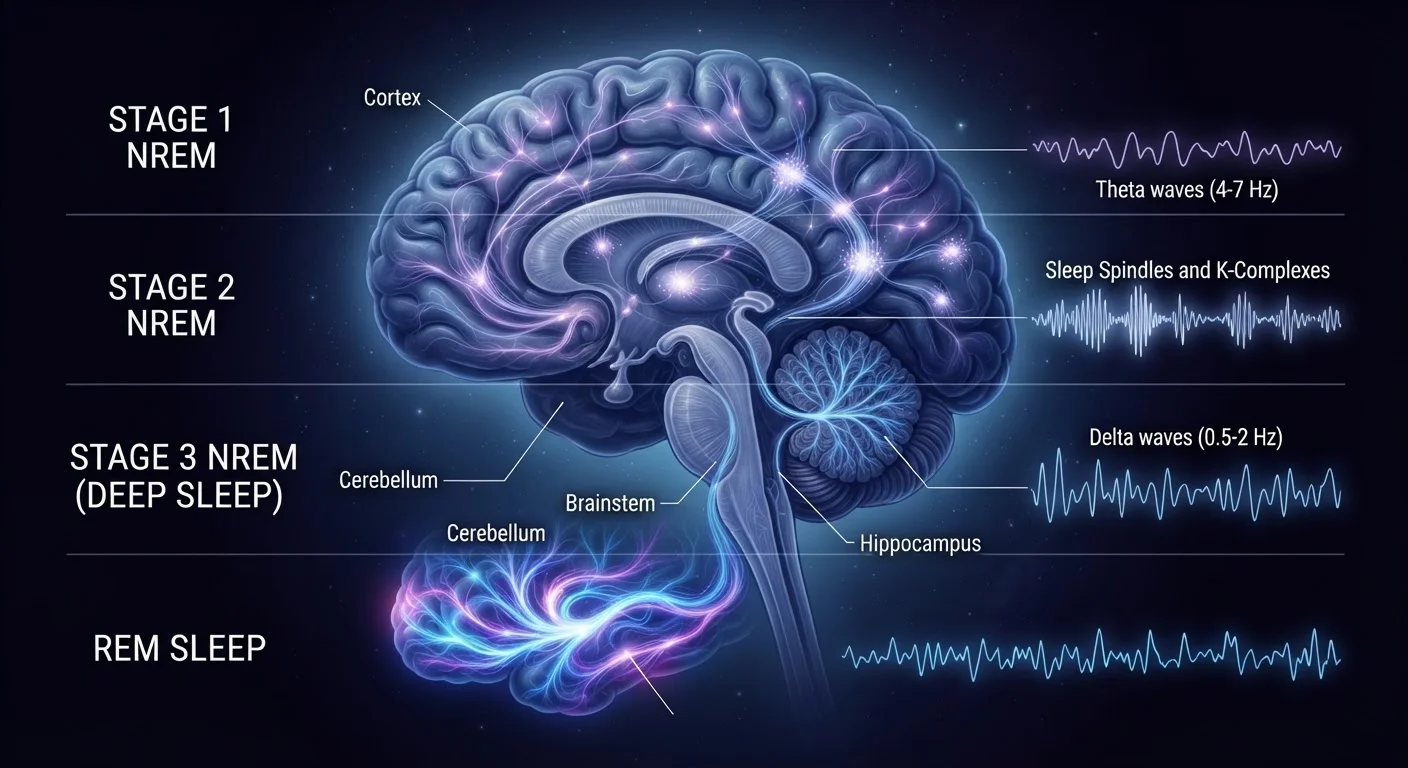
The Architecture of a Night's Sleep
Sleep is not a single, uniform state. From the moment you close your eyes, your brain begins a carefully choreographed sequence of biological events — cycling through distinct stages that each serve a specific purpose. Understanding this architecture helps explain why the quantity of sleep is only part of the equation; the quality and completeness of your cycles matter just as much.
A standard sleep cycle runs approximately 90 minutes and includes four stages: three phases of NREM sleep (N1, N2, and N3) followed by REM sleep. These cycles repeat throughout the night, though their composition shifts — early cycles contain more deep sleep, while later cycles lean heavier on REM. For a fuller look at how these two dominant types differ in function, see REM sleep vs. deep sleep.
What Happens in Each Sleep Stage
N1 (Light Sleep): This is the transition between wakefulness and sleep. It lasts just one to seven minutes. Muscle activity slows, eye movements are minimal, and the brain begins producing theta waves — slower than the alpha waves of relaxed wakefulness. You can be easily awakened and may experience hypnic jerks, those brief muscle twitches common during sleep onset.
N2 (Established Light Sleep): The longest stage overall, N2 accounts for roughly 45–55% of total sleep time. Body temperature drops, heart rate slows, and the brain produces sleep spindles — short bursts of oscillating neural activity thought to play a role in memory consolidation and protecting sleep from environmental disruption.
N3 (Deep Slow-Wave Sleep): Also called slow-wave sleep, N3 is the most physically restorative stage. Delta waves — the slowest brainwaves — dominate. Growth hormone is released, immune function is supported, and tissue repair occurs. Waking during this stage produces the most severe sleep inertia. What actually happens to your body during rest explores these repair mechanisms in detail.
REM Sleep: Brain activity surges to near-waking levels. Eyes move rapidly beneath closed lids, voluntary muscles are temporarily paralyzed, and vivid dreaming commonly occurs. REM is strongly associated with emotional memory processing, learning consolidation, and mood regulation. Its proportion grows with each successive cycle — the final cycle before waking can contain 45–60 minutes of REM alone.
~90 min
Average duration of one sleep cycle
Sleep medicine research consistently identifies 90 minutes as the typical cycle length, though individual cycles can range from 70 to 110 minutes.
4–6
Cycles completed in a full night's sleep
Most adults cycling through seven to nine hours of sleep will complete four to six full NREM-REM cycles per night.
20–25%
Proportion of sleep time spent in REM
In healthy adults, REM sleep typically accounts for roughly one-fifth to one-quarter of total nightly sleep, according to established sleep stage research.
Why Disrupted Cycles Leave You Feeling Off
Each stage of the sleep cycle is interdependent. Skipping or cutting short any one stage — whether through an early alarm, alcohol consumption, or fragmented sleep — has downstream effects. Alcohol, for instance, is well-documented to suppress REM sleep in the first half of the night, reducing cognitive restoration even when total sleep time appears adequate.
Hormones play a central role in orchestrating these cycles. Melatonin, adenosine, and cortisol interact across the night to regulate sleep pressure and the timing of each stage. For a clear explanation of this hormonal choreography, see the hormones that run your sleep.
Timing your wake-up to align with a lighter stage — N1 or N2 — rather than N3 can meaningfully reduce grogginess. Why waking mid-cycle feels so rough examines this in depth. Practically, maintaining a consistent sleep schedule allows your body to anticipate wake time and naturally shift toward lighter sleep stages near morning — reducing the likelihood of jarring mid-cycle interruptions.
For evidence-based routines that support complete, uninterrupted cycling through all stages, the Better Sleep Habits hub is a useful starting point.
This article is for informational purposes only and does not constitute medical advice. If you have concerns about your sleep or suspect a sleep disorder, please consult a qualified healthcare professional.
Frequently Asked Questions
Most adults need four to six complete sleep cycles per night, which translates to roughly seven to nine hours of total sleep. Individual needs vary based on age, health, and lifestyle. Consistently getting fewer cycles than your body requires can accumulate as sleep debt over time.
Waking during deep sleep (N3) typically causes the most pronounced grogginess, a phenomenon called sleep inertia. This occurs because the brain is in its most suppressed state and requires time to return to full alertness. Waking during lighter stages — N1 or N2 — tends to feel less disorienting.
The fundamental architecture of sleep cycles is universal across healthy adults, but the proportion of time spent in each stage varies by age, health status, and sleep quality. For example, older adults generally experience less deep (N3) sleep than younger adults.
Research suggests that extended sleep on weekends can partially offset the cognitive effects of weekday sleep debt, but does not fully restore all biological processes. Consistent nightly sleep is more effective than irregular recovery sleep for long-term health and cognitive function.
Common disruptors include alcohol (which suppresses REM sleep), noise, inconsistent sleep schedules, sleep disorders such as sleep apnea, and stress. Even brief awakenings can fragment cycle progression without the sleeper being consciously aware.
The content on this site is for informational purposes only and is not a substitute for professional advice. Always consult a qualified professional for guidance specific to your situation.