

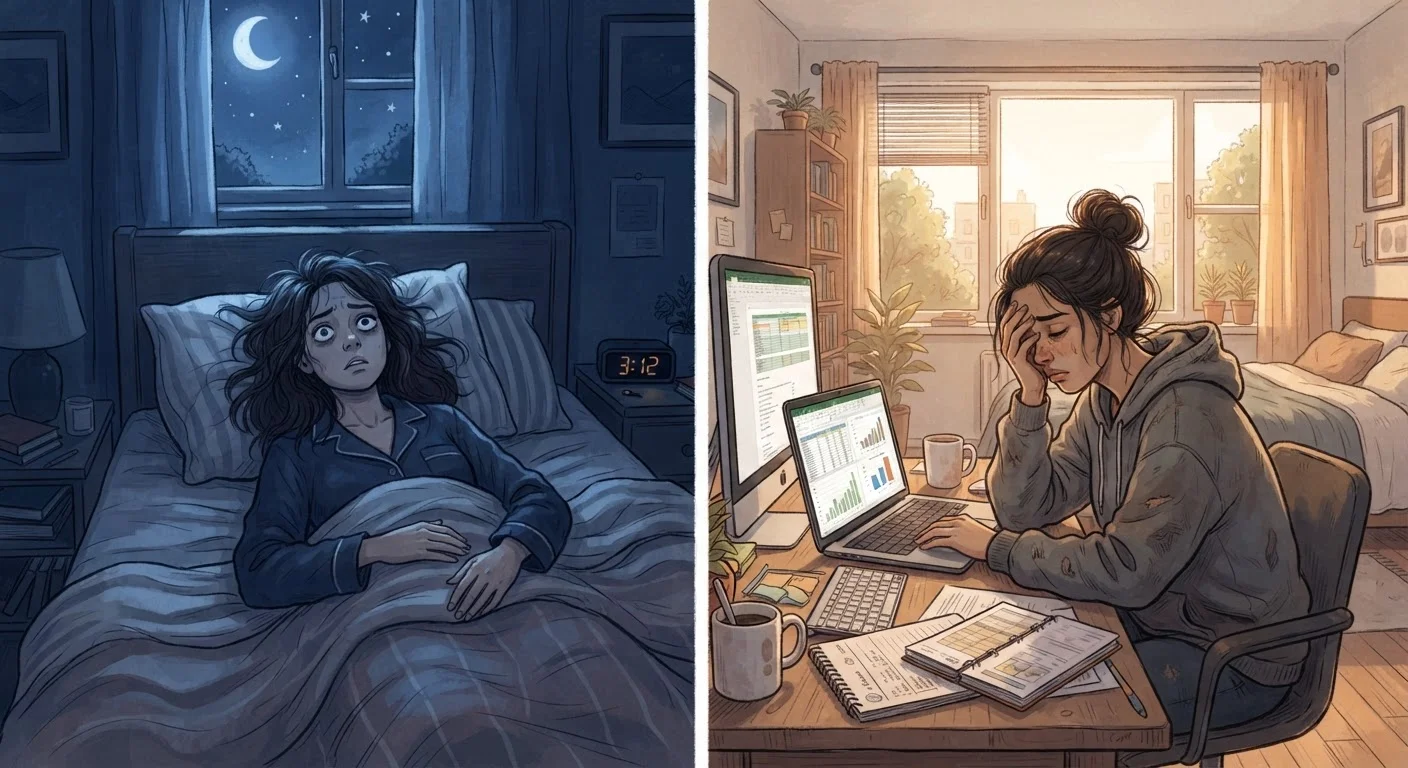
Option A
Insomnia
A disorder of sleeplessness despite adequate opportunity.
Best for: Understanding a clinical condition where the brain's ability to initiate or maintain sleep is impaired.
Option B
Sleep Deprivation
A circumstantial shortfall caused by insufficient time in bed.
Best for: Recognizing when lifestyle, schedule, or environment is simply not allowing enough sleep time.
The Core Distinction: Opportunity vs. Ability
Many people use "insomnia" and "sleep deprivation" interchangeably, but sleep medicine treats them as fundamentally different problems. The distinction comes down to a single clarifying question: Is there adequate opportunity to sleep?
Sleep deprivation occurs when a person does not get enough sleep because their circumstances don't allow it — demanding work schedules, a newborn, shift work, or late-night screen habits all reduce the hours available for rest. The biological drive to sleep remains fully intact. Given the chance, these individuals fall asleep readily, often within minutes.
Insomnia, by contrast, is characterized by difficulty initiating or maintaining sleep despite having enough time and a suitable environment to do so. The American Academy of Sleep Medicine defines insomnia disorder as sleep difficulty occurring at least three nights per week for at least three months, accompanied by meaningful daytime impairment. The problem is not the absence of opportunity — it's that the brain's sleep-initiation process is disrupted. To understand the two biological systems that normally drive sleep, see how circadian rhythm and sleep pressure interact.
How Each Condition Plays Out Day to Day
The day-to-day experience of these two conditions differs in telling ways.
Someone who is sleep deprived tends to feel consistently drowsy, struggles to stay alert through routine tasks, and will often fall asleep during passive activities — reading, watching television, or riding as a passenger. Their sleep, when they do get it, is typically fast-arriving and restorative. Catch-up sleep on weekends often provides meaningful relief, though it doesn't fully compensate for a chronic deficit. For a detailed look at what sustained short sleep does to the body and brain, the cumulative effects of sleep deprivation are well documented.
Someone with insomnia, on the other hand, often reports a paradox: they feel fatigued and unable to function well during the day, yet they cannot fall asleep at night — even when exhausted and in bed. Rather than intense sleepiness, they may experience a kind of hyperarousal: a racing mind, heightened alertness, or physical tension. Napping doesn't necessarily help and can make nighttime sleep harder. This is partly why insomnia is harder to resolve than most people expect — it often feeds on itself.
| Criterion | Insomnia | Sleep Deprivation |
|---|---|---|
| Core problem | Inability to sleep despite opportunity | Insufficient time allocated to sleep |
| Sleep onset when given time | Difficult or impossible | Rapid — often within minutes |
| Daytime experience | Fatigue with hyperarousal, not sleepiness | Strong, persistent drowsiness |
| Cause | Behavioral, psychological, or physiological | Circumstantial — schedule, environment, habits |
| Effect of extra sleep opportunity | May not help; can worsen the cycle | Typically provides meaningful relief |
| Primary intervention | CBT-I or clinical evaluation | Protecting and extending sleep time |
| Duration pattern | Chronic (months or longer) | Situational or ongoing by circumstance |
Why the Distinction Matters for Next Steps
Getting the distinction right isn't just academic — it shapes what actually helps.
For sleep deprivation, the path forward centers on restructuring time and habits: protecting a consistent sleep window, reducing obligations or stimulants that encroach on rest, and understanding the role of sleep timing consistency alongside total duration. These are largely behavioral and environmental adjustments.
Insomnia generally requires a different approach. Cognitive Behavioral Therapy for Insomnia (CBT-I) is currently considered the first-line treatment by major sleep medicine organizations — it addresses the thought patterns and behaviors that perpetuate sleeplessness. Spending extra time in bed, which might seem logical, can actually worsen insomnia by fragmenting sleep pressure. This is one reason why common misconceptions — explored in detail in sleep disorder myths that keep people from getting help — can delay meaningful relief.
If you're unsure which category applies to you, a healthcare provider or sleep specialist is the appropriate resource. Both conditions are serious, and for a broader framework on how sleep disorders are classified and why evaluation matters, sleep disorders explained offers useful grounding.
When Both Conditions Overlap
It's possible for someone to experience both insomnia and sleep deprivation simultaneously — for example, a night-shift worker who also has difficulty sleeping during the day. Co-occurring conditions can complicate the picture significantly. If your sleep difficulties don't fit neatly into one category, or if daytime impairment is severe, seeking evaluation from a sleep specialist is the most reliable way to identify what's driving the problem.
This article is for informational purposes only and is not a substitute for professional medical advice, diagnosis, or treatment. If you are experiencing persistent sleep difficulties, please consult a qualified healthcare professional.
The content on this site is for informational purposes only and is not a substitute for professional advice. Always consult a qualified professional for guidance specific to your situation.