

Our Verdict
Both natural infection and vaccination can generate lasting immune memory, but they are not interchangeable strategies. Vaccination provides comparable or superior protection for many diseases while eliminating the serious risks of acquiring immunity through actual illness. Natural immunity, while sometimes robust, is unpredictable in strength and comes at a potentially high cost to health.
| Best for | Recommended |
|---|---|
| Those seeking reliable, low-risk immune protection | Vaccine-induced immunity |
| Understanding post-infection immune status | Consult a healthcare provider for guidance on additional vaccination |
How Each Type of Immunity Works
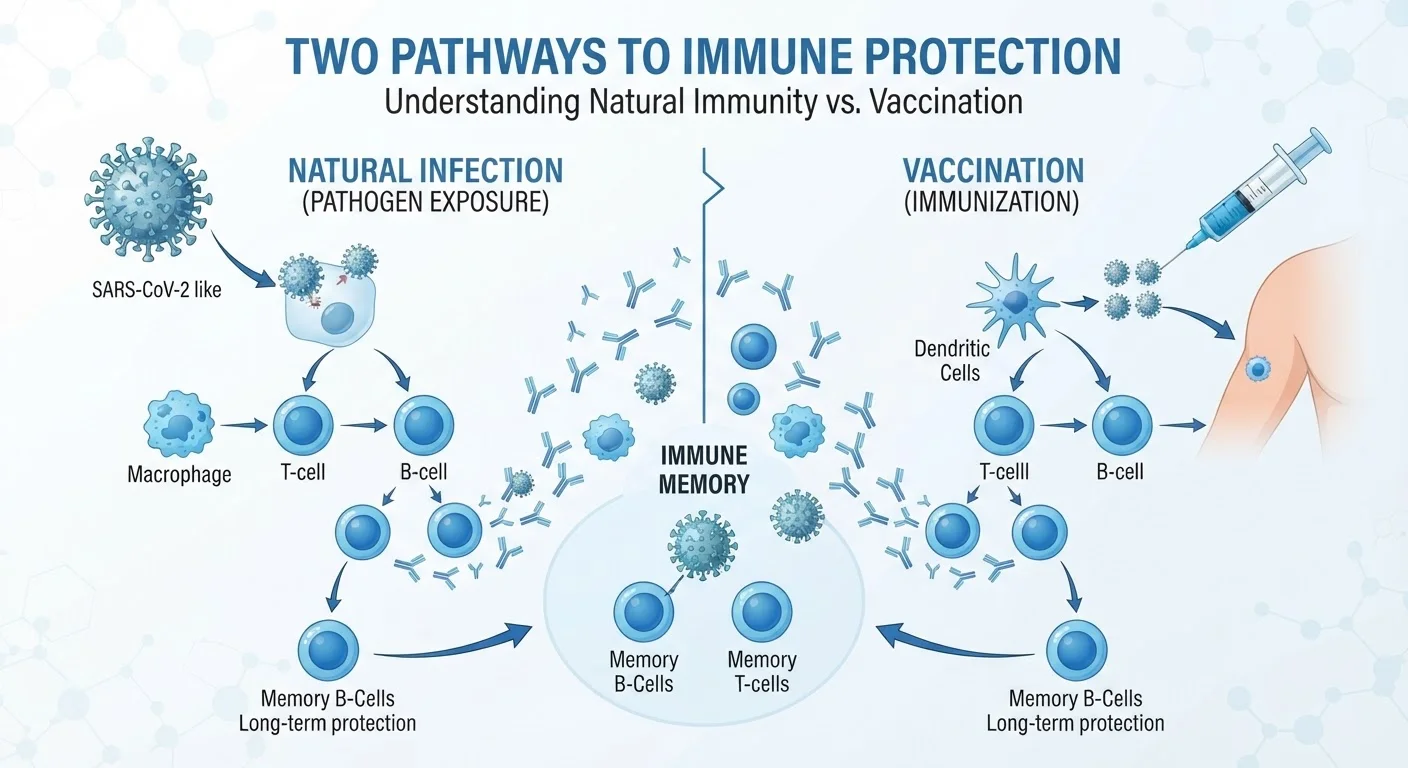
When the immune system encounters a pathogen — whether through infection or vaccination — it mounts a response that involves both immediate defenses and the creation of long-lived immune memory cells. B cells produce antibodies tailored to the invader, while T cells coordinate the attack and remember the threat for future encounters. This shared foundation is why both pathways can offer protection.
However, the nature of that exposure differs considerably. Natural infection exposes the immune system to the full pathogen — all of its proteins, in their native form — which can trigger a broad immune response. Vaccination introduces only selected components (such as a protein, weakened virus, or genetic instructions) designed to prime immunity without causing disease. As explained in our guide to vaccine-induced immune memory, this targeted approach still trains the immune system effectively, often with engineered precision.
Comparing Strength and Duration
Research on immune durability reveals a nuanced picture that varies by pathogen.
| Natural Immunity | Vaccine-Induced Immunity | |
|---|---|---|
| Source of exposure | Full live pathogen during illness | Selected antigen or attenuated pathogen |
| Consistency of response | Varies widely by infection severity | More standardized and predictable |
| Duration | Pathogen-dependent; can be lifelong or brief | Pathogen-dependent; bolstered by boosters |
| Risk to acquire | Risk of serious illness, complications, death | Small, well-characterized adverse event risk |
| Breadth of immune response | Broad — targets many pathogen proteins | Targeted — focuses on key antigens |
| Public health recommendation | Not recommended as a deliberate strategy | Strongly recommended for most populations |
For diseases like measles, vaccination produces very high-level, lifelong antibody responses — comparable to or exceeding those from infection. For COVID-19, studies published in journals including Science and Nature found that hybrid immunity (infection followed by vaccination) produced particularly robust antibody responses, but natural infection alone varied widely by disease severity. Mild infections sometimes generated weaker or shorter-lasting immunity than vaccination.
Waning immunity is a concern for both pathways. Booster doses exist partly because antibody levels from either source can decline over time, though memory B and T cells often remain to mount rapid responses upon re-exposure.
The Risk Calculus: A Critical Difference
Perhaps the most important distinction is not immunological but medical: acquiring natural immunity means surviving the disease first. For many pathogens — measles, pertussis, COVID-19, hepatitis B — that infection carries real risks of serious complications, hospitalization, long-term health consequences, and death, particularly for vulnerable populations.
Vaccines, by contrast, are designed to confer protection with a well-characterized and generally much smaller risk profile. The safety monitoring systems used by the CDC and FDA continuously track adverse events to ensure that benefits outweigh risks at the population level. For context, the risk of serious complications from measles infection is orders of magnitude higher than from the MMR vaccine.
This is why public health authorities do not recommend deliberately seeking infection as an immunity strategy. The unpredictability of individual outcomes — who will have a mild case versus a severe one — makes that approach medically unjustifiable. For a closer look at how these safety assessments work, see our article on persistent vaccine safety myths addressed with evidence.
When Natural Immunity and Vaccination Interact
Immunity from prior infection and vaccination are not mutually exclusive. Evidence, particularly from COVID-19 research, suggests that vaccinating individuals who have already been infected can meaningfully boost their antibody levels and broaden the immune response — a combination sometimes called "hybrid immunity." This does not mean infection is a prerequisite; vaccination alone achieves strong protection for most people and most diseases.
Clinicians may also consider prior infection history when advising on vaccine timing, but current guidance from major health authorities generally recommends staying up to date on recommended vaccines regardless of infection history, unless there is a specific contraindication. The broader societal benefit of vaccination — contributing to community-level protection — also factors into these recommendations, as explored in our article on how herd immunity protects whole communities.
This article is for general informational and educational purposes only and does not constitute medical advice. Consult a qualified healthcare professional for guidance specific to your health situation, vaccination history, or medical needs.
The content on this site is for informational purposes only and is not a substitute for professional advice. Always consult a qualified professional for guidance specific to your situation.