

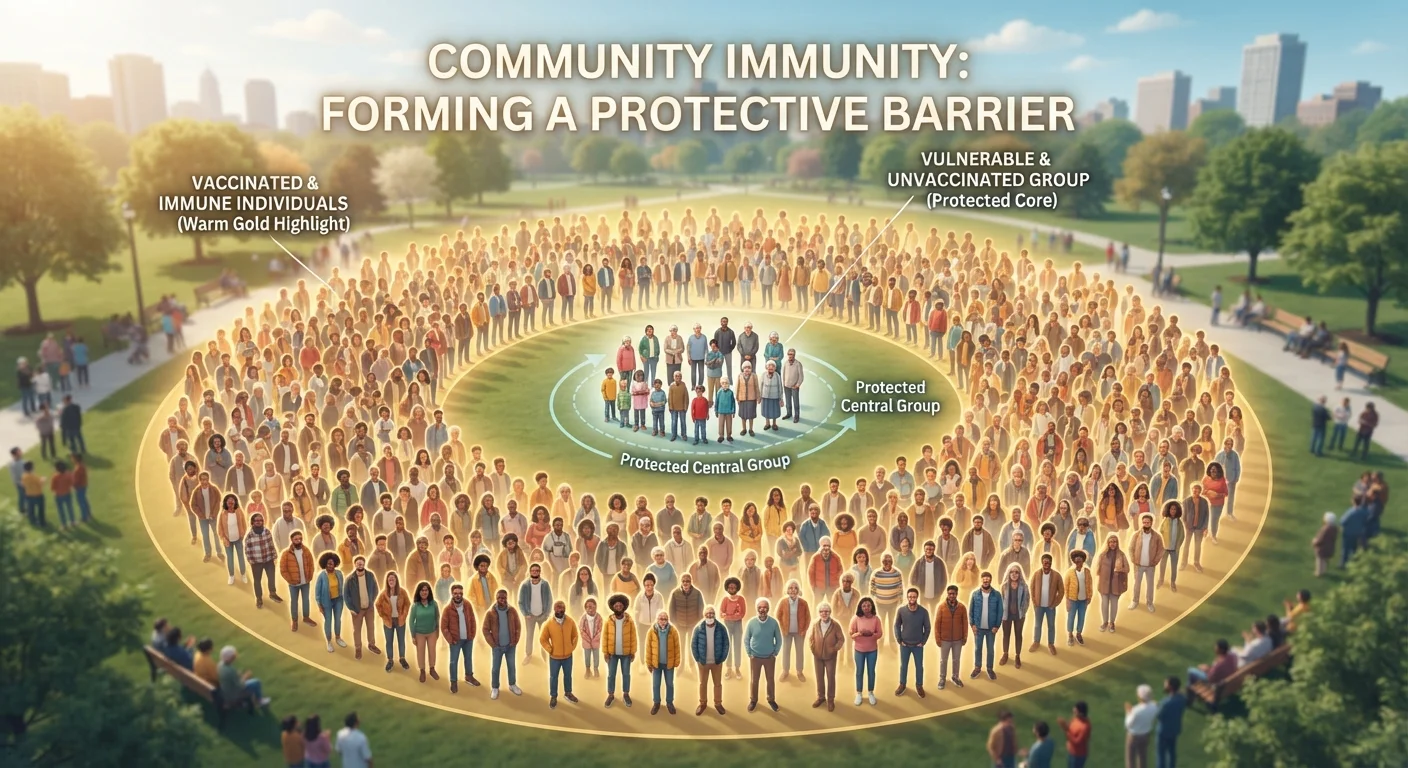
The Math Behind the Threshold
Every contagious disease has a characteristic called the basic reproduction number (R₀) — the average number of people one infectious person will infect in a population with no immunity. Measles has an R₀ estimated between 12 and 18, making it extraordinarily contagious. Seasonal influenza typically ranges from 1.2 to 1.4. The higher the R₀, the greater the proportion of the population that must be immune to break transmission chains.
The herd immunity threshold is calculated as 1 − (1/R₀). For measles with an R₀ of 15, that means approximately 93–95% of the population must be immune. For polio, with a lower R₀, around 80–85% coverage is sufficient. These are not arbitrary targets — they represent the mathematical tipping point at which the average infected person transmits to fewer than one new person, causing the outbreak to die out.
To understand how vaccines build the underlying immune response that makes this possible, see how vaccines train immune memory.
95%
Vaccination coverage needed to achieve measles herd immunity
The CDC and WHO cite approximately 95% coverage as the threshold needed to interrupt measles transmission, reflecting the virus's high R₀ of 12–18.
80–85%
Estimated polio herd immunity threshold
Because polio is less contagious than measles, a lower but still substantial proportion of immune individuals is needed to prevent sustained transmission.
R₀ 12–18
Basic reproduction number for measles
Measles is among the most contagious diseases known; the WHO cites its R₀ as the primary reason its herd immunity threshold is so high.
Who Depends on Community Immunity
Herd immunity is not an abstract public health statistic — it is a direct, practical shield for some of the most vulnerable members of a community. Several groups cannot receive certain vaccines or do not mount sufficient immune responses even after vaccination:
- Newborns and young infants who are too young to have completed their vaccination schedules
- Immunocompromised individuals, such as those undergoing chemotherapy or living with certain immune disorders
- People with specific allergies to vaccine components
- Elderly individuals whose immune response to vaccination may be weaker
For these groups, the immunity of the people around them is their primary defense. Immunocompromised individuals face unique vaccine considerations — and community coverage directly affects their risk. When vaccination rates in a neighborhood, school, or social network fall below threshold, these individuals face meaningfully higher exposure risk.
Why Coverage Erodes — and What That Means
Herd immunity is not a permanent achievement. It requires active, ongoing maintenance. Several factors can erode community coverage over time:
- Waning immunity — protection from some vaccines decreases over time without booster doses. Learn more about why booster doses are recommended and how public health agencies set those schedules.
- Vaccine hesitancy — when portions of a community decline vaccination, coverage can slip below threshold even if overall rates appear acceptable. Vaccine hesitancy is shaped by psychological and social factors that go well beyond simple misinformation.
- Population turnover — new births continuously introduce susceptible individuals. Sustained programs are necessary to maintain threshold coverage.
The CDC has documented multiple U.S. measles outbreaks linked to clusters of unvaccinated individuals, demonstrating that localized drops in coverage — even within a largely vaccinated nation — are sufficient to allow a previously controlled disease to re-emerge.
Vaccination as a Community Act
Choosing to be vaccinated is both an individual health decision and a contribution to collective protection. When high coverage is maintained, the protective effect cascades through the entire community — including to people you will never meet but who share your schools, transit systems, and health care facilities.
It is worth noting that herd immunity is a threshold concept, not a guarantee of zero risk. Even well above threshold, sporadic cases can occur. And herd immunity does not apply equally to all diseases — some pathogens have environmental reservoirs (like tetanus) where herd immunity is not a meaningful concept at all.
For everyday consumers, the actionable takeaway is straightforward: staying current with recommended vaccines — including applicable boosters — is one of the most concrete ways an individual can support community-level disease control. If you are unsure about your vaccination status or eligibility, a primary care provider or pharmacist can review your history and the current CDC-recommended schedule.
This article is for general informational and educational purposes only and does not constitute medical advice. Consult a qualified healthcare professional for guidance specific to your health situation.
Frequently Asked Questions
It varies by disease and is determined by the pathogen's contagiousness. Measles, one of the most contagious diseases, requires roughly 95% coverage. Polio requires around 80–85%. There is no single universal percentage — each disease has its own threshold.
Natural infection can confer immunity in individuals who recover, but achieving herd immunity this way comes at the cost of widespread illness, serious complications, and death. Vaccination provides a controlled, far safer pathway to the same population-level protection.
People who cannot be vaccinated benefit the most — including newborns too young for certain vaccines, immunocompromised individuals, and those with specific allergies. These groups depend on the immunity of those around them to stay safe.
Not necessarily. Herd immunity reduces transmission enough to prevent sustained outbreaks, but elimination or eradication requires sustaining high coverage over time and globally. Smallpox is the only human disease eradicated; polio has been eliminated in most, but not all, countries.
When coverage falls below the threshold, the disease gains enough susceptible hosts to spread again. This is what drives resurgent measles outbreaks in communities with lower vaccination rates, as documented by the CDC in multiple U.S. outbreaks over the past decade.
No. Herd immunity must be actively maintained. Immunity from some vaccines wanes over time, new unvaccinated individuals are born into the population, and vaccine hesitancy can reduce coverage. Ongoing vaccination programs are essential to sustaining community-level protection.
The content on this site is for informational purposes only and is not a substitute for professional advice. Always consult a qualified professional for guidance specific to your situation.