

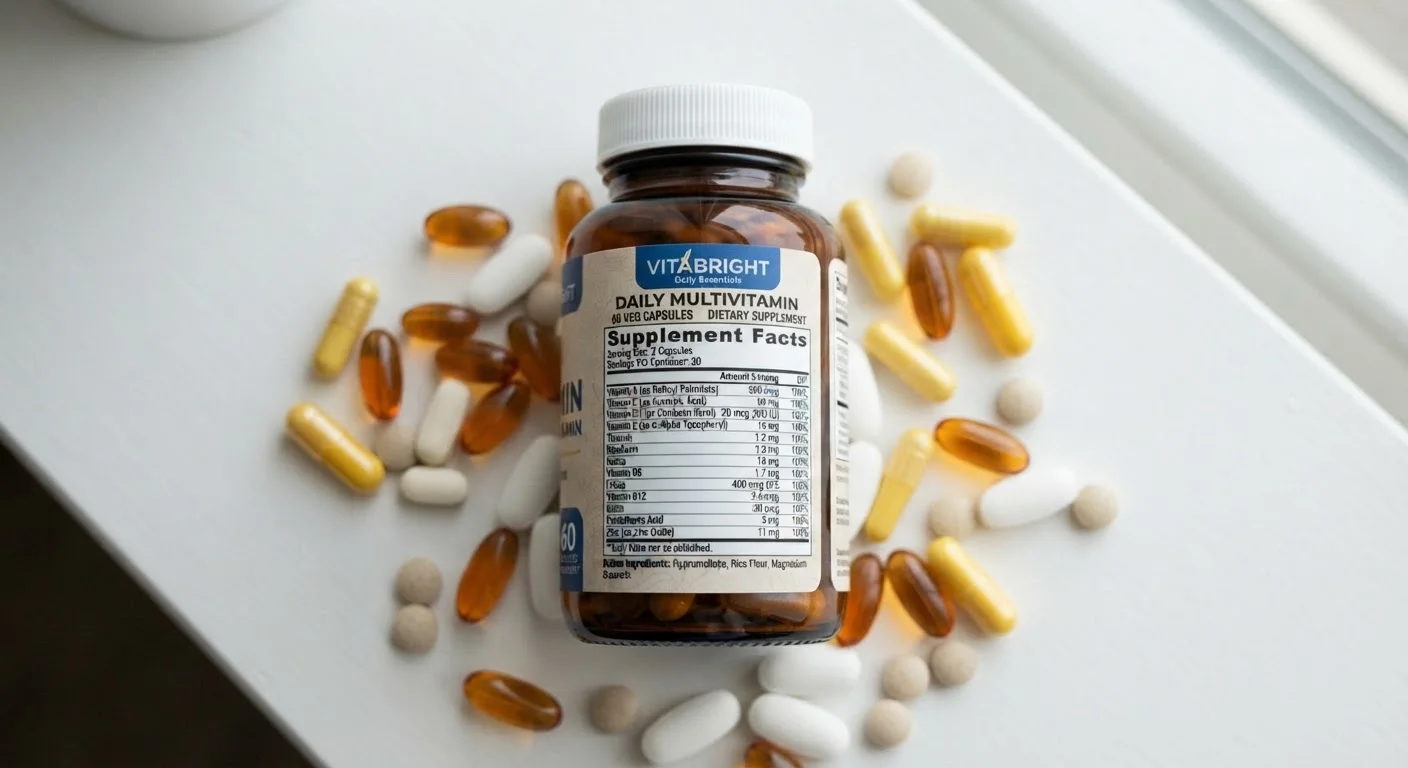
The Core Language of Supplement Labels
Every dietary supplement sold in the United States must carry a Supplement Facts panel — the structured label that lists ingredients, amounts, and reference values. Once you understand the vocabulary, these panels become much more readable.
The most prominent figures you'll encounter are:
- Serving size — the amount the label's numbers are based on (capsules, tablets, or volume)
- Amount per serving — the actual weight of each nutrient in that serving
- % Daily Value (%DV) — how the serving compares to a standardized daily target
For context on how this compares to reading macronutrient data, see reading a nutrition label through a macronutrient lens.
Units of Measurement: mg, mcg, and IU Explained
Nutrient amounts on supplement labels are expressed in units of weight or biological activity. Knowing what these abbreviations mean prevents confusion when comparing products.
- mg (milligrams)
- Used for nutrients needed in relatively larger amounts, such as vitamin C, magnesium, and calcium. One milligram is one-thousandth of a gram.
- mcg (micrograms)
- Used for nutrients required in very small quantities, like vitamin B12, folate, and vitamin D. One microgram is one-thousandth of a milligram — making it 1,000 times smaller than an mg.
- IU (International Units)
- An older unit measuring biological activity, historically used for vitamins A, D, and E. The FDA has largely transitioned labels to mcg or mg, but you may still see IU listed alongside the newer unit on some products.
5% DV
Considered low for a nutrient
According to FDA label-reading guidance, 5% Daily Value or less per serving indicates a low amount of that nutrient.
20% DV
Considered high for a nutrient
The FDA considers 20% Daily Value or more per serving to be a high amount, useful when you want to identify rich sources of a nutrient.
1,000x
Size difference between mg and mcg
One milligram contains 1,000 micrograms, making unit awareness critical when comparing supplement doses across products.
Understanding these units also matters when you're comparing the numbers on your supplement to nutrient recommendations from a healthcare provider, who will typically reference the same units.
What Percent Daily Value Actually Tells You
The % Daily Value is a quick benchmark that tells you what fraction of a standard daily target a single serving covers. A %DV of 20% means one serving provides one-fifth of the daily reference amount for that nutrient.
General FDA guidance suggests that 5% DV or less per serving is considered low, while 20% DV or more is considered high. This rule of thumb works well for nutrients you want to ensure you're getting enough of — but it's worth noting that a very high %DV isn't always desirable.
For the same reason that grams and percentages can tell different stories on a food label — a point explored in why grams and percentages tell different stories on a nutrition label — the %DV on a supplement panel can mask important nuance. A supplement delivering 500% DV of a fat-soluble vitamin warrants more scrutiny than one delivering 500% DV of vitamin C.
Tolerable Upper Intake Levels: The Safety Ceiling
Daily Values tell you how much to aim for; Tolerable Upper Intake Levels (ULs) tell you where the ceiling is. A UL is the highest daily intake of a nutrient that is unlikely to cause harm for most healthy adults, as established by the National Academies of Sciences, Engineering, and Medicine.
Supplement labels are not required to display ULs, which means a product can legally contain amounts that exceed safe thresholds without any visible warning. This is one reason that reviewing both the amount per serving and the %DV in context matters — particularly for fat-soluble vitamins (A, D, E, K) and certain minerals like iron and zinc, which accumulate in the body.
For a detailed look at which nutrients carry real toxicity risks when consumed in excess, see overstating supplements: the risks of taking too much.
This article is for general informational purposes only and does not constitute medical advice. Always consult a qualified healthcare professional before starting, stopping, or changing any supplement regimen, especially if you have a health condition, are pregnant, or are caring for a child or older adult.
Frequently Asked Questions
Percent Daily Value (%DV) tells you what portion of the recommended daily intake for a nutrient one serving of the supplement provides, based on a 2,000-calorie reference diet. A %DV of 100% means one serving delivers the full target amount for an average adult. It's a useful comparison tool, though your personal needs may differ.
Milligrams (mg) and micrograms (mcg) are both units of weight used to measure nutrient amounts. One milligram equals 1,000 micrograms, so mcg represents a much smaller quantity. Nutrients required in tiny amounts — like vitamin B12 and vitamin D — are typically listed in mcg, while others like vitamin C or magnesium appear in mg.
IU stands for International Unit, an older measurement used for fat-soluble vitamins like A, D, and E. It measures biological activity rather than weight. The FDA now requires most labels to use mcg or mg instead of IU, though some products still list both. Conversion factors vary by nutrient, so check the label carefully.
Not necessarily, but it depends on the specific nutrient. Water-soluble vitamins like vitamin C are excreted when consumed in excess, so very high %DVs pose less immediate risk. Fat-soluble vitamins (A, D, E, K) and some minerals accumulate in the body and can cause harm at excessive levels. Consult a healthcare provider if you're unsure.
A Tolerable Upper Intake Level (UL) is the highest daily intake of a nutrient considered safe for most healthy adults, as established by the National Academies. Regularly exceeding the UL increases the risk of adverse health effects. Not all nutrients have established ULs, and supplement labels are not required to display them.
No. Daily Values are based on a generalized 2,000-calorie diet for a reference adult and don't account for age, sex, pregnancy status, or health conditions. Children, older adults, pregnant individuals, and those with chronic conditions often have different nutrient needs. Always discuss supplementation with a qualified healthcare professional.
The content on this site is for informational purposes only and is not a substitute for professional advice. Always consult a qualified professional for guidance specific to your situation.