

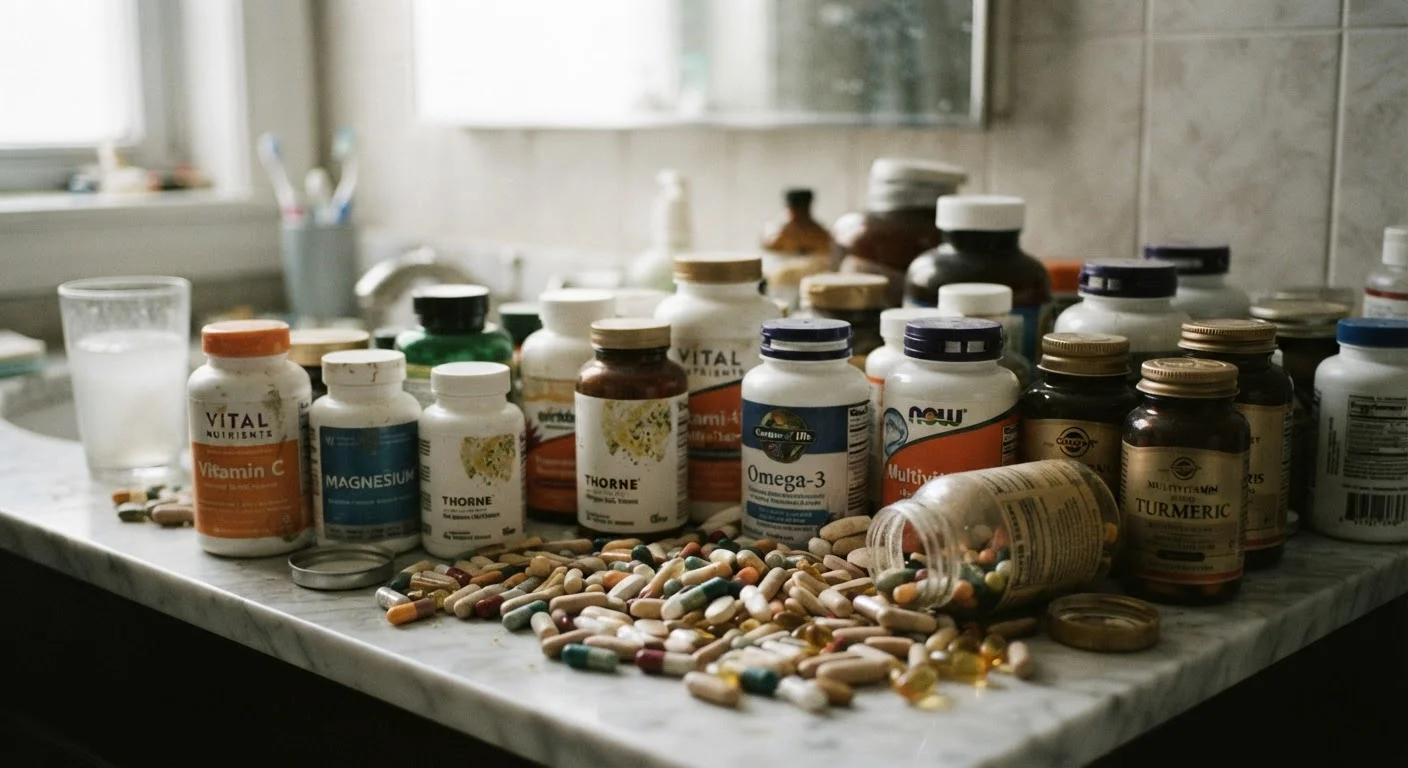
Why 'More Is Better' Doesn't Apply to Supplements
Americans spend billions of dollars on dietary supplements each year, often operating under a simple assumption: if a little is good, more must be better. With micronutrients, that logic breaks down quickly — and sometimes dangerously.
Every vitamin and mineral has a Tolerable Upper Intake Level (UL), a threshold established by the National Academies of Sciences, Engineering, and Medicine above which the risk of adverse health effects rises. Staying beneath that threshold matters as much as meeting recommended daily amounts. The challenge is that many people don't know where those limits are — or that their combined supplement use may already be crossing them.
This article walks through the most common mistakes people make when supplementing, why those mistakes happen, and what to do instead. For a broader look at how nutrients interact with each other, see our guide on micronutrients that compete or cooperate.
Taking multiple supplements without checking for overlapping nutrients.
Why it happens: Many people take a multivitamin alongside individual supplements, not realizing that nutrients like vitamin A, iron, or calcium appear in both — effectively doubling or tripling their intake.
Assuming 'natural' or 'food-based' supplements are automatically safe in any amount.
Why it happens: Marketing language around 'whole food' supplements creates a perception that these products behave just like eating food. But concentrated extracts can still deliver pharmacological doses of certain compounds.
Megadosing vitamin D without confirmed blood levels or medical guidance.
Why it happens: Vitamin D deficiency is widely discussed in health media, leading many people to self-prescribe high-dose supplements without first testing their actual levels.
Supplementing iron without a confirmed deficiency.
Why it happens: Fatigue and low energy are often attributed to low iron, prompting people to self-supplement. However, iron has a narrow therapeutic window and iron overload is a real and serious risk.
Using high-dose supplements as a substitute for a varied, balanced diet.
Why it happens: Supplements are convenient and marketed as a nutritional safety net, which can encourage people to rely on them rather than address dietary gaps through food.
Understanding Toxicity Risk by Nutrient Type
Not all nutrients carry equal toxicity risk. The distinction between fat-soluble and water-soluble vitamins is one of the most important concepts in supplement safety.
Fat-soluble vitamins — A, D, E, and K — dissolve in fat and are stored in the liver and fatty tissues. When consumed in excess, they accumulate rather than being flushed out. Vitamin A toxicity (hypervitaminosis A) from preformed retinol found in supplements can cause liver damage, bone thinning, and in pregnancy, birth defects. Vitamin D toxicity, though less common, leads to dangerously elevated calcium levels in the blood, a condition called hypercalcemia.
Water-soluble vitamins like vitamin C and the B vitamins are generally excreted when taken in excess — but this doesn't make them entirely safe at high doses. Very high intakes of vitamin B6, for example, are associated with nerve damage (peripheral neuropathy). Niacin (B3) in supplement form can cause liver damage and severe flushing at doses used to influence cholesterol.
~57%
U.S. adults using dietary supplements
According to the National Institutes of Health Office of Dietary Supplements, more than half of American adults report taking at least one dietary supplement.
4,000 IU
Tolerable Upper Intake Level for vitamin D (adults)
The National Academies sets the adult UL for vitamin D at 4,000 IU per day; many high-dose supplements on the market far exceed this threshold.
3,000 mcg RAE
Upper Intake Level for preformed vitamin A (adults)
The UL for preformed vitamin A (retinol) is 3,000 mcg RAE per day for adults; chronic excess is associated with liver damage and reduced bone density.
Minerals carry their own risk profile. Iron overload can damage the liver and heart, particularly in people with hemochromatosis or those who supplement without a confirmed deficiency. Excess calcium from supplements — not food — has been linked in some studies to increased cardiovascular risk. Selenium toxicity (selenosis) causes hair loss, nail brittleness, and in severe cases, neurological problems.
If you'd prefer to meet your micronutrient needs through food rather than pills, our article on building micronutrient intake through everyday meals offers practical, low-risk strategies.
This article is for general informational and educational purposes only and does not constitute medical advice. Always consult a qualified healthcare professional before starting, stopping, or changing any supplement regimen.
The content on this site is for informational purposes only and is not a substitute for professional advice. Always consult a qualified professional for guidance specific to your situation.