

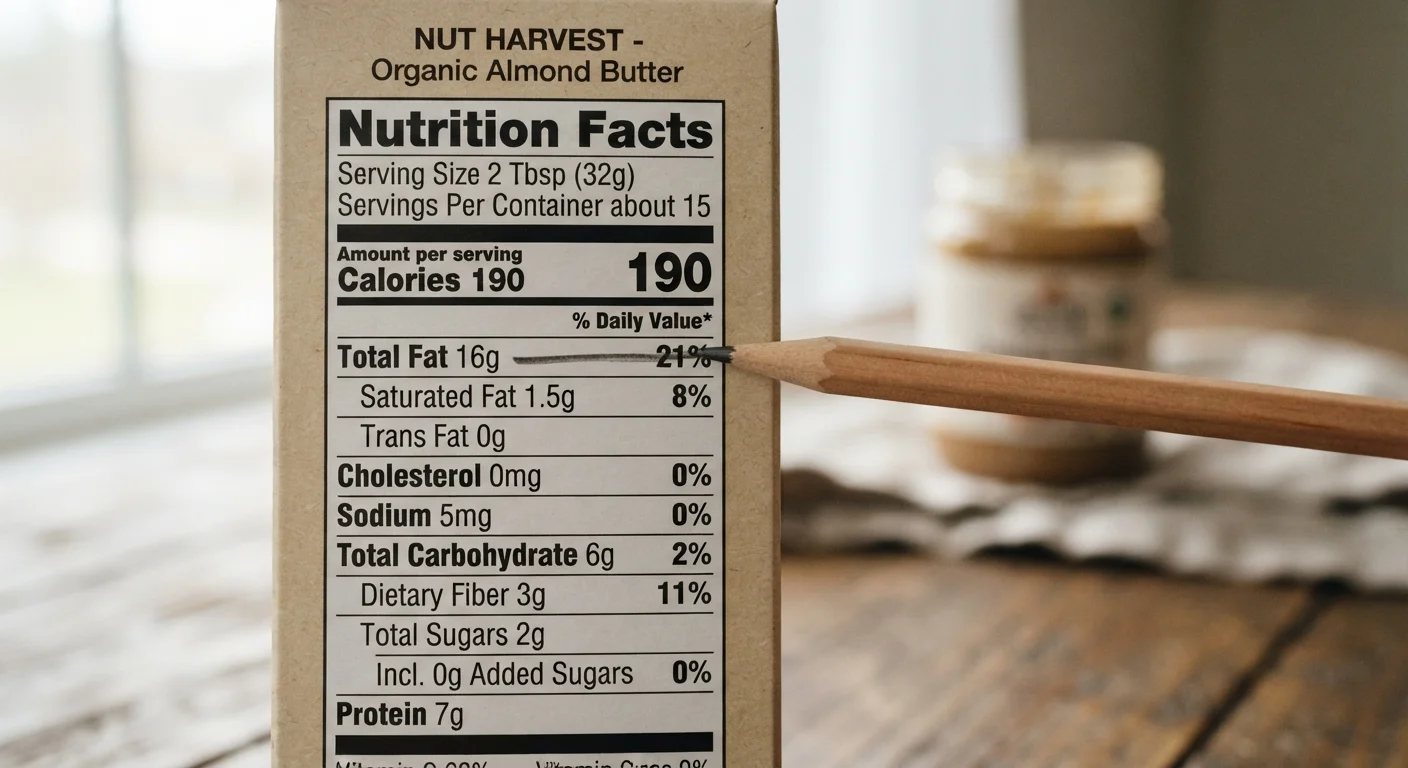
Before You Read the Numbers: Start with Serving Size
Every figure on a Nutrition Facts panel — calories, grams of fat, grams of protein — applies to one serving as defined by the manufacturer. If you eat two servings, every number doubles. This single detail trips up more label readers than any other, so always locate the Serving Size and Servings Per Container lines before looking at anything else.
The U.S. Food and Drug Administration updated serving-size rules to reflect amounts people realistically eat, so modern labels are more accurate than older ones. Still, verify the serving against your actual portion before drawing conclusions.
If you're new to thinking about macronutrients at all, our introduction to macronutrients covers the basics before diving into label reading.
What you will need
Locating Each Macronutrient on the Label
Once you have the serving size anchored, the three macronutrients appear in a predictable order on every standard U.S. label:
- Total Fat — listed in grams, with indented subcategories for saturated fat and trans fat directly beneath it.
- Total Carbohydrate — listed in grams, with indented subcategories for dietary fiber, total sugars, and (when applicable) added sugars.
- Protein — listed in grams, with no required subcategories on most labels.
Each of these lines also carries a % Daily Value (%DV) based on a 2,000-calorie reference diet. A quick rule of thumb: 5% DV or less is considered low for a nutrient; 20% DV or more is considered high. For nutrients you want to limit — saturated fat, trans fat, added sugars — lower %DV values are generally preferable. For nutrients like fiber, higher is usually better.
For a deeper look at when grams and percentages can point in opposite directions, see why grams and percentages tell different stories.
Identify the serving size and number of servings
Find the bold Serving Size line at the very top of the panel. Note the unit (e.g., 1 cup, 28 g, 2 tablespoons) and how many servings are in the container. Decide how many servings you plan to eat and keep that multiplier in mind for every number that follows.
Read Total Fat and its subcategories
Locate the Total Fat line and note the grams. Then check the indented lines beneath it:
- Saturated Fat — current dietary guidelines suggest keeping this relatively low as a share of total calories.
- Trans Fat — artificial trans fats have been largely removed from the U.S. food supply, but check this line; aim for 0 g.
Unsaturated fats are not required to be listed separately, but they make up the difference between total fat and the sum of saturated plus trans fat.
Read Total Carbohydrate and its subcategories
Find Total Carbohydrate in grams. Then review the indented subcategories:
- Dietary Fiber — contributes to digestive health and satiety; higher values are generally beneficial.
- Total Sugars — includes naturally occurring sugars (e.g., from fruit or dairy) and added sugars combined.
- Added Sugars — sugars and syrups added during processing; dietary guidelines recommend limiting these.
Starch is not required to be listed but can be calculated: Total Carbohydrate minus Total Sugars minus Dietary Fiber equals approximate starch grams.
Read Protein
Find the Protein line and note the grams per serving. Unlike fat and carbohydrates, protein has no required subcategories on standard labels. The %DV for protein is only required on labels making a protein-related claim or on foods marketed to children under four.
Use the gram amount to gauge how much protein a food contributes relative to your overall daily intake. General public health guidance in the U.S. suggests adequate protein across the day from varied sources, but individual needs differ based on age, activity level, and health status.
Use % Daily Value to assess the bigger picture
Scan the %DV column alongside each macronutrient. Remember that %DV is based on a 2,000-calorie reference diet — your actual needs may be higher or lower. Use these percentages to quickly compare products or to see whether a food is a meaningful source of a given nutrient rather than as a personal prescription.
Reading Macronutrients in Context
Raw numbers become meaningful only when you place them in context. A food with 20 grams of fat per serving might be nutrient-dense (think nuts or salmon) or heavily processed — fat type and overall ingredient quality both matter. For a plain-English breakdown of fat categories, see our guide on saturated, unsaturated, and trans fats.
Similarly, a high carbohydrate count dominated by dietary fiber looks very different nutritionally from the same gram count driven mostly by added sugars. Protein grams on a label give you a straightforward quantity, but the label alone won't tell you about amino acid completeness — that context comes from knowing the food source.
Compare Products on Equal Terms
When evaluating two similar products side by side, adjust for serving size before comparing macronutrient grams. A food with a smaller listed serving size will always appear lower in fat, carbs, and protein — even if a realistic portion is identical in weight to a competitor's larger stated serving. Normalizing to the same gram or cup amount gives you an honest comparison.
When comparing two products, hold serving sizes constant before comparing macronutrient grams — otherwise you're comparing apples to oranges. Evidence on whether a specific ratio of macronutrients is optimal is nuanced; our article on macronutrient ratios and the evidence behind them explores what the research actually shows.
Once you can read individual labels confidently, the natural next step is building eating habits that bring balanced macronutrients together across meals. Our guide on habits that support balanced eating offers practical, sustainable approaches without rigid tracking.
This article is for general informational and educational purposes only and does not constitute medical or dietary advice. Consult a qualified healthcare professional or registered dietitian for guidance tailored to your individual health needs.
The content on this site is for informational purposes only and is not a substitute for professional advice. Always consult a qualified professional for guidance specific to your situation.