

Two Columns, Two Different Questions
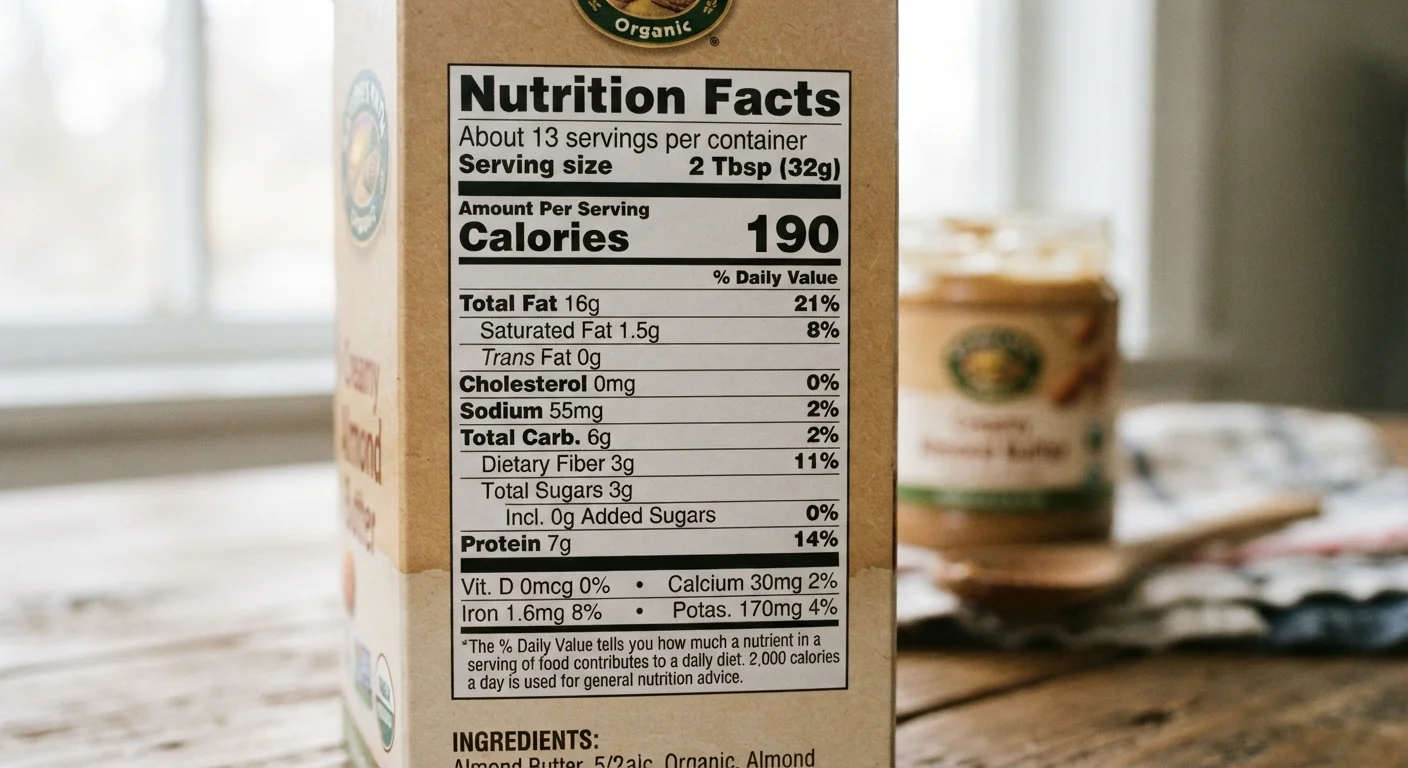
Pick up almost any packaged food and flip it over. The Nutrition Facts label lists each nutrient twice: once as a weight in grams and once as a percentage. Most people glance at one or the other and move on — but the two numbers are answering fundamentally different questions, and mixing them up leads to real confusion.
Grams answer: How much of this nutrient is in the food? The percentage answers: How much of what I'm supposed to eat in a day does this represent? Those are related questions, but they're not the same question — and that's exactly why a food can have what looks like a small gram count but a surprisingly high %DV, or a large gram count that barely registers as a percentage.
For a solid foundation on what each macronutrient actually does in the body, see Macronutrients Explained: What Proteins, Carbs, and Fats Actually Do.
Why the Same Nutrient Can Look Big or Small Depending on the Column
The key to understanding the disconnect is the Daily Value — the reference amount the FDA uses to calculate percentages. Daily Values are set for a 2,000-calorie diet and reflect established dietary guidance for the general population.
Here's where it gets interesting: the Daily Values for different nutrients vary enormously. The Daily Value for total fat is 78 grams. For sodium, it's 2,300 milligrams. For dietary fiber, it's 28 grams. Because those baselines differ, the math produces very different percentages for similar-looking gram amounts.
78 g
Daily Value for total fat
The FDA sets the Daily Value for total fat at 78 grams per day, based on a 2,000-calorie reference diet.
275 g
Daily Value for total carbohydrates
The carbohydrate Daily Value is 275 grams — meaning even large gram amounts of carbs can register as modest percentages.
2,300 mg
Daily Value for sodium
Sodium's Daily Value reflects the upper limit recommended by the Dietary Guidelines for Americans for the general adult population.
5% or 20%
FDA low vs. high %DV thresholds
The FDA's established benchmarks: 5% DV or less per serving is considered low; 20% DV or more is considered high for any nutrient.
Consider two examples side by side. A serving of food with 14 grams of fat represents 18% DV — a meaningful chunk. But 14 grams of total carbohydrates is only about 5% DV, because the carbohydrate Daily Value is 275 grams. Same weight, very different percentage. Neither number is wrong; they're just measuring against different yardsticks.
This is also why reading a nutrition label through a macronutrient lens requires knowing what each column is actually designed to show.
When to Use Grams and When to Use Percentages
Both columns are useful — they just shine in different situations.
Use grams when you need precision across the day. If you're tracking your total daily protein intake, for instance, grams give you a concrete, addable number. You can look at breakfast, lunch, dinner, and snacks, add the gram figures together, and know where you stand. Percentages don't add up neatly across meals the same way.
Use %DV for quick food comparisons. Standing in a grocery aisle comparing two brands of crackers? The %DV columns let you immediately see which one delivers more fiber or less sodium per serving without doing any math. The FDA's rule of thumb is straightforward: 5% DV or less is low, 20% DV or more is high.
It's also worth noting that protein is a partial exception — most Nutrition Facts labels do not list a %DV for protein, because the FDA doesn't require it for the general population. You'll typically only see the gram count there.
For a broader look at how macronutrient proportions play out across a whole diet, see what the evidence says about macronutrient ratios.
The 2,000-Calorie Baseline Is a Reference, Not a Rule
The most important context for %DV is this: the 2,000-calorie baseline is a regulatory convention chosen to make labels comparable across products — it isn't a calorie target for any individual. Some people need significantly more or fewer calories per day depending on their age, size, activity level, and health status.
That means if your energy needs differ substantially from 2,000 calories, the percentages on the label will be off-scale for you in one direction or the other. A 20% DV for fat doesn't mean the same thing for someone eating 1,400 calories a day as it does for someone eating 2,800.
This is especially relevant for children, older adults, pregnant or breastfeeding individuals, and people managing chronic health conditions — all of whom should rely on guidance from a qualified healthcare provider rather than standard label benchmarks alone. If you're just beginning to think about nutrition labels, our guide for people new to thinking about nutrition is a good starting point.
Labels for micronutrients like vitamins and minerals follow the same %DV logic — but with very different Daily Value numbers. Supplement labels use similar conventions but often cover a wider range of reference values and units.
This article is for general informational and educational purposes only and is not a substitute for professional medical or dietary advice. Consult a qualified healthcare provider for guidance tailored to your individual health needs.
Frequently Asked Questions
This happens when the Daily Value reference amount for that nutrient is large. For example, carbohydrates have a Daily Value of 275 grams, so even 30 grams of carbs only represents about 11% DV. The gram count looks significant, but relative to what most people need in a day, it's moderate.
The FDA uses these as general benchmarks. A %DV of 5% or less means a food is low in that nutrient per serving. A %DV of 20% or more means it's high. These thresholds help you quickly gauge whether a food is a significant source of a nutrient or not.
Not exactly. The %DV is calculated against a 2,000-calorie reference diet, which is a regulatory standard rather than a personalized recommendation. People with higher or lower calorie needs — including children, pregnant individuals, or those with specific health conditions — should consult a healthcare provider for personalized guidance.
The FDA does not require a %DV for protein on most food labels because protein deficiency is not considered a public health concern for the general U.S. population. Some labels do include it voluntarily or when a protein content claim is made.
Both serve different purposes. Use grams when you're tracking a specific amount of a nutrient across your whole day. Use %DV when you want a quick, at-a-glance comparison between foods or to gauge whether a serving is a little or a lot of a given nutrient.
The content on this site is for informational purposes only and is not a substitute for professional advice. Always consult a qualified professional for guidance specific to your situation.