

What Makes a Vitamin or Mineral 'Essential'?
A micronutrient is considered essential when your body cannot make enough of it on its own and must obtain it from food. Unlike macronutrients like proteins, carbs, and fats, vitamins and minerals are needed in small amounts — but their absence has outsized consequences for health. To understand how these nutrients function inside the body, see Vitamins and Minerals: What They Actually Do Inside Your Body.
Essential vitamins are divided into two categories: fat-soluble (A, D, E, K) — stored in body fat and liver — and water-soluble (C and all eight B vitamins) — which are not stored long-term and need regular replenishment. Minerals are similarly split between macrominerals (needed in larger amounts, like calcium and magnesium) and trace minerals (needed in tiny amounts, like iron and zinc).
Fat-soluble vitamins
Vitamins A, D, E, and K, which dissolve in fat and are stored in body tissues. Because they accumulate, excessive intake over time can reach harmful levels.
Water-soluble vitamins
Vitamin C and the eight B vitamins, which dissolve in water and are not significantly stored by the body. They need to be replenished regularly through food.
Macrominerals
Minerals the body needs in relatively larger amounts — typically more than 100 mg per day — including calcium, magnesium, phosphorus, potassium, and sodium.
Trace minerals
Minerals required in very small amounts — usually less than 100 mg per day — such as iron, zinc, iodine, selenium, and copper. Small does not mean unimportant.
Micronutrient
A collective term for vitamins and minerals — nutrients needed in small quantities that support virtually every physiological process in the body.
Antioxidant
A compound that helps neutralize unstable molecules called free radicals, which can damage cells. Several vitamins and minerals — including C, E, and selenium — act as antioxidants.
The Full Micronutrient Roster at a Glance
The table below summarizes each essential vitamin and mineral, its primary role in the body, and reliable everyday food sources. This is not an exhaustive medical reference — it is a practical starting point. For a broader look at the micronutrients many Americans fall short on, see Nutrients Americans Commonly Undereat — and Where to Find Them.
| Total essential vitamins | 13 (National Institutes of Health, Office of Dietary Supplements) |
| Essential minerals (macro + trace) | 16+ (Dietary Reference Intakes, National Academies of Sciences) |
| Most common U.S. micronutrient shortfalls | Vitamin D, calcium, potassium, dietary fiber (2020–2025 Dietary Guidelines for Americans) |
| Fat-soluble vitamins | A, D, E, K |
| Water-soluble vitamins | C, B1, B2, B3, B5, B6, B7, B9, B12 |
| Best overall dietary strategy | Eat a varied, whole-food diet across all food groups (2020–2025 Dietary Guidelines for Americans) |
| Micronutrient | Primary Role | Key Food Sources |
|---|---|---|
| Vitamin A | Vision, immune defense, skin integrity | Liver, sweet potato, carrots, spinach |
| Vitamin D | Calcium absorption, bone health, immune function | Fatty fish, fortified milk, egg yolks, sunlight exposure |
| Vitamin E | Antioxidant protection, immune support | Sunflower seeds, almonds, wheat germ oil |
| Vitamin K | Blood clotting, bone metabolism | Kale, broccoli, Brussels sprouts, fermented foods |
| Vitamin C | Collagen synthesis, antioxidant, immune function | Bell peppers, citrus, strawberries, broccoli |
| Thiamin (B1) | Energy metabolism, nerve function | Whole grains, pork, legumes |
| Riboflavin (B2) | Energy production, cellular growth | Dairy, eggs, lean meats, leafy greens |
| Niacin (B3) | DNA repair, energy metabolism | Poultry, tuna, peanuts, enriched grains |
| B6 | Protein metabolism, neurotransmitter synthesis | Chickpeas, salmon, potatoes, bananas |
| Folate (B9) | DNA synthesis, red blood cell formation | Lentils, spinach, asparagus, fortified cereals |
| B12 | Nerve function, red blood cell production | Meat, fish, dairy, fortified plant milks |
| Biotin (B7) | Fat and carbohydrate metabolism | Eggs, almonds, sweet potato, salmon |
| Pantothenic Acid (B5) | Hormone synthesis, energy metabolism | Avocado, sunflower seeds, mushrooms, chicken |
| Calcium | Bone structure, muscle contraction, nerve signaling | Dairy, fortified plant milks, sardines, tofu |
| Magnesium | Enzyme activity, muscle and nerve function | Nuts, seeds, whole grains, dark chocolate |
| Phosphorus | Bone and teeth structure, energy transfer | Meat, dairy, beans, nuts |
| Potassium | Fluid balance, blood pressure, heart rhythm | Bananas, potatoes, beans, leafy greens |
| Sodium | Fluid balance, nerve transmission | Table salt, processed foods (widely consumed) |
| Iron | Oxygen transport in blood | Red meat, lentils, spinach, fortified cereals |
| Zinc | Immune function, wound healing, enzyme activity | Oysters, beef, pumpkin seeds, legumes |
| Iodine | Thyroid hormone production | Iodized salt, seafood, dairy |
| Selenium | Antioxidant defense, thyroid health | Brazil nuts, tuna, eggs, sunflower seeds |
| Copper | Iron metabolism, connective tissue formation | Shellfish, nuts, seeds, whole grains |
| Manganese | Bone development, antioxidant enzyme function | Whole grains, nuts, leafy vegetables, tea |
| Chromium | Supports normal insulin function | Broccoli, whole grains, grape juice |
| Fluoride | Dental and bone health | Fluoridated water, tea, fish |
| Molybdenum | Enzyme cofactor for metabolism of certain amino acids | Legumes, grains, nuts |
Putting This Reference to Practical Use
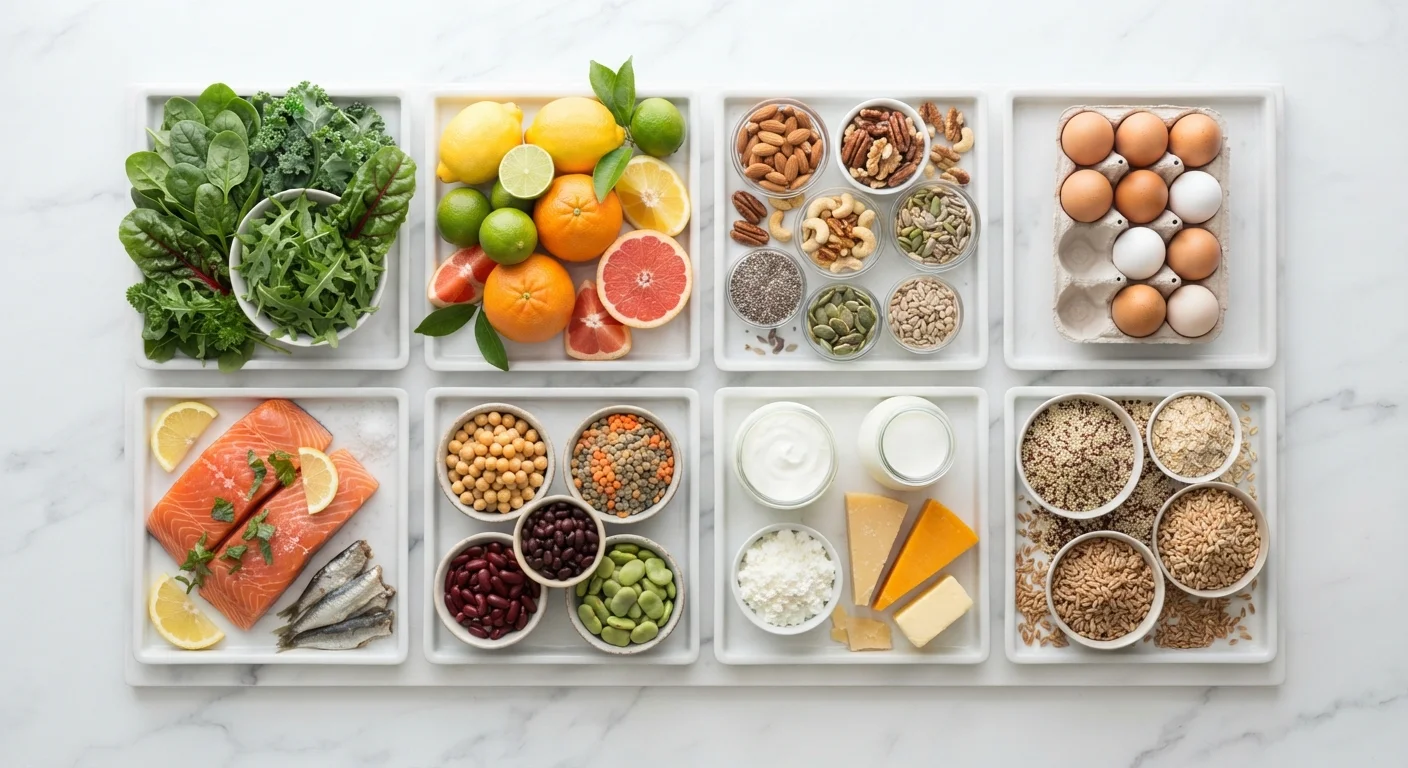
A reference chart is only as useful as the habits it informs. Variety is the most dependable strategy: eating across food groups — vegetables, fruits, whole grains, legumes, proteins, and dairy or fortified alternatives — naturally covers the majority of your micronutrient needs. No single food is nutritionally complete on its own.
Certain groups have heightened needs that warrant extra attention. People who are pregnant, breastfeeding, older adults, or managing a chronic health condition may have different requirements than the general population. Always consult a qualified healthcare professional before making significant changes to your diet or adding supplements. To build a practical meal approach around these nutrients, see Food First: Building Micronutrient Intake Through Everyday Meals.
Needs also shift across your lifespan. Children, teenagers, and older adults face notably different micronutrient demands — a topic explored in Micronutrient Needs Across Life Stages. And if you're just beginning to think about this topic, Micronutrients for Everyday Americans: A Starter's Overview offers a solid foundation.
This article is for general informational and educational purposes only and is not a substitute for personalized medical or dietary advice. Consult a qualified healthcare provider regarding your individual nutritional needs.
The content on this site is for informational purposes only and is not a substitute for professional advice. Always consult a qualified professional for guidance specific to your situation.