

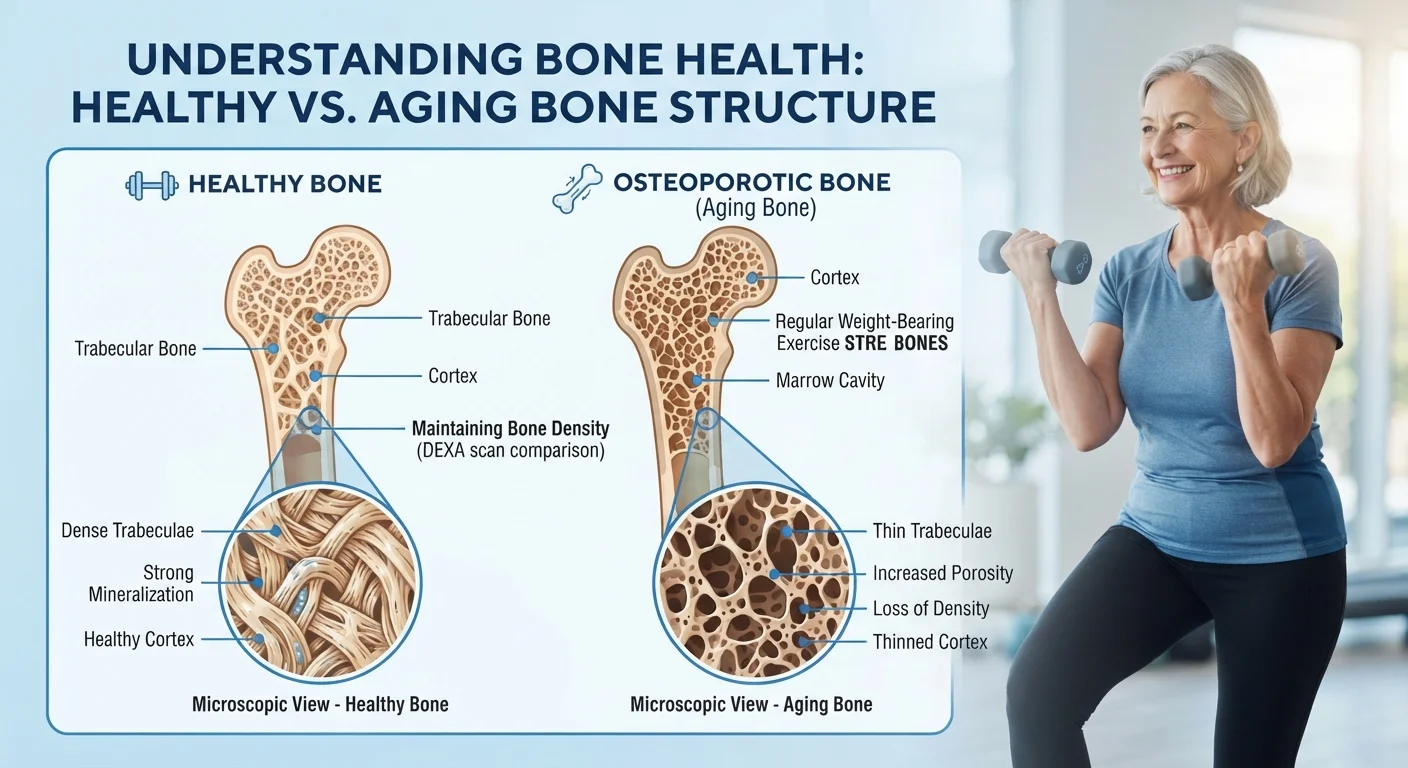
When Bone Mass Peaks — and Why It Matters
Most people don't think about their bones until something goes wrong. But skeletal health follows a predictable arc that begins long before any symptoms appear. The human skeleton reaches its maximum density — called peak bone mass — somewhere between the mid-20s and age 30. The higher that peak, the more reserve a person has against the natural losses that come later.
Genetics account for a substantial portion of peak bone mass, but lifestyle factors during childhood and young adulthood play a meaningful role. Regular physical activity, particularly weight-bearing and resistance exercise, stimulates bone formation. Adequate calcium and vitamin D intake provides the raw materials. Avoiding smoking and excessive alcohol use during these years also contributes to a stronger skeletal foundation.
For a broader picture of how the skeleton fits into overall physical change across adult life, see our decade-by-decade overview of physical aging.
~30
Age when peak bone mass is typically reached
According to the National Institutes of Health, most people reach maximum bone density between their mid-20s and age 30.
Up to 20%
Bone density women may lose around menopause
The National Osteoporosis Foundation notes that women can lose up to 20% of their bone density in the five to seven years following menopause.
10 million+
Americans estimated to have osteoporosis
The National Osteoporosis Foundation estimates that more than 10 million Americans have osteoporosis, with millions more in the osteopenia range.
The Decades of Decline: What Changes and When
After peak bone mass is achieved, a slow decline begins. Through the 30s, bone resorption (the process by which old bone is broken down) and bone formation remain roughly balanced, but formation gradually loses ground. By the early 40s, net bone loss typically begins in earnest.
The steepest drop for women occurs in the five to ten years surrounding menopause, driven largely by falling estrogen levels. Estrogen plays a critical role in regulating bone turnover; its decline removes a key brake on bone resorption. Some women lose up to 20% of their bone density during this window. Men experience a slower, steadier decline tied to gradual decreases in testosterone, typically becoming more pronounced after age 70.
Joint cartilage follows a somewhat different timeline. The rubbery tissue that cushions joints begins to thin and lose elasticity starting as early as the 40s, contributing to the morning stiffness and reduced range of motion many people notice in midlife. This is largely a mechanical and biochemical process, distinct from — though often occurring alongside — bone density changes.
Nutrition plays a central supporting role throughout these decades. How dietary needs shift from your 50s to your 80s is worth understanding in this context, as calcium and protein requirements remain significant well into later life.
Lifestyle Factors That Influence the Rate of Change
While age-related bone and joint changes are universal, the pace and severity vary considerably between individuals. Several modifiable factors influence how quickly or slowly these changes progress.
- Weight-bearing and resistance exercise: Activities such as walking, jogging, dancing, and strength training apply mechanical stress to bones, signaling them to maintain or increase density. Sedentary behavior accelerates loss.
- Calcium and vitamin D: These two nutrients work in tandem for bone mineralization. Dietary sources are generally preferred, though some people may require supplementation under medical guidance. For a detailed look at this relationship, see our article on calcium, vitamin D, and bone health after menopause.
- Smoking and alcohol: Both are associated with accelerated bone loss and are modifiable risk factors worth addressing at any age.
- Body weight: Being underweight is a risk factor for low bone density, while carrying excess weight places added stress on joint cartilage over time.
Movement also supports joint health by maintaining the circulation of synovial fluid — the lubricating fluid in joints — and preserving the muscle strength that reduces load on cartilage. How activity priorities shift across later decades provides practical context for staying appropriately active.
Monitoring, Testing, and When to Talk to a Doctor
Bone density loss is largely silent until a fracture occurs, which is why screening matters. A DEXA scan (dual-energy X-ray absorptiometry) is the standard clinical tool. It's painless, quick, and uses low levels of radiation to measure bone mineral density at the hip and spine — the two sites most predictive of fracture risk.
Clinical guidelines from organizations such as the U.S. Preventive Services Task Force recommend screening for women beginning at age 65, and for younger postmenopausal women with elevated risk factors. Men are typically screened starting at age 70, or earlier if risk factors are present. Your primary care provider is the right starting point for evaluating your individual situation.
It is also worth noting that bone health intersects with muscle health. Stronger muscles reduce fall risk, which is a key driver of fracture-related injury in older adults. Why muscle loss accelerates after 60 explores complementary strategies for preserving both strength and skeletal resilience.
This article is for general informational and educational purposes only and is not a substitute for professional medical advice, diagnosis, or treatment. Always consult a qualified healthcare provider with questions about your bone health, screening needs, or any symptoms you are experiencing.
Frequently Asked Questions
Bone density typically peaks around ages 25 to 30, then slowly begins to decline. For most people, the rate of loss is gradual through the 30s and 40s, but it can accelerate significantly during and after menopause in women, and more steadily in men after age 70.
Reversing significant bone loss is difficult, but slowing further loss is very achievable through weight-bearing exercise, adequate nutrition, and — when appropriate — medications prescribed by a physician. Some lifestyle interventions may produce modest gains in density, particularly in people who were previously sedentary or nutrient-deficient.
Osteopenia describes below-average bone density that is not yet in the clinical range for osteoporosis. Osteoporosis is a more advanced reduction in bone density that significantly raises fracture risk. Both are diagnosed through DEXA scanning and assessed using standardized T-scores.
Not exactly. Bone density loss and joint cartilage breakdown are related but distinct processes. Cartilage wear can begin in the 40s and 50s without significant bone density loss, while bone loss can progress in people with relatively healthy joint cartilage.
Major clinical guidelines generally recommend DEXA scans starting at age 65 for women and 70 for men. Earlier screening may be advised for those with risk factors such as long-term corticosteroid use, a family history of osteoporosis, or a history of fractures. Consult your doctor about your individual risk profile.
The content on this site is for informational purposes only and is not a substitute for professional advice. Always consult a qualified professional for guidance specific to your situation.