

Why Activity Needs Aren't Static After 60
Physical activity is one of the most studied levers for healthy aging, yet many older adults operate on a single, fixed idea of what exercise should look like — often borrowed from middle age. The reality is more nuanced. As the body changes across each decade of later life, what exercise does for you, what your body tolerates, and what outcomes matter most all shift in meaningful ways.
The U.S. Department of Health and Human Services' Physical Activity Guidelines for Americans recommend that adults aged 65 and older aim for at least 150 minutes of moderate-intensity aerobic activity per week, plus muscle-strengthening activities on two or more days. Those broad targets hold across older age groups, but the type, intensity, and purpose of movement that best serves a 62-year-old differ substantially from what suits someone at 78 or 84.
Understanding those shifts — grounded in how physiology actually changes — helps older adults set realistic goals, avoid injury, and stay motivated. For a broader look at the physical changes driving these shifts, see our decade-by-decade overview of physical aging.
When beginning or modifying a strength program in your 60s or 70s, focus first on mastering movement patterns with bodyweight alone before adding load. Correct mechanics protect joints and establish the neuromuscular patterns that make weighted exercise safer and more effective.
Poor form under load is a primary cause of exercise-related injury in older adults; establishing sound movement patterns first significantly reduces this risk.
For adults in their 70s and 80s, practicing balance exercises near a sturdy countertop or wall — close enough to touch if needed — allows more challenging progressions without fall risk.
A safety anchor reduces fear of falling during balance training, which allows individuals to practice at their actual ability edge rather than holding back excessively.
Track perceived exertion rather than pace or heart rate targets as your primary intensity gauge. Moderate effort — where you can hold a conversation but not sing — is the sweet spot for most aerobic sessions after 65.
Heart rate responses to exertion shift with age and can be affected by medications like beta-blockers, making perceived exertion a more reliable and accessible intensity guide for many older adults.
Movement in Your 60s: Building a Resilient Foundation
The early 60s are often a window of opportunity. Many people are relatively healthy, may be transitioning out of full-time work, and have more time to invest in physical wellbeing. This decade is when building — or reinforcing — strong movement habits pays the longest dividends.
Aerobic Capacity
Cardiovascular fitness naturally declines with age, but it remains highly trainable in the 60s. Brisk walking, cycling, swimming, and low-impact aerobics are well-tolerated and effective. The goal is to sustain moderate intensity — where conversation is possible but slightly labored — for accumulated periods throughout the week.
Strength Training
Sarcopenia, the age-related loss of muscle mass and strength, accelerates after 60. Research consistently shows that progressive resistance training — using weights, resistance bands, or bodyweight exercises — can meaningfully slow this process. Two to three sessions per week targeting major muscle groups (legs, hips, back, core, shoulders, arms) is a reasonable target for most people in this decade. See our companion article on bone density and joint health for context on why this matters structurally.
Flexibility and Mobility
Joint range of motion narrows with age. Incorporating stretching, yoga, or mobility work supports posture, reduces stiffness, and keeps daily movements fluid. These sessions don't need to be lengthy — even 10 to 15 minutes of deliberate stretching after aerobic activity is beneficial.
Movement in Your 70s: Shifting Priorities Toward Function
By the 70s, physiology has shifted noticeably. Reaction time slows, muscle mass continues declining even with training, and joint conditions such as osteoarthritis are more prevalent. This doesn't mean activity becomes less important — quite the opposite. But the emphasis often shifts from performance to functional fitness: the capacity to do what daily life requires safely and independently.
Balance Becomes Central
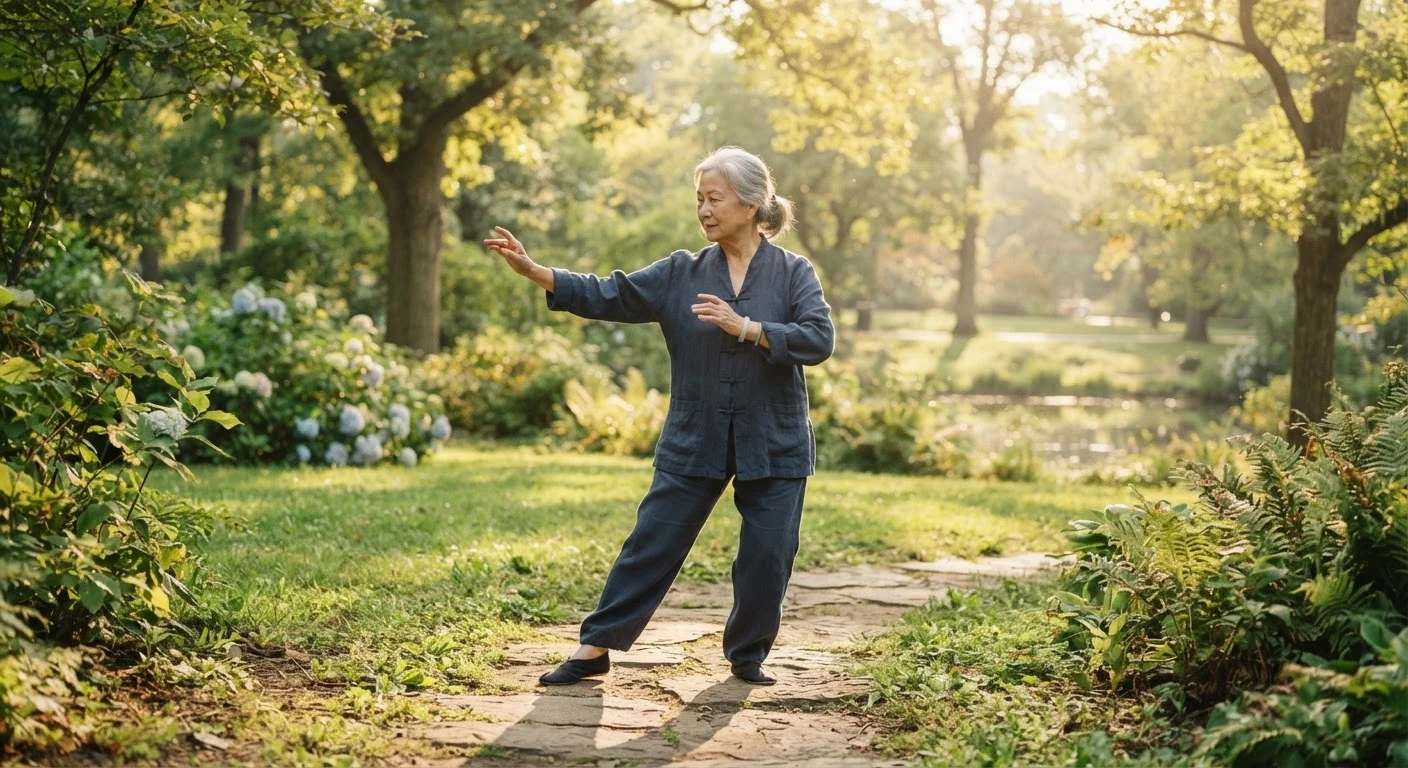
Falls are a leading cause of injury-related hospitalization among adults over 65. In the 70s, balance-specific training — tai chi, single-leg standing exercises, heel-to-toe walking — should move from optional add-on to core component. Evidence supports tai chi in particular as effective for fall reduction in this age group.
Resistance Training Remains Essential
Strength work doesn't stop mattering in the 70s — if anything, maintaining muscle becomes more urgent. The approach may need to adapt: lighter loads with more repetitions, longer recovery between sessions, and greater attention to form to protect joints. Working with a physical therapist or certified trainer experienced with older adults can be valuable here.
Aerobic Activity: Moderate and Consistent
High-intensity interval training may still be appropriate for some fit individuals in their 70s, but for many, sustained moderate activity — walking, water aerobics, cycling on flat terrain — delivers cardiovascular benefit with lower injury risk. Consistency matters more than intensity at this stage. For a nuanced look at impact levels, our article on low-impact vs. high-impact exercise after 65 is a useful reference.
Movement at 80 and Beyond: Preserving Independence
At 80 and beyond, the overarching goal of physical activity often crystallizes into a single theme: preserving the ability to live independently and safely. This means maintaining enough strength to rise from a chair, enough balance to walk without falling, and enough cardiovascular capacity to manage routine activities without excessive fatigue.
Functional Movements as the Core
Exercises that mirror real-life actions — chair squats, step-ups, reaching movements, and controlled walking on varied surfaces — are particularly valuable. These train the neuromuscular coordination required for everyday tasks, not just isolated muscle groups.
Reduced Volume, Maintained Frequency
Recovery takes longer at this age. Reducing session duration or intensity while maintaining frequency (moving most days of the week) tends to work better than long, infrequent workouts. Even short bouts of movement — 10 minutes of walking, gentle stretching in a chair — accumulate meaningfully over a week.
Social and Mental Dimensions
Group exercise classes, walking clubs, or community programs provide social engagement alongside physical benefit, which matters increasingly for cognitive health and motivation. The social infrastructure around movement can be as important as the movement itself.
Nutrition also plays a supporting role at every age. Our Healthy Aging Nutrition hub explores how dietary needs interact with activity across the later decades.
This article is for general informational and educational purposes only and does not constitute medical advice. Always consult a qualified healthcare provider before starting, modifying, or stopping any exercise program, especially if you have chronic health conditions, recent injuries, or other medical concerns.
Adapting Safely: What All Decades Have in Common
Despite the decade-specific shifts, several principles apply broadly across the 60s, 70s, and 80s.
- Start where you are. Fitness levels vary enormously among older adults. Someone new to exercise at 72 should begin conservatively, regardless of what peers their age are doing.
- Prioritize consistency over intensity. Moving regularly — even at modest effort — produces compounding benefits over time. Missing weeks due to injury from overexertion is counterproductive.
- Include all four domains. Aerobic fitness, muscular strength, balance, and flexibility each address different aspects of functional health. Neglecting any one domain creates gaps.
- Listen to the body's signals. Mild muscle soreness after strength training is expected; sharp joint pain, chest discomfort, or dizziness during exercise are not. These warrant stopping and consulting a physician.
- Work with professionals. Physical therapists, certified personal trainers with older-adult specializations, and physicians can all contribute to a safe, effective plan — particularly for those managing chronic conditions.
Use our Active Aging Checklist to evaluate whether your current habits cover all four domains. And for a broader perspective on how movement adapts across the decades, our companion guide walks through practical strategies from your 40s onward.
The content on this site is for informational purposes only and is not a substitute for professional advice. Always consult a qualified professional for guidance specific to your situation.