

Start here
Why Sleep Hygiene Matters for Long-Term Health
Next
Your Sleep Environment: The Foundation
Then
Timing and Routine: Anchoring Your Circadian Clock
Build on it
Daytime Habits That Shape Nighttime Sleep
If needed
When to Seek Professional Guidance
Why Sleep Hygiene Matters for Long-Term Health
Most of us know sleep matters, but fewer of us treat it with the same deliberate care we give to exercise or nutrition. Sleep hygiene — the set of practices that support regular, restorative rest — is where that gap starts to close. For a fuller picture of what the term actually encompasses, see what sleep hygiene really covers and why it's worth understanding from the ground up.
Poor sleep isn't just about feeling tired. Research in behavioral science and sleep medicine links chronic sleep deprivation to reduced cognitive function, mood dysregulation, impaired immune response, and diminished capacity to recover from physical and emotional stress. Resilience — the ability to adapt and bounce back — depends heavily on consistent, quality rest. Sleep isn't a passive break from life; it's when your brain consolidates memories, your muscles repair, and your stress-response system recalibrates.
The good news: many of the factors that undermine sleep are changeable. This guide walks you through the most evidence-supported starting points — no gadgets required.
Sleep hygiene
The set of daily behaviors and environmental conditions that influence how easily you fall asleep and how well you stay asleep through the night.
Circadian rhythm
Your body's internal 24-hour clock that regulates when you feel sleepy or alert, driven largely by light exposure and consistent daily timing.
Melatonin
A hormone produced by the brain in response to darkness that signals to the body it's time to prepare for sleep.
Sleep pressure
The biological drive to sleep that builds up the longer you've been awake — sometimes called homeostatic sleep drive — and is one reason consistent wake times support better sleep.
REM sleep
Rapid eye movement sleep is the stage most associated with dreaming and emotional memory processing; it makes up a significant portion of a healthy night's sleep and is easily disrupted by alcohol.
Sleep architecture
The pattern and sequence of sleep stages — light sleep, deep sleep, and REM — that cycle through the night; disruptions to this structure affect how rested you feel in the morning.
Your Sleep Environment: The Foundation
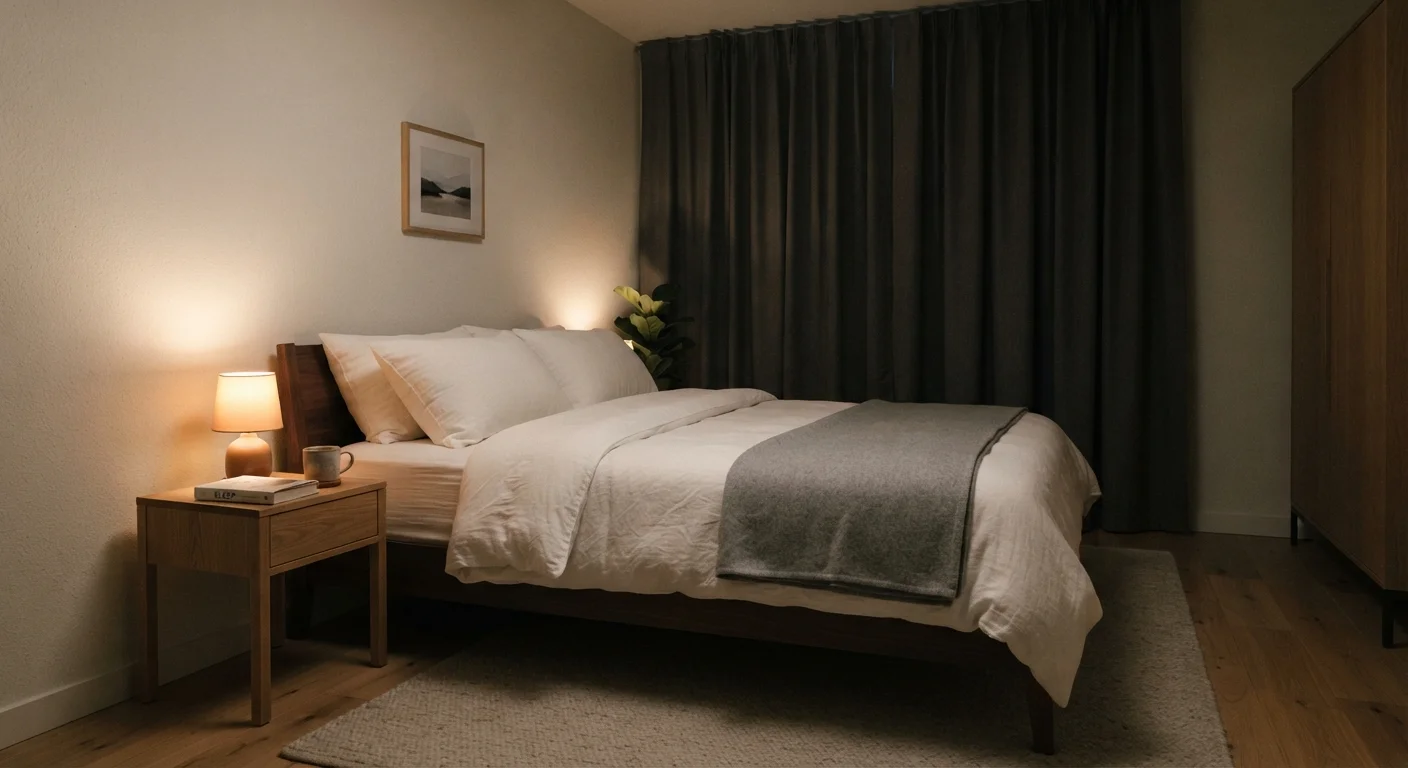
Your bedroom sends biological signals before you even close your eyes. Light, temperature, noise, and even clutter influence how easily your brain transitions into sleep mode.
- Light: Exposure to bright or blue-spectrum light in the evening suppresses melatonin — the hormone that signals your brain it's time to sleep. Dim your living space in the hour before bed, and consider blackout curtains if streetlights or early sunrises are a factor.
- Temperature: Your core body temperature needs to drop slightly to initiate sleep. A cooler room — generally somewhere in the mid-60s Fahrenheit — supports that process. Experiment to find what feels right for you.
- Noise: Unpredictable noise is more disruptive than steady background sound. White noise machines or earplugs can help mask intermittent disturbances like traffic or a partner's movements.
- Bed association: Using your bed only for sleep (and sex) strengthens your brain's learned association between lying down and sleeping — a principle drawn from cognitive behavioral approaches to insomnia.
Small adjustments here often yield noticeable results quickly, making environment one of the highest-leverage areas to address first.
Timing and Routine: Anchoring Your Circadian Clock
Your body runs on an internal clock — the circadian rhythm — that regulates sleep, wakefulness, hormone release, and dozens of other biological processes on roughly a 24-hour cycle. When your schedule is erratic, that clock drifts, and falling asleep or waking up at the right times becomes harder. To understand the biology behind this, learn what a consistent sleep schedule does to your circadian biology.
Anchoring your clock means going to bed and waking at the same time every day — including weekends. Even one or two nights of sleeping in can shift your rhythm enough to create Sunday-night insomnia and Monday-morning grogginess.
A wind-down routine in the 30–60 minutes before bed also matters. Activities that signal safety and calm — light reading, gentle stretching, a warm shower — help lower arousal and ease the transition toward sleep. Pairing mindfulness practices with this window can be especially effective; see our broader overview of mindfulness and rest for practical options.
Make Your Wind-Down Routine Non-Negotiable
Treat the 30–45 minutes before bed as protected time — not for catching up on work or scrolling social media, but for genuinely low-stimulus activities. Even reading a physical book, taking a warm bath, or listening to calm audio can meaningfully lower physiological arousal. Consistency matters more than the specific activity you choose.
Daytime Habits That Shape Nighttime Sleep
What you do during the day has a direct impact on your sleep that night. A few key areas:
- Caffeine: Caffeine has a half-life of roughly five to six hours in most adults, meaning a 3 p.m. coffee still has half its stimulant effect at 8 or 9 p.m. If sleep onset is a struggle, experimenting with an earlier caffeine cutoff — around noon or early afternoon — is a reasonable first step.
- Alcohol: Though alcohol can feel sedating, it fragments sleep in the second half of the night by suppressing REM sleep and causing more frequent arousals. Restorative sleep and regular alcohol use are difficult to reconcile.
- Physical movement: Regular physical activity is associated with better sleep quality, though vigorous exercise close to bedtime can be stimulating for some people. Morning or early-afternoon movement tends to be the most sleep-supportive timing.
- Food timing: Heavy meals close to bedtime can interfere with sleep comfort and digestion. For a research-grounded look at the relationship between eating patterns and sleep, see building a sleep-friendly diet.
When to Seek Professional Guidance
Sleep hygiene improvements help many people — but they aren't a cure for every sleep problem. If you've applied these strategies consistently for several weeks and still struggle to fall asleep, stay asleep, or feel rested, that's worth discussing with a healthcare provider.
Certain symptoms — including loud or irregular snoring, waking with a gasp or headache, or excessive daytime sleepiness that interferes with daily functioning — can indicate conditions like sleep apnea that go beyond lifestyle factors. Learn about the management approaches used for sleep apnea to understand what evaluation and treatment can look like. And if you're preparing for a medical appointment about sleep, knowing what to bring and what to say can make that conversation far more productive.
Sleep science also continues to evolve. For a deeper grounding in how sleep cycles, hormones, and circadian biology actually work, the complete guide to sleep science is a valuable companion to the practical habits here.
This article is for general informational purposes only and does not constitute medical advice. If you have concerns about your sleep or health, please consult a qualified healthcare professional.
Frequently Asked Questions
Sleep hygiene is the collection of behavioral and environmental habits that influence how well you sleep. It covers everything from your bedroom temperature and light exposure to your pre-bed routine and caffeine intake. Think of it as the foundation upon which consistent, quality rest is built.
Most people notice some improvement within one to two weeks of consistently applying good sleep practices. However, results vary significantly depending on what's disrupting your sleep in the first place. If you don't see progress after a few weeks, it's worth discussing the issue with a healthcare provider.
Yes — research consistently shows that a cooler room supports the drop in core body temperature that signals the brain to initiate sleep. Most sleep researchers point to a room temperature in the mid-60s Fahrenheit as a general target, though personal comfort varies. Experimenting with your thermostat is a simple, free adjustment worth trying.
Night mode reduces blue light emission but doesn't eliminate it entirely, and the stimulating content of most apps can keep your brain alert regardless of screen color temperature. The safest approach is to avoid screens for at least 30–60 minutes before bed. If that's not realistic, dim your screen fully and favor low-stimulus content.
Short naps of 20–30 minutes earlier in the afternoon can reduce daytime sleepiness without interfering with nighttime sleep for most people. Longer or later naps can reduce sleep pressure — your body's drive to sleep — making it harder to fall asleep at night. If nighttime insomnia is a concern, it's generally wise to limit naps.
If sleep difficulties persist despite consistent hygiene improvements, or if you experience symptoms like loud snoring, gasping during sleep, or extreme daytime fatigue, it's time to consult a healthcare professional. These can be signs of conditions such as sleep apnea that require medical evaluation rather than lifestyle changes alone.
The content on this site is for informational purposes only and is not a substitute for professional advice. Always consult a qualified professional for guidance specific to your situation.