

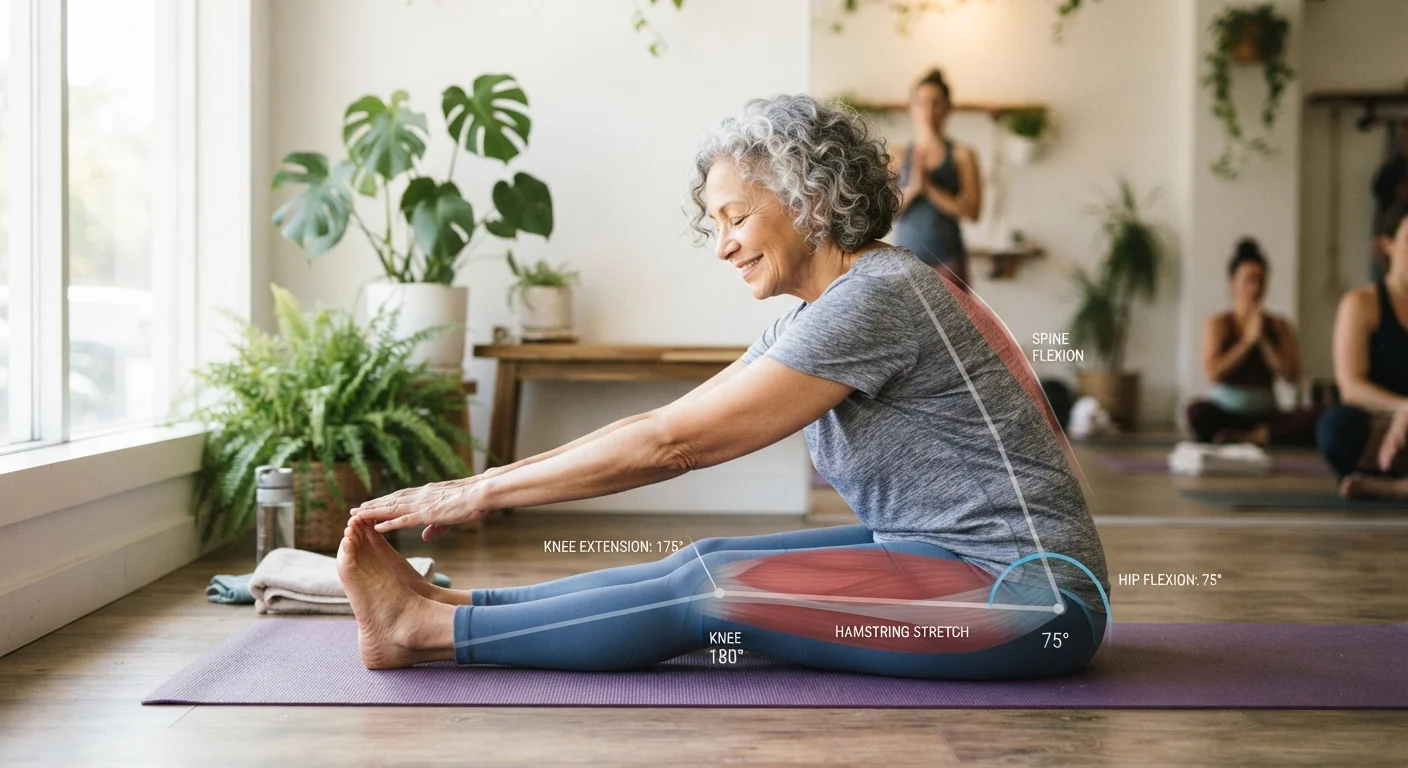
Why These Three Terms Are Not the Same
In fitness studios, physical therapy clinics, and online wellness content, the words mobility, flexibility, and range of motion are used almost interchangeably. This is a mistake — and for older adults working to maintain independence, the distinction matters considerably.
Each term describes a different physical quality. Confusing them can lead to training approaches that address only part of the problem. For example, someone with good passive flexibility may still struggle with functional mobility, and treating one as a proxy for the other may leave real movement limitations unaddressed.
For a broader foundation, see the complete reference on movement and mobility — this article focuses specifically on clarifying these three core terms.
Flexibility
The capacity of muscles and surrounding connective tissues to passively lengthen when an external force is applied. It does not require active muscle engagement and is a property of soft tissue, not of joints.
Range of Motion (ROM)
The measurable arc, typically expressed in degrees, through which a joint can move. ROM can be passive (externally assisted) or active (self-generated) and is influenced by both tissue flexibility and joint structure.
Mobility
The ability to actively move a joint through its available range using one's own muscular strength and neuromuscular control. Mobility is what translates physical capability into real-world functional movement.
Passive Flexibility
The degree to which soft tissues can lengthen when the body is relaxed and moved by an external force, such as a therapist or gravity. It reflects tissue pliability without active muscular involvement.
Neuromuscular Control
The coordination between the nervous system and muscles that allows precise, controlled movement. It is a critical component of mobility that declines with age and disuse if not actively maintained.
End-Range Strength
The muscular ability to generate and sustain force at the outermost positions of a joint's available motion. Weakness at end range is a common reason mobility lags behind flexibility.
Defining Each Term Precisely
Flexibility
Flexibility refers to the ability of soft tissues — primarily muscles and their surrounding connective tissue — to lengthen passively. When a physical therapist lifts your leg while you remain relaxed, they are testing your passive flexibility. It requires no active muscle control. Flexibility is a property of tissue, not of joints or movement systems.
Range of Motion
Range of motion (ROM) is a measurement — the degrees through which a joint can move, either passively (moved by an external force) or actively (moved by the person's own muscles). ROM is joint-specific and is often quantified with a goniometer in clinical settings. It reflects both the flexibility of surrounding soft tissues and the structural limits of the joint itself. ROM does not tell you whether a person can use that range in functional movement.
Mobility
Mobility is the ability to actively move a joint through its available range of motion with adequate strength and neuromuscular control. It encompasses flexibility but goes further: a person must be able to generate and control movement throughout the range, not merely be placed into a position passively. Mobility is what matters when rising from a chair, reaching overhead, or stepping over an obstacle.
For a direct side-by-side comparison, the article on mobility vs. flexibility explores how each quality independently affects movement.
How Age Changes Each Quality Differently
Aging affects flexibility, ROM, and mobility through distinct mechanisms, which is why a single intervention rarely addresses all three.
- Flexibility decreases as collagen fibers in tendons and muscle fascia become stiffer and less elastic. This process begins gradually in the fourth decade and accelerates without regular stretching and movement.
- Range of motion may narrow due to joint changes such as cartilage thinning, capsular tightening, or accumulated scar tissue — changes that are not fully reversible through stretching alone.
- Mobility often declines more steeply than flexibility because it also depends on muscle strength and neuromuscular coordination, both of which require deliberate training to maintain.
This means an older adult can have reasonably preserved passive flexibility — tissue that lengthens adequately when relaxed — while still lacking the active muscular control needed to use that range safely in daily tasks. Understanding what functional mobility actually means helps clarify why active control is the more clinically relevant target.
| Flexibility depends on | Muscle and connective tissue pliability |
| Range of motion is measured in | Degrees of joint arc (passive or active) (Standard clinical goniometry) |
| Mobility requires | Strength + flexibility + neuromuscular control |
| Primary flexibility decline begins | Approximately the fourth decade of life (General physiological consensus) |
| ROM can be limited by | Tissue stiffness, joint structure, or scarring |
| Static stretching primarily addresses | Passive flexibility — not active mobility |
Practical Takeaways for Everyday Movement
Recognizing these distinctions helps older adults — and those who support them — choose the right type of movement practice:
- Stretching alone builds flexibility, not mobility. Static stretching improves tissue length but does not train the nervous system to actively use new ranges.
- Mobility training requires active effort — movements like controlled joint circles, end-range strengthening, or resistance-based exercises that load muscles throughout their full range.
- ROM measurements are a snapshot, not a performance indicator. A clinician measuring your hip ROM is gathering one data point, not a complete picture of how well you move.
For a plain-language breakdown of additional movement terms, the key terms reference for mobility-focused individuals is a useful companion resource. Always consult a qualified physical therapist or healthcare provider before beginning a new movement program, particularly if you have existing joint conditions or pain.
This article is for general informational and educational purposes only and does not constitute medical advice. Consult a qualified healthcare professional for guidance tailored to your individual health needs.
The content on this site is for informational purposes only and is not a substitute for professional advice. Always consult a qualified professional for guidance specific to your situation.