

Why the Distinction Matters
Most people use "flexibility" and "mobility" as if they mean the same thing. They don't - and confusing them can lead to training gaps that show up as stiffness, limited movement, or injury over time.
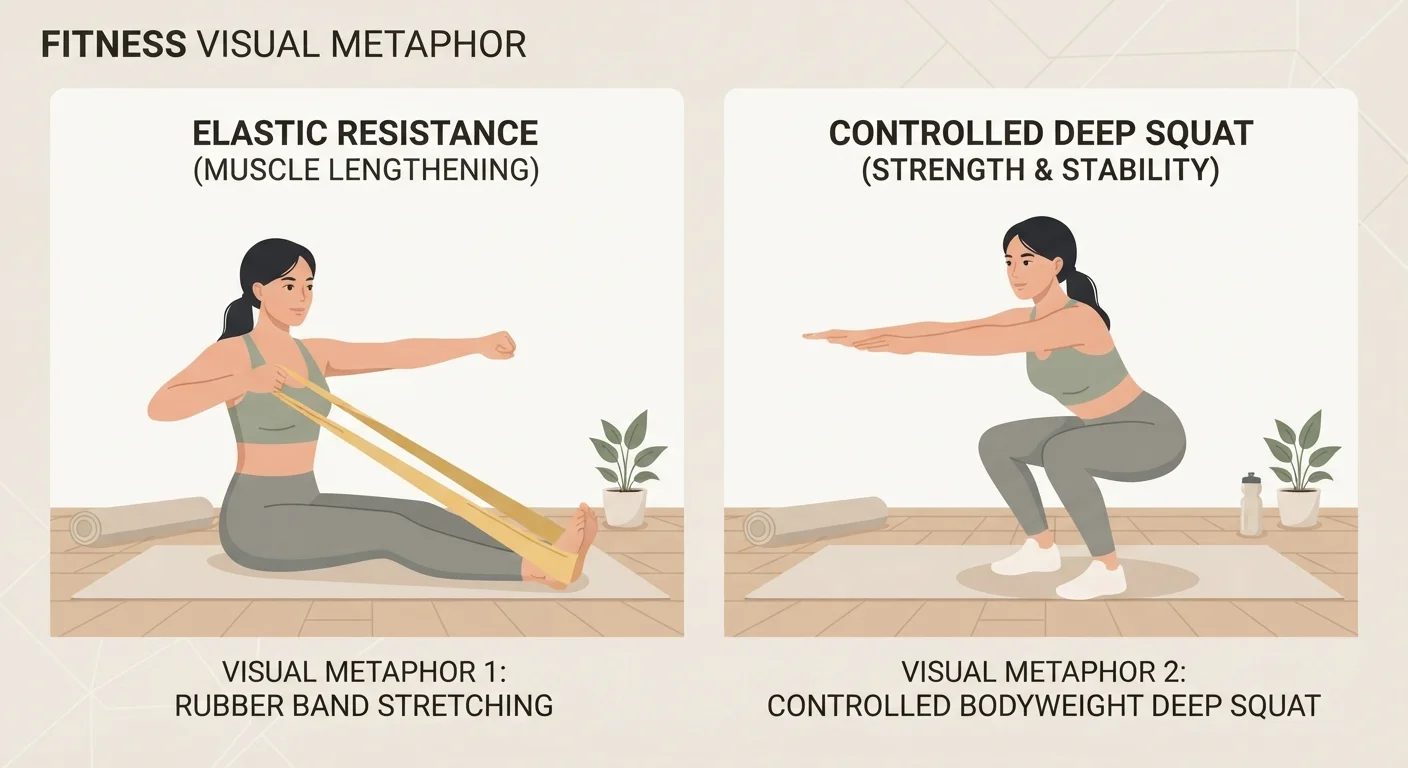
Think of it this way: flexibility is a property of soft tissue, while mobility is a functional capability of a joint. A gymnast may have extraordinary flexibility - their muscles lengthen easily under load - but an office worker with tight hips may have decent flexibility in their hamstrings yet struggle to perform a bodyweight squat with control. That gap is a mobility problem.
Understanding this distinction helps you train smarter. If you only stretch, you may gain tissue length without ever developing the active strength to use it. For a deeper look at how these ideas connect to healthy aging and everyday function, see what functional mobility actually means after 30.
Test Your Mobility, Not Just Your Flexibility
A simple self-check: can you perform a deep squat with your heels on the floor and arms overhead without losing your torso position? If you can stretch your hamstrings easily but struggle with this pattern, you likely have a mobility gap - not just a flexibility one. Active movement tests reveal more than static stretches.
Breaking Down Flexibility
Flexibility refers specifically to how much a muscle or connective tissue can elongate. It is typically assessed passively - meaning with help from gravity, a strap, or another person rather than your own muscular effort.
Common examples include a seated hamstring stretch, a standing quad stretch, or a doorway chest opener. In each case, an external force creates the range. Your muscles are not actively contracting to get you there.
Flexibility does matter. Adequate tissue length reduces mechanical stress on joints and allows for more natural movement. But on its own, it tells you only part of the story. Someone can be impressively flexible in a static stretch and still move poorly through the same range during an actual exercise or daily task.
For a plain-language breakdown of the terminology around these qualities, the key terms every mobility-focused person should know is a useful reference.
Breaking Down Mobility
Mobility adds an active dimension to flexibility. It is your ability to move a joint through its available range under your own muscular control - often while bearing load or maintaining a position against gravity.
A hip that is mobile can move through a deep squat pattern fluidly, hold a hip hinge position without collapsing, and rotate smoothly during walking. These are active demands. They require not just tissue length but neuromuscular coordination and strength at end ranges.
This is why mobility training often includes exercises like controlled articular rotations, tempo squats, or active hip circles - movements designed to build strength and awareness through full ranges of motion, not just stretch tissues passively.
80%
Adults with low back pain linked to mobility deficits
Research published in exercise science literature consistently identifies limited hip and thoracic mobility as contributing factors in non-specific low back pain in adults.
2x
Greater injury risk with passive-only stretching routines
Studies in sports medicine suggest that stretching without corresponding strength work through new ranges may not reduce injury risk as effectively as combined mobility training approaches.
For a thorough comparison of all three related concepts, mobility, flexibility, and range of motion are not interchangeable explores the distinctions in greater depth.
Building Both Into Daily Habits
You don't need a separate hour-long session for each quality. The most sustainable approach integrates both into your existing routine - and leverages everyday movement as training.
- Morning joint circles: Rotate your ankles, hips, shoulders, and neck through full ranges each morning. This is active mobility work that primes joints for the day.
- Static stretching after activity: Hold lengthening positions for 20-30 seconds when your tissues are warm. This builds flexibility and helps maintain tissue health.
- Strength through range: Exercises like Romanian deadlifts, deep squats, or overhead pressing train muscles to be strong where they are long - the key to usable mobility.
- Frequent positional changes: Sitting for long periods shortens hip flexors and limits thoracic movement. Breaking up sedentary time with brief movement snacks helps preserve range over the long term.
For a broader reference on building these habits into a lasting practice, see the complete reference for everyday physical health.
This article is for general informational and educational purposes only and is not a substitute for professional medical or fitness advice. If you have an injury, chronic condition, or specific health concern, consult a qualified healthcare or movement professional before beginning any new exercise practice.
Frequently Asked Questions
Yes. A person may have long, pliable muscles - measurable flexibility - but lack the active muscular control to use that range in movement. For example, someone might be able to passively push their leg high with assistance but struggle to lift it there independently. Mobility requires both range and strength.
For everyday function, mobility is generally considered more practically useful because it reflects what your body can actually do during movement. Flexibility contributes to mobility, but active control of your joints matters more for activities like walking, lifting, and bending safely.
Stretching can improve flexibility, which is one component of mobility. However, to translate that new range into real movement ability, you also need to strengthen muscles through that range. A combined approach - stretching plus active mobility work - tends to be more effective than passive stretching alone.
Most exercise science guidelines suggest that daily or near-daily movement practice yields better results than occasional long sessions. Even 10-15 minutes of purposeful movement - joint circles, active stretches, or light functional exercises - can support joint health over time. Consult a qualified fitness professional to tailor frequency to your goals.
They overlap but are not identical. Yoga emphasizes breath, flexibility, and often mindfulness, while dedicated mobility training focuses specifically on active joint control and end-range strength. See our <a href="/fitness-and-movement/movement-mobility/yoga-vs-dedicated-mobility-training-whats-the-difference-in-practice">comparison of yoga and mobility training</a> for a fuller breakdown.
The content on this site is for informational purposes only and is not a substitute for professional advice. Always consult a qualified professional for guidance specific to your situation.