

Why Balance Declines With Age — and Why It Can Be Reversed
Balance is not a single ability but the product of three interacting systems: the vestibular system in the inner ear, the visual system, and the proprioceptive system — the body's network of sensors in muscles and joints that detect position in space. All three tend to lose sensitivity and processing speed with age, which is why older adults can feel unsteady even in familiar environments.
According to the Centers for Disease Control and Prevention (CDC), falls are the leading cause of fatal and non-fatal injuries among adults 65 and older in the United States. However, this is not an inevitable consequence of aging. Numerous well-designed studies, including systematic reviews of exercise interventions in older populations, have found that targeted balance training can significantly reduce fall rates over time.
The key mechanism is neuromuscular adaptation — the brain and muscles learning to communicate faster and more precisely in response to postural challenges. This is the same principle that makes balance trainable at any age, though the process may be slower and require more consistency after 65. For a broader perspective on how movement needs shift across the later decades, see how movement needs change after 50.
Consult Your Doctor Before Starting
If you have a history of falls, a balance disorder, osteoporosis, or any chronic health condition, speak with your healthcare provider before beginning a new exercise program. This article provides general educational information only and is not a substitute for personalized medical advice. A physical therapist can assess your individual fall risk and design a program suited to your needs.
Tools and Setup
These exercises require minimal equipment. The most important element is a reliable support surface — not because you should rely on it throughout, but because having it available allows you to challenge your balance at the edge of your comfort zone safely.
What you will need
Sturdy chair or countertop
Provides a stable handhold during exercises to allow safe progression without fall risk.
Non-slip mat
Reduces slip risk on smooth floor surfaces during standing exercises.
Supportive footwear
Flat, close-fitting shoes with rubber soles help stabilize the foot during balance exercises.
The Balance Exercise Routine
Perform the following exercises in sequence. The complete routine takes roughly 10–20 minutes and is appropriate for most older adults beginning a balance program. Progress gradually — comfort and safety take precedence over speed of advancement.
Set Up a Safe Practice Space
Choose a clear area near a wall, sturdy chair, or fixed countertop. Remove loose rugs, cords, or clutter that could create a tripping hazard. Good lighting is essential — make sure the space is well-lit and easy to navigate. Have your support surface within arm's reach before you begin any exercise.
Practice Weight Shifting
Stand behind your chair with both hands lightly resting on the back. With feet hip-width apart, slowly shift your weight to your right foot, hold for 5 seconds, then shift to your left. Repeat 10 times per side. This exercise trains the small stabilizing muscles in your ankles and hips that are critical for preventing falls during everyday movement like turning or reaching.
Try the Single-Leg Stand
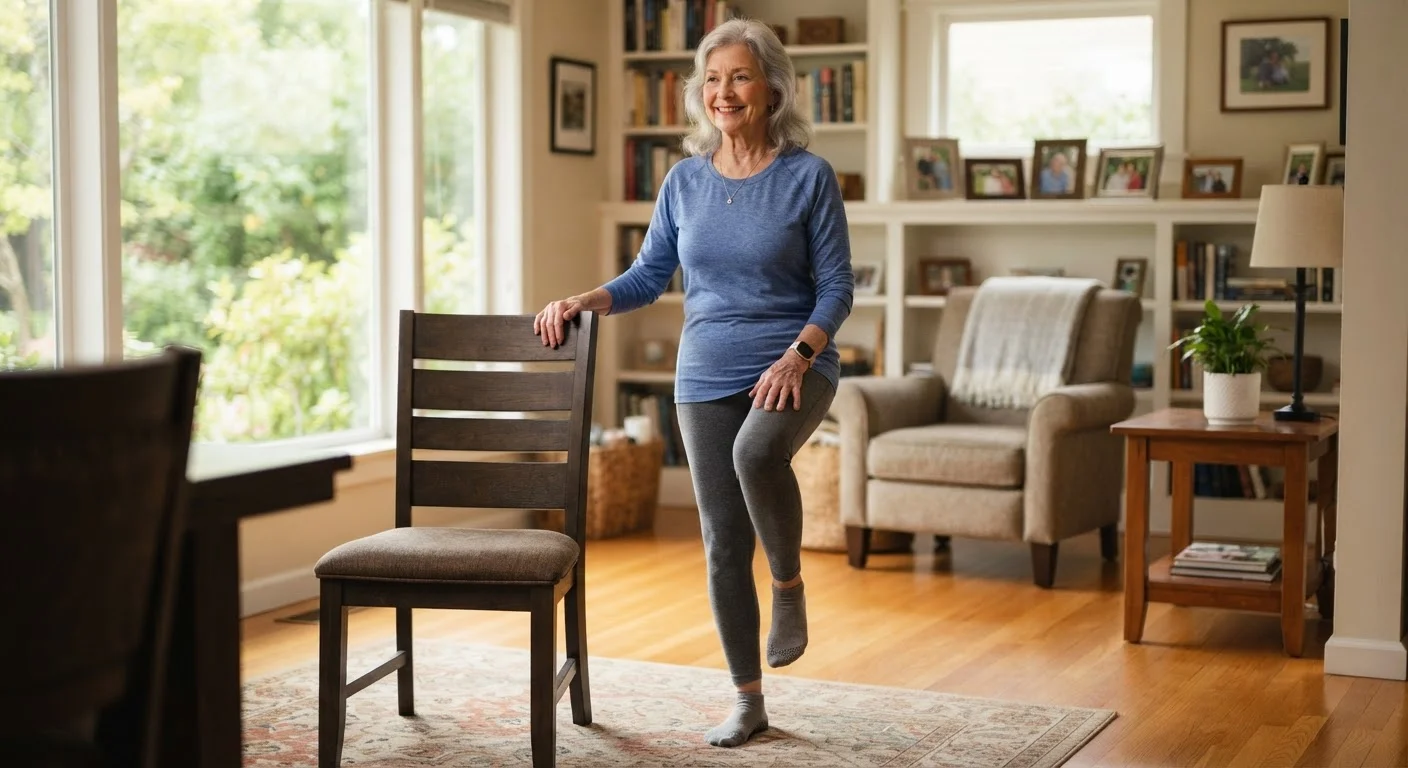
Holding the chair lightly for safety, lift one foot a few inches off the floor and balance on the other leg. Aim to hold for 10 seconds, working up to 30 seconds as your strength improves. Complete 3 repetitions per leg. Research published in geriatric medicine literature consistently identifies single-leg stance ability as one of the most reliable predictors of fall risk — improving it has direct real-world benefit.
Walk Heel-to-Toe Along a Line
Place one foot directly in front of the other so the heel of the leading foot touches the toes of the back foot. Walk slowly in a straight line for 10 steps, using a wall to your side for security if needed. This exercise strengthens the vestibular system's coordination with your muscles and mimics the narrow-base walking patterns that become hazardous in real environments like hallways and staircases.
Add Sit-to-Stand Transitions
Sit in a sturdy, armless chair with feet flat on the floor. Lean slightly forward, then press through your heels to stand — without using your hands if possible. Lower yourself back down slowly and with control. Aim for 10 repetitions. This movement trains the leg strength and postural control required for one of the most fall-prone daily transitions older adults face. See functional fitness guidance for older adults for more on exercises that mirror real daily tasks.
Finish With a Standing March
Holding your chair, lift your right knee to hip height, lower it, then lift your left. Alternate for 20 repetitions total. This dynamic exercise challenges balance while building hip flexor and core strength — both essential for clearing obstacles like curbs and thresholds. It also promotes circulation in the lower legs.
Consistency Matters More Than Duration
Even 10 minutes of balance practice daily produces cumulative benefit over weeks and months. Research supports short, frequent sessions over occasional longer workouts for building neuromuscular control. Consider pairing these exercises with an existing daily habit — after brushing your teeth or before lunch — to make them easier to sustain.
Building Balance Into a Broader Fitness Routine
Balance exercises are most effective when integrated with strength and functional movement work. Leg strength — particularly in the quadriceps, glutes, and calves — is directly linked to fall prevention because strong muscles can recover from a stumble before it becomes a fall. Consider pairing this balance routine with strength training guidance for older adults for a more complete approach.
Beyond formal exercise, everyday movement habits — standing while talking on the phone, taking the stairs, or simply walking more — accumulate meaningful stability benefits over time. To evaluate whether your current routine adequately addresses balance alongside other fitness dimensions, the active aging checklist can serve as a useful self-assessment tool.
This article is for general informational and educational purposes only and does not constitute medical advice. Always consult a qualified healthcare professional before beginning a new exercise program, especially if you have a history of falls, balance disorders, or chronic health conditions.
The content on this site is for informational purposes only and is not a substitute for professional advice. Always consult a qualified professional for guidance specific to your situation.