

Why These Three Variables Matter
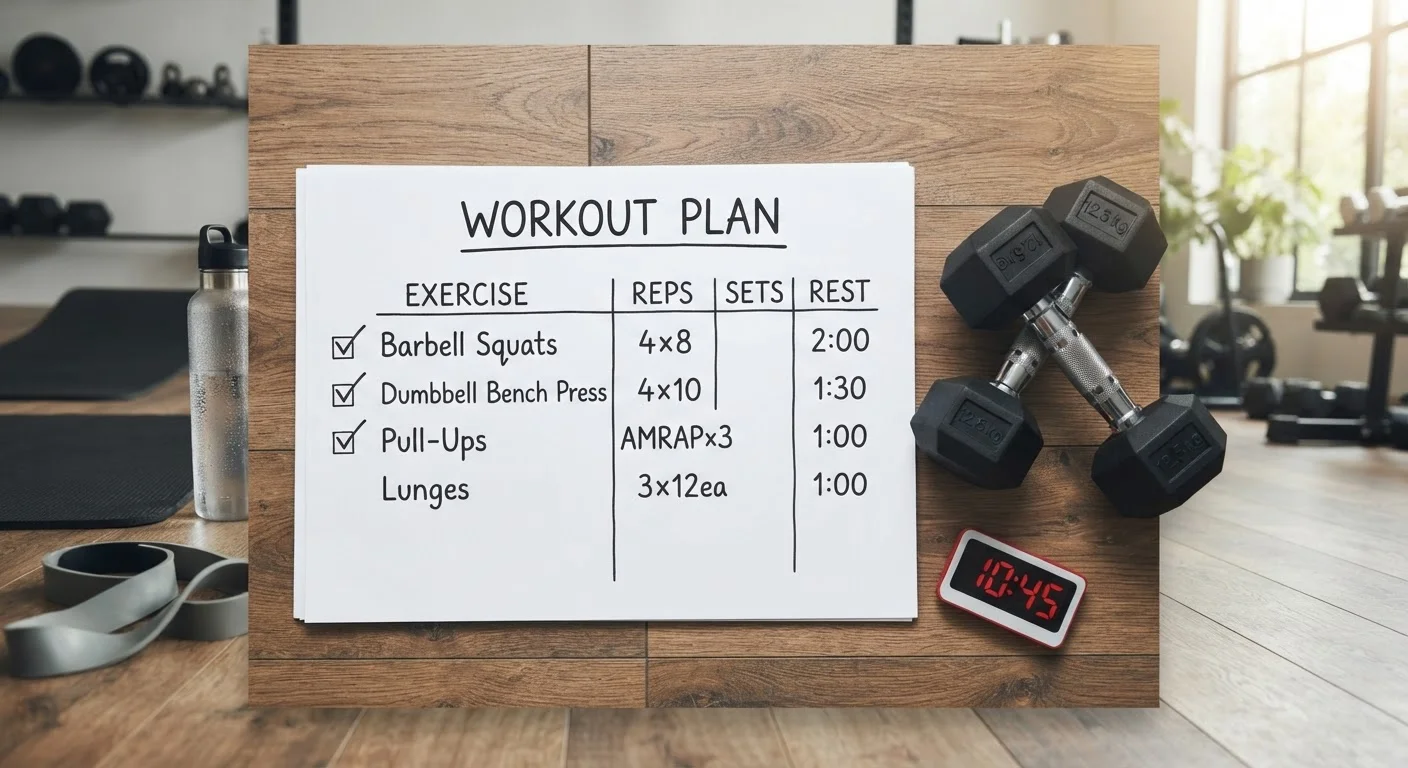
Walk into any gym, open any fitness app, and you'll see workout instructions built around three numbers: how many times to do a movement (reps), how many rounds of that movement to complete (sets), and how long to pause between rounds (rest). Together, these three variables are the primary levers of resistance training — and understanding what each one actually does gives you the ability to train with intention rather than guesswork.
If you've ever wondered why some programs call for 3 sets of 12 reps while others prescribe 5 sets of 5, the answer lies in what each combination is designed to produce. To get a fuller picture of how the body responds to these inputs, see how exercise works at a physiological level.
| Primary purpose of reps | Determines the physical quality trained (strength, size, or endurance) |
| Primary purpose of sets | Accumulates total training volume to drive adaptation |
| Primary purpose of rest | Controls recovery between sets to shape the nature of the stimulus |
| Strength-focused rep range | 1–5 reps at high resistance (General exercise science consensus) |
| Hypertrophy-focused rep range | 6–12 reps at moderate resistance (General exercise science consensus) |
| Endurance-focused rep range | 13–20+ reps at lower resistance (General exercise science consensus) |
| Typical rest for strength work | 2–5 minutes between sets |
| Typical rest for hypertrophy | 60–90 seconds between sets |
Reps: The Basic Unit of Effort
A repetition (rep) is one complete execution of an exercise — one squat, one push-up, one curl. The number of reps you perform in a given set directly influences what physical quality you're developing.
- Low reps (1–5): Training at or near your maximum capacity. Primarily develops maximal strength and neuromuscular efficiency. Typically paired with heavier resistance.
- Moderate reps (6–12): The classic hypertrophy range, where muscle size tends to increase most efficiently. Balances mechanical tension and metabolic stress.
- Higher reps (13–20+): Builds muscular endurance — the muscle's ability to sustain effort over time. Often uses lighter loads and produces a significant cardiovascular demand.
These ranges aren't rigid boundaries; they describe tendencies based on exercise science. Outcomes also depend on how much effort you bring to each set — a set of 15 done casually produces different results than one taken close to failure. For help understanding effort levels, see our guide on measuring workout intensity.
Sets: Volume and Accumulated Stimulus
A set is a group of consecutive reps performed without stopping. If reps are the basic unit of effort, sets are how you accumulate enough total training stimulus to drive adaptation.
Training volume — the total amount of work done — is one of the most reliably documented drivers of muscle and strength development. More sets generally means more volume, but there are meaningful trade-offs:
- 1–2 sets per exercise: Appropriate for beginners or as a maintenance strategy. Research suggests even a single hard set can produce measurable adaptation in untrained individuals.
- 3–5 sets per exercise: The most common range for general fitness goals, balancing stimulus with recovery demand.
- 6+ sets per exercise: Typically used in advanced programming where high volume is periodically emphasized. Comes with greater recovery cost.
Across a full workout, the total number of sets you accumulate per muscle group per week is a key variable to track as you advance. Beginners generally respond well to lower weekly volumes; intermediate and advanced trainees typically require more to continue progressing.
Rest: The Variable Most People Underestimate
Rest intervals — the time you pause between sets — are not filler time. They determine how recovered your muscles and energy systems are when the next set begins, which in turn shapes the quality and nature of that set's stimulus.
- Short rest (30–60 seconds): Muscles haven't fully recovered, so fatigue accumulates. This increases metabolic stress and cardiovascular demand. Common in circuits and endurance-focused programs.
- Moderate rest (60–90 seconds): A middle ground used frequently in hypertrophy-focused training. Enough recovery to maintain rep quality without fully clearing fatigue.
- Longer rest (2–5 minutes): Allows near-complete recovery of the phosphocreatine energy system. Essential for maximal strength work, where maintaining force output across sets is the priority.
Cutting rest short when training for strength can undermine performance on subsequent sets. Conversely, resting too long in metabolic or endurance circuits reduces the intended stimulus. Rest is a deliberate training choice — not an afterthought. To understand what's actually happening in your body during recovery periods, see what happens during rest and recovery.
This article is for general informational and educational purposes only. It is not a substitute for personalized guidance from a qualified fitness professional or medical advice from a licensed healthcare provider. Consult a professional before beginning any new exercise program, especially if you have an existing health condition or injury.
The content on this site is for informational purposes only and is not a substitute for professional advice. Always consult a qualified professional for guidance specific to your situation.