

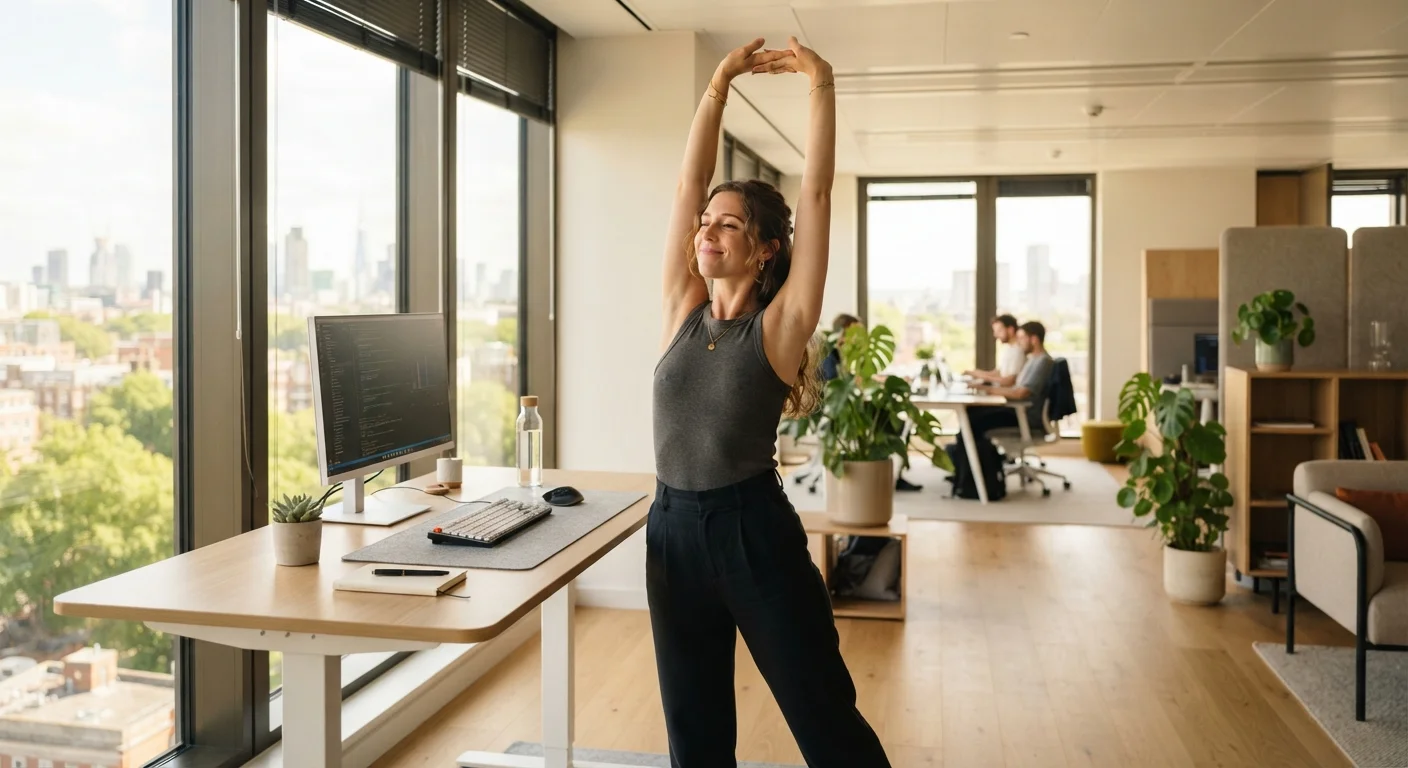
Why Desk Workers Need a Movement Reset
Most adults spend six to ten hours a day seated. Over time, that sustained posture creates a predictable pattern of tightness and weakness: hip flexors shorten, the thoracic spine (the mid-back) loses its natural curve, and the muscles around the shoulders and neck become chronically overloaded. What prolonged sitting does to your body goes beyond discomfort - it gradually affects circulation, joint loading, and how your nervous system registers posture.
The good news is that the solution doesn't require a gym membership or a long lunch break. Research in exercise science consistently supports the idea that frequent, short movement breaks are more effective at countering sedentary effects than a single, longer session later in the day. The goal of this routine is to give you a practical, repeatable sequence you can use throughout your workday.
Before you begin, it's worth noting that if you have a known back condition, joint injury, or chronic pain, consult a qualified healthcare professional before starting any new movement routine. This content is general health information, not medical advice.
What You'll Need Before You Start
This reset is designed to require as little as possible. Review the tools and prerequisites below, then move on to the step-by-step routine.
What you will need
Stable chair or desk edge
Used as a light support point during the standing hip flexor stretch to maintain balance.
Phone or computer timer
Set recurring 45-60 minute alerts to prompt each movement break consistently.
Foam roller or rolled towel
Can be placed along the thoracic spine for a passive chest-opener if available, though the routine works without it.
The Step-by-Step Daily Movement Reset
Perform this sequence once every 45-60 minutes during your workday, or at minimum twice: once mid-morning and once mid-afternoon. Each move flows into the next, so you can complete the full reset in under five minutes without changing clothes or leaving your immediate workspace.
Stand Up and Take a Full Breath
Push back from your desk and stand up fully. Place your feet hip-width apart. Inhale slowly through your nose for four counts, expanding your ribs outward, then exhale completely for four counts. Repeat three times.
This is not a filler step. Sustained sitting tends to encourage shallow chest breathing. Deliberately resetting your breath helps activate your diaphragm and signals your nervous system to downshift from a tense, forward-focused state.
Thoracic Rotation Stretch
Remain standing (or sit at the edge of your chair with feet flat). Cross your arms over your chest and slowly rotate your upper body to the right as far as is comfortable. Hold for two seconds, then return to center. Rotate left. That's one repetition. Complete five on each side.
The thoracic spine - roughly from the base of your neck to the bottom of your ribcage - is the segment most prone to stiffening during desk work. Gentle rotation helps restore its normal range of motion and reduces the compressive load transferred to your lower back and neck.
Standing Hip Flexor Stretch
Step your right foot forward into a staggered stance, keeping your torso upright. Gently push your left hip forward while squeezing your left glute (the buttock muscle on the back leg's side) until you feel a mild stretch at the front of the left hip. Hold for 20-30 seconds, then switch sides.
The hip flexors - particularly the iliopsoas - are in a shortened position the entire time you sit. Regularly lengthening them helps reduce anterior pelvic tilt, a postural shift that can contribute to lower back tension over time.
Shoulder Blade Retraction and Depression
Stand or sit tall. Draw both shoulder blades back and downward - imagine you're trying to tuck them into your back pockets. Hold for three seconds, then release fully. Repeat ten times.
Forward head posture and rounded shoulders are common byproducts of keyboard and screen use. This movement re-engages the lower trapezius and rhomboids, muscles that tend to become inhibited and elongated from sustained forward-reaching posture.
Neck Half-Circle Release
Gently drop your chin toward your chest. Slowly roll your head to the right until your right ear approaches your right shoulder. Pause for two seconds, then roll back through center and to the left. Complete three slow passes in each direction. Do not roll your head backward - this compresses the cervical spine and is generally not recommended.
This movement addresses neck tension that accumulates from sustained forward gaze at a monitor, particularly when the screen is positioned too low or too far to one side.
For a broader look at how to structure movement throughout your entire workday, see our realistic framework for office-bound adults.
Making the Habit Stick
The biggest obstacle for most desk workers isn't the routine itself - it's remembering to do it. A few strategies that exercise behavior researchers commonly recommend: set a recurring calendar alert or phone timer, link the reset to an existing cue (such as every time you finish a meeting or refill your water), and keep your expectations low at first. Two moves done consistently beats a perfect routine done twice.
It's also worth revisiting some of the assumptions you hold about posture and sitting. Many popular beliefs - like the idea that you must always sit perfectly upright - are not as well-supported as you might think. Our article on common posture myths unpacks what the evidence actually says.
Finally, be aware that some everyday movement habits can inadvertently stress joints over time. If you want to audit your broader movement patterns beyond the workday, movement habits that quietly damage your joints is a useful companion read.
This article is for informational purposes only and is not a substitute for professional medical advice. If you experience pain, numbness, or other concerning symptoms, stop the activity and speak with a qualified healthcare provider.
The content on this site is for informational purposes only and is not a substitute for professional advice. Always consult a qualified professional for guidance specific to your situation.