

Why Sitting All Day Is Its Own Health Risk
Most people understand that regular exercise supports long-term health. What's less intuitive is that sitting for long, unbroken stretches carries its own risks - separate from whether you exercise at all. Research published in journals including Annals of Internal Medicine suggests that prolonged sedentary time is associated with increased risk of cardiovascular disease, metabolic dysfunction, and all-cause mortality, even among people who meet weekly physical activity guidelines.
This doesn't mean your gym sessions are wasted. It means the hours between workouts matter too. For the average office worker logging six to nine hours of seated work daily, that's a meaningful gap worth addressing - not with guilt, but with practical strategy.
If you've ever felt stiff by mid-afternoon or sluggish after a full day at your desk, that's your body signaling exactly this. The goal isn't to transform your workspace into a gym - it's to thread movement through the hours you're already living. See our desk worker's daily movement reset for a structured routine you can use throughout your workday.
Best Practices for Building Movement Into a Desk-Bound Day
The following practices are grounded in exercise science and behavioral research. None require special equipment or a dramatic schedule overhaul - they're designed to fit inside the workday you already have.
Break sitting time with a brief movement reset every 30 to 60 minutes.
Research consistently shows that interrupting sedentary time - even with just a few minutes of light activity - can reduce spikes in blood glucose, support circulation, and ease musculoskeletal tension. Setting a recurring reminder removes the reliance on willpower. Over an eight-hour workday, these breaks add up to a meaningful volume of movement.
Treat walking meetings as a default when the format allows.
Audio-only calls - check-ins, one-on-ones, brainstorming sessions - rarely require a screen. Walking during these calls converts otherwise sedentary time into light-intensity movement without sacrificing productivity. Many people also report that movement supports clearer thinking during conversation.
Use transitions deliberately as movement opportunities.
The moments between tasks - grabbing coffee, moving between meetings, heading to the restroom - are already built into your day. Slightly lengthening these transitions (taking the long route, using a farther bathroom or printer) requires no extra time commitment and adds light activity without disrupting focus.
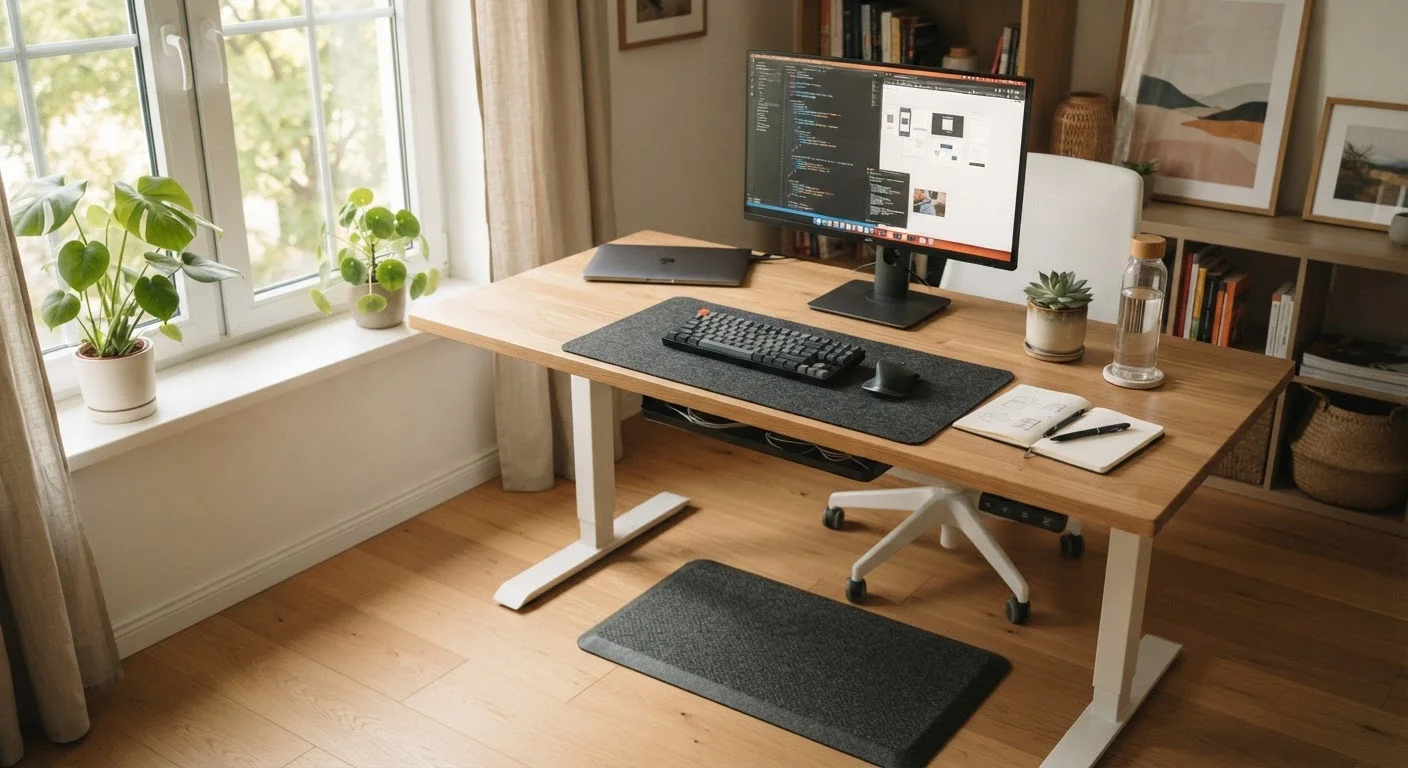
Alternate between sitting and standing throughout the day rather than standing all day.
Prolonged standing has its own drawbacks - fatigue, lower-limb discomfort, and varicose vein risk - so the goal isn't to replace sitting with continuous standing. Research supports posture variety: rotating between seated, standing, and moving positions reduces cumulative strain on any single muscle group or joint.
Anchor movement habits to existing daily cues.
Behavior research consistently shows that attaching new habits to established routines - a technique called 'habit stacking' - increases follow-through significantly. Your day already has reliable anchors: morning log-in, lunch break, afternoon coffee, end-of-day shutdown. Tying a movement behavior to each one creates structure without additional planning.
If you don't currently think of yourself as an active person, these small pivots are a genuinely effective starting point. Our companion piece on active living for non-athletes explores this mindset shift in depth.
Start Here: Quick Wins for Today
Before overhauling your entire routine, start with changes that take under five minutes to implement. The actions below have a disproportionate effect relative to their effort - they lower the activation barrier and build momentum for bigger habits over time.
Pair these micro-changes with a broader daily audit. Our daily wellness audit for busy adults helps you track movement alongside sleep, nutrition, and stress in one realistic framework.
This article is for general informational purposes only and is not a substitute for personalized medical or fitness advice. Consult a qualified healthcare professional before starting any new exercise program, especially if you have a chronic health condition.
The content on this site is for informational purposes only and is not a substitute for professional advice. Always consult a qualified professional for guidance specific to your situation.