

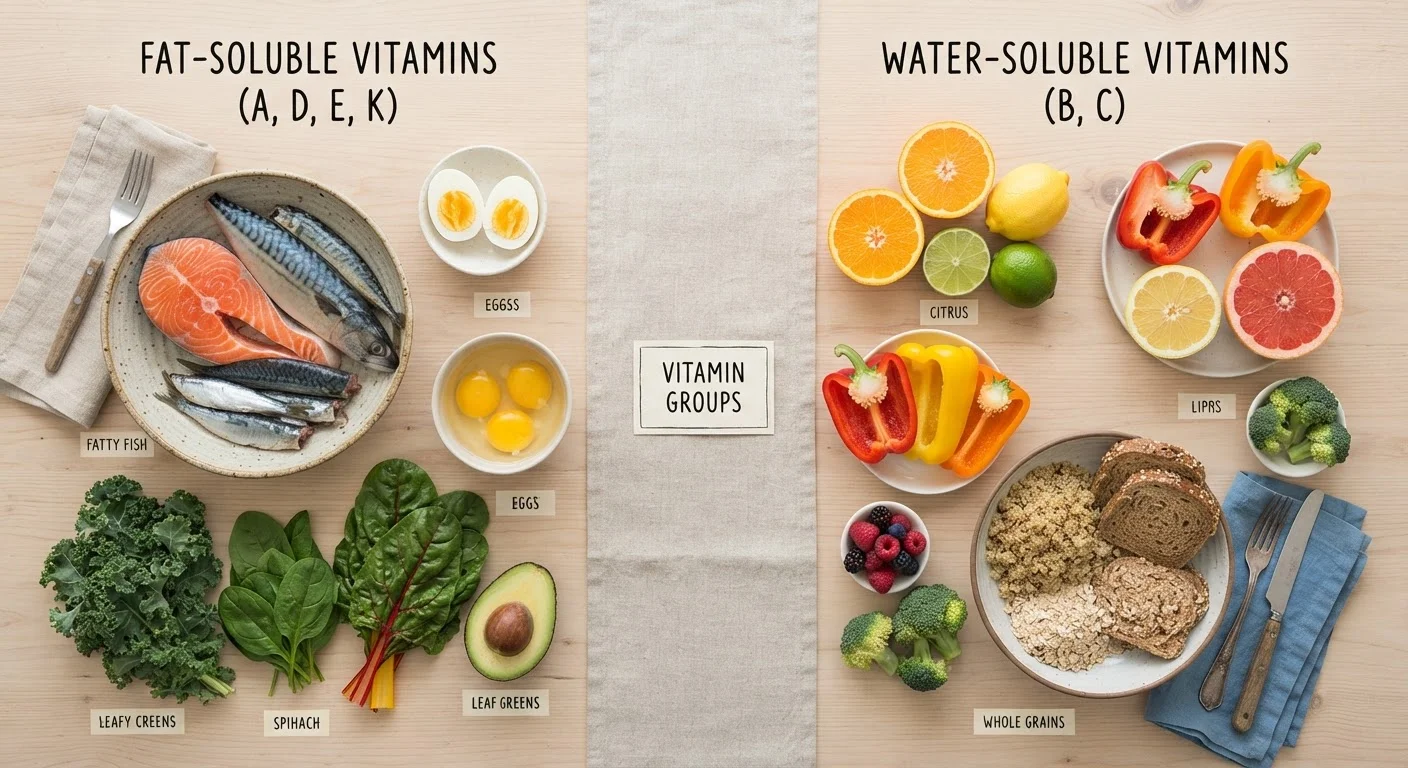
Option A
Fat-Soluble Vitamins
The long-term reserves stored in body fat and liver tissue.
Best for: Understanding why vitamins A, D, E, and K require dietary fat to be absorbed and why their levels can build up over time.
Option B
Water-Soluble Vitamins
The daily workhorses that dissolve in water and cycle out quickly.
Best for: Understanding why vitamin C and the eight B vitamins need regular replenishment through food and why excess amounts are generally excreted.
What Makes a Vitamin Fat-Soluble or Water-Soluble?
Every vitamin is classified by one fundamental chemical property: whether it dissolves in fat or in water. That distinction determines how your body absorbs, transports, stores, and ultimately eliminates each nutrient.
Fat-soluble vitamins (A, D, E, and K) are absorbed through the small intestine alongside dietary fats. They hitch a ride on lipid carriers called chylomicrons, enter the lymphatic system, and are stored in the liver and fatty tissue for future use. Because the body holds onto these reserves, you do not need to consume them every single day — but those reserves can also accumulate to harmful levels when intake is chronically excessive, especially from concentrated supplements.
Water-soluble vitamins — vitamin C and the eight B vitamins (thiamine, riboflavin, niacin, pantothenic acid, B6, biotin, folate, and B12) — dissolve directly in water, pass into the bloodstream through the intestinal wall, and travel freely throughout the body. Whatever the body cannot use is filtered by the kidneys and excreted in urine. The practical result: they need regular replenishment through food.
To understand why dietary fat is involved at all, it helps to know what fat actually does in the body. Our closer look at dietary fat explains how fat absorption works and why fat-soluble vitamin uptake depends on it.
Side-by-Side: How the Two Groups Compare
The table below summarizes the most practically important differences between the two vitamin categories.
| Criterion | Fat-Soluble Vitamins | Water-Soluble Vitamins |
|---|---|---|
| Which vitamins | A, D, E, K | C and all 8 B vitamins |
| How absorbed | With dietary fat via lymphatic system | Directly into bloodstream via intestinal wall |
| Storage in body | Stored in liver and fatty tissue | Minimal storage; excreted in urine |
| Frequency needed | Not required every day | Regular daily intake recommended |
| Toxicity risk | Higher risk at excessive doses | Generally lower; kidneys clear surplus |
| Key food sources | Liver, dairy, eggs, fatty fish, leafy greens | Citrus, whole grains, legumes, vegetables |
One nuance worth noting: even within each category, individual vitamins vary. Vitamin B12, for instance, is stored in the liver in larger amounts than most other water-soluble vitamins — a deficiency may take years to develop on a diet that excludes animal products. Vitamin D, while fat-soluble, is produced by the skin when exposed to sunlight, adding another acquisition pathway beyond diet alone. These variations are explored further in our overview of what vitamins and minerals actually do inside your body.
Absorption, Storage, and Toxicity Risk
Because fat-soluble vitamins accumulate in body tissue, getting too much over time — particularly from high-dose supplements — is a genuine concern. Vitamin A toxicity (hypervitaminosis A) can cause liver damage, bone thinning, and other serious effects. Excess vitamin D from supplements can raise blood calcium to unsafe levels. These risks are generally not a concern from food alone, but they are well-documented with long-term supplement overuse.
Water-soluble vitamins carry a much lower toxicity risk. The kidneys are efficient at clearing surpluses. That said, very high supplemental doses of certain B vitamins — notably B6 — have been associated with nerve-related symptoms in some individuals at sustained megadoses. This underscores a general principle: more is not always better, regardless of vitamin category.
A Note on Supplement Labels
The % Daily Value (%DV) figures on supplement labels do not distinguish between fat-soluble and water-soluble vitamins, which can obscure meaningful differences in risk. A supplement delivering 500% DV of vitamin C is very different in terms of safety from one delivering 500% DV of vitamin A. When evaluating any supplement, check the category of each vitamin listed and consult a healthcare professional if you have questions about appropriate intake levels for your individual situation.
For absorption of fat-soluble vitamins, meal composition matters. Research consistently shows that consuming vitamins A, D, E, and K alongside a source of dietary fat improves how much of the nutrient the body actually absorbs. A spinach salad dressed with olive oil, for example, delivers more of its vitamin K than the same salad eaten plain. Understanding the role different types of fat play can help: see our reference on saturated, unsaturated, and trans fats for context.
Practical Takeaways for Everyday Eating
Understanding this divide does not require overhauling your diet — it just informs smarter everyday choices.
- Pair fat-soluble vitamin sources with a small amount of fat. Roasted sweet potato with a drizzle of oil, or eggs with avocado, are naturally good pairings.
- Prioritize consistency for water-soluble vitamins. Since vitamin C and most B vitamins are not stored long-term, eating a variety of fruits, vegetables, whole grains, and legumes regularly is more effective than occasional high-dose consumption.
- Be cautious with high-dose fat-soluble supplements. Unlike excess water-soluble vitamins, surplus fat-soluble vitamins do not leave the body easily. If you are considering supplementation, discuss appropriate amounts with a qualified healthcare professional.
- Avoid very low-fat diets without guidance. Chronically restricting fat can impair absorption of vitamins A, D, E, and K. The macronutrients section of our site covers what proteins, carbs, and fats actually do and why fat is not a nutrient to eliminate.
This article is for general informational and educational purposes only and is not a substitute for personalized medical or nutritional advice. Consult a qualified healthcare professional before making changes to your diet or supplement routine.
The content on this site is for informational purposes only and is not a substitute for professional advice. Always consult a qualified professional for guidance specific to your situation.