

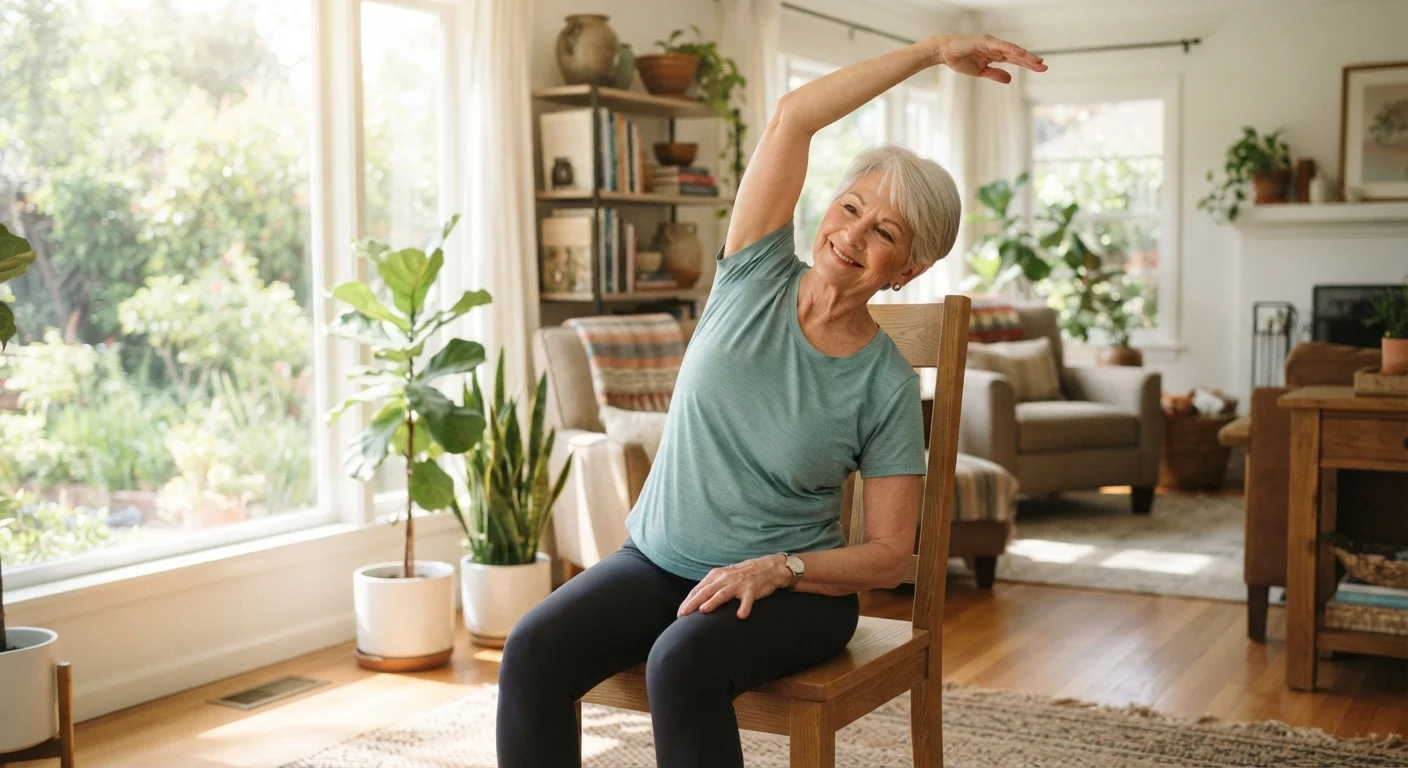
Option A
Chair Yoga
The accessible, structured approach to flexibility and mindful movement.
Best for: Older adults with balance concerns, limited floor mobility, or joint conditions that make ground-level exercise uncomfortable.
Option B
Floor-Based Stretching
The traditional, range-maximizing method for deep muscular flexibility.
Best for: Older adults who can safely transition to and from the floor and want to target flexibility across larger muscle groups.
How Each Approach Works for Aging Joints
As adults move into their 50s, 60s, and beyond, joint cartilage gradually thins, connective tissue loses elasticity, and muscle mass naturally declines — a process called sarcopenia. These changes make deliberate flexibility and mobility work increasingly important, not less. The question isn't whether to stretch, but which method best fits your current physical baseline. For a broader look at how movement needs evolve with age, see how movement needs shift after 50.
Chair yoga adapts classical yoga poses so they can be performed seated or with the chair as a support prop. This eliminates the need to lower to the floor, stand on one leg unsupported, or bear weight through vulnerable wrists or knees. Movements typically include seated spinal twists, supported forward folds, shoulder rolls, and gentle hip openers — all performed at a pace that invites breath awareness.
Floor-based stretching encompasses static holds performed on a mat — hamstring stretches, supine knee-to-chest pulls, prone hip flexor lengthening, and similar positions. Because gravity assists the stretch, these positions can achieve deeper muscular release than seated alternatives, particularly for the posterior chain (hamstrings, glutes, and lower back). The limitation is the demand placed on the individual to safely transition between standing and floor positions.
| Criterion | Chair Yoga | Floor-Based Stretching |
|---|---|---|
| Fall risk | Low — continuous chair support | Moderate — floor transitions required |
| Joint stress | Minimal — load distributed through seat | Low to moderate — position dependent |
| Muscle groups targeted | Upper body, spine, hips (partially) | Full posterior chain, hips, spine |
| Flexibility depth | Moderate — range limited by seated position | Greater — gravity-assisted lengthening |
| Equipment needed | Stable chair only | Exercise mat, possibly support blocks |
| Mindfulness integration | High — breath and body awareness central | Low to moderate — technique-focused |
| Best for beginners | Yes — low barrier to entry | Conditional — depends on mobility baseline |
Accessibility, Safety, and Real-World Practicality
For many older adults, the most critical factor isn't which method produces superior flexibility gains in a clinical trial — it's which method they can perform safely and consistently at home. Chair yoga wins decisively on accessibility. A stable chair, a few feet of clear space, and guidance from a qualified instructor (in person or via a reputable video program) are all that's required. There's no risk associated with getting up from the floor, and the continuous support reduces the likelihood of losing balance mid-movement.
Floor stretching, by contrast, introduces two additional physical demands: the controlled descent to the floor and the return to standing. For adults with knee osteoarthritis, hip replacement history, or significant balance impairment, these transitions can pose a fall or injury risk that negates any flexibility benefit. If floor work is desired, using a firm, low platform or performing stretches on a bed can reduce the transition challenge. For context on how low-impact activity compares to higher-intensity options in aging, see low-impact vs. high-impact exercise after 65.
Research published in geriatric rehabilitation contexts suggests that chair-based exercise programs demonstrate strong adherence rates among older adults — partly because they are perceived as less intimidating and less painful than floor-level alternatives. Adherence, not theoretical efficacy, is often what determines real-world outcomes.
This article is for general informational purposes only and does not constitute medical advice. Consult a qualified healthcare provider before starting any new exercise program, particularly if you have existing joint conditions, cardiovascular concerns, or a history of falls.
The content on this site is for informational purposes only and is not a substitute for professional advice. Always consult a qualified professional for guidance specific to your situation.