

What Research Actually Says About Metabolic Rate Across Life
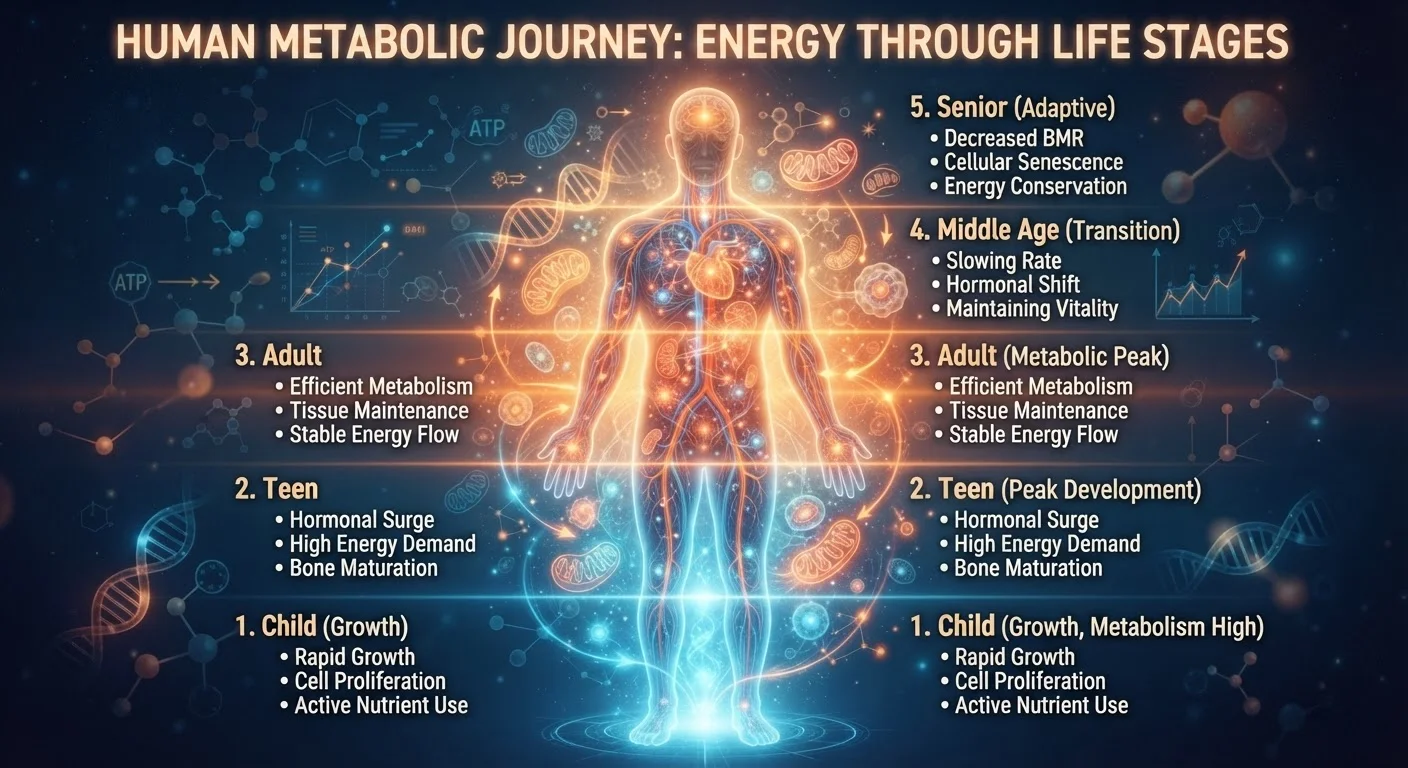
A landmark 2021 study published in Science, analyzing data from more than 6,400 people across 29 countries and ages 8 to 95, reshaped how researchers understand lifelong energy expenditure. Its central finding surprised many: total daily energy expenditure — when adjusted for body size and composition — remains largely stable from roughly age 20 to age 60. The steep metabolic cliff that popular culture associates with turning 30 or 40 simply does not appear in the data.
After 60, however, metabolism does begin a measurable decline — about 0.7% per year. After 80, the drop accelerates further. These findings suggest that the metabolic changes most adults in their 30s and 40s attribute to aging are more likely driven by behavioral and body composition shifts than by the aging process itself. For a clearer picture of which physical changes are genuinely age-related versus lifestyle-driven, see what science says is actually normal after 40.
The Muscle Connection: Why Body Composition Matters More Than Age
The most significant metabolic shift in midlife is not a spontaneous slowdown of cellular machinery — it is the gradual loss of skeletal muscle mass, a process known as sarcopenia. Muscle is metabolically active tissue; it burns calories even at rest. As muscle mass declines, resting metabolic rate drops proportionally. This is why two people of the same age and weight can have meaningfully different caloric needs depending on their muscle-to-fat ratio.
Sarcopenia accelerates after 60, but it begins as early as the mid-30s in sedentary individuals, with losses estimated at roughly 3–8% of muscle mass per decade before age 60. The practical implication is significant: maintaining or building muscle through resistance exercise is one of the most evidence-backed strategies for preserving metabolic function with age. For a detailed look at why this process speeds up and how to address it, muscle loss after 60 and what slows it down covers the mechanisms and interventions clearly.
Myth
Metabolism crashes dramatically after age 30, making weight gain essentially inevitable.
Fact
Research shows metabolic rate is stable from roughly 20 to 60 when adjusted for body size; perceived slowdowns are largely explained by muscle loss and reduced activity.
The belief that metabolism falls off a cliff in early adulthood is widespread but poorly supported. The 2021 Science study found no significant age-related decline in adjusted energy expenditure between ages 20 and 60. Weight changes in this period are more accurately attributed to decreasing physical activity and gradual muscle loss — both of which are modifiable — rather than an irreversible metabolic shift.
Myth
Eating less is the primary solution to a slowing metabolism as you age.
Fact
Indiscriminate calorie restriction can worsen muscle loss and nutrient deficiencies; prioritizing protein intake and physical activity is more effective.
When calorie intake drops sharply without attention to macronutrient quality, the body may break down muscle tissue for energy — the opposite of what supports a healthy metabolism. Registered dietitians and geriatric health researchers consistently emphasize adequate protein, not reduced total intake, as the dietary lever most relevant to metabolic and functional health in older adults. Eating patterns should be assessed with a qualified professional, not adjusted based on general assumptions about aging and food quantity.
Myth
Once metabolism slows with age, there is nothing meaningful you can do to reverse it.
Fact
Resistance training, adequate protein, and consistent physical activity can preserve or partially restore metabolic function at most adult ages.
Evidence from exercise physiology consistently shows that skeletal muscle responds to resistance training across the adult lifespan — including in adults in their 70s and 80s. Building or maintaining muscle mass directly supports resting metabolic rate. This does not mean aging has no metabolic effects, but it does mean those effects are meaningfully modifiable. The common misconceptions about growing older resource addresses this and related assumptions in more detail.
Myth
Metabolic decline is uniform — it happens at the same rate for everyone as they age.
Fact
The pace of metabolic change varies considerably based on body composition, activity level, hormonal factors, and health status.
Aging is not a single, uniform biological program. Two 65-year-olds can have markedly different resting metabolic rates depending on their lean muscle mass, physical activity habits, hormonal environments, and chronic conditions. Thyroid function, for instance, affects metabolic rate and can shift with age or health status. Hormonal changes associated with menopause and andropause also influence energy metabolism. These individual differences reinforce why population-level generalizations about metabolism and aging should be interpreted carefully and personal health decisions made with a qualified clinician.
Adapting Your Nutrition Approach — Without Overcorrecting
A common response to the perceived metabolism slowdown is aggressive calorie restriction. This is often counterproductive. Severely cutting calories — particularly without attention to protein intake — can accelerate muscle loss, reduce energy available for physical activity, and compromise nutrient absorption, which already becomes less efficient with age. The goal should be nutrient density, not minimal intake.
Older adults generally need more protein per kilogram of body weight than younger adults, not less — a fact that contradicts the widespread assumption that aging means eating less of everything. Digestive changes also affect how nutrients are absorbed; how digestion shifts with age explores how gut function evolves and which dietary habits support it. For a broader review of faulty nutrition assumptions, nutrition myths that mislead older adults addresses the most common ones directly.
Stable 20–60
Age range of relatively stable adjusted metabolic rate
A 2021 study in Science found total energy expenditure, adjusted for body composition, does not significantly decline between ages 20 and 60.
~0.7% / year
Annual metabolic decline after age 60
The same large-scale international study found energy expenditure begins declining at approximately 0.7% per year after age 60, accelerating after 80.
3–8%
Muscle mass lost per decade in sedentary adults before age 60
Estimates from geriatric and sports medicine research suggest sedentary individuals lose between 3% and 8% of skeletal muscle mass per decade starting in the mid-30s.
This article is for general informational purposes only and does not constitute medical advice. Consult a qualified healthcare professional before making changes to your diet, exercise routine, or health management plan.
The content on this site is for informational purposes only and is not a substitute for professional advice. Always consult a qualified professional for guidance specific to your situation.