

Our Verdict
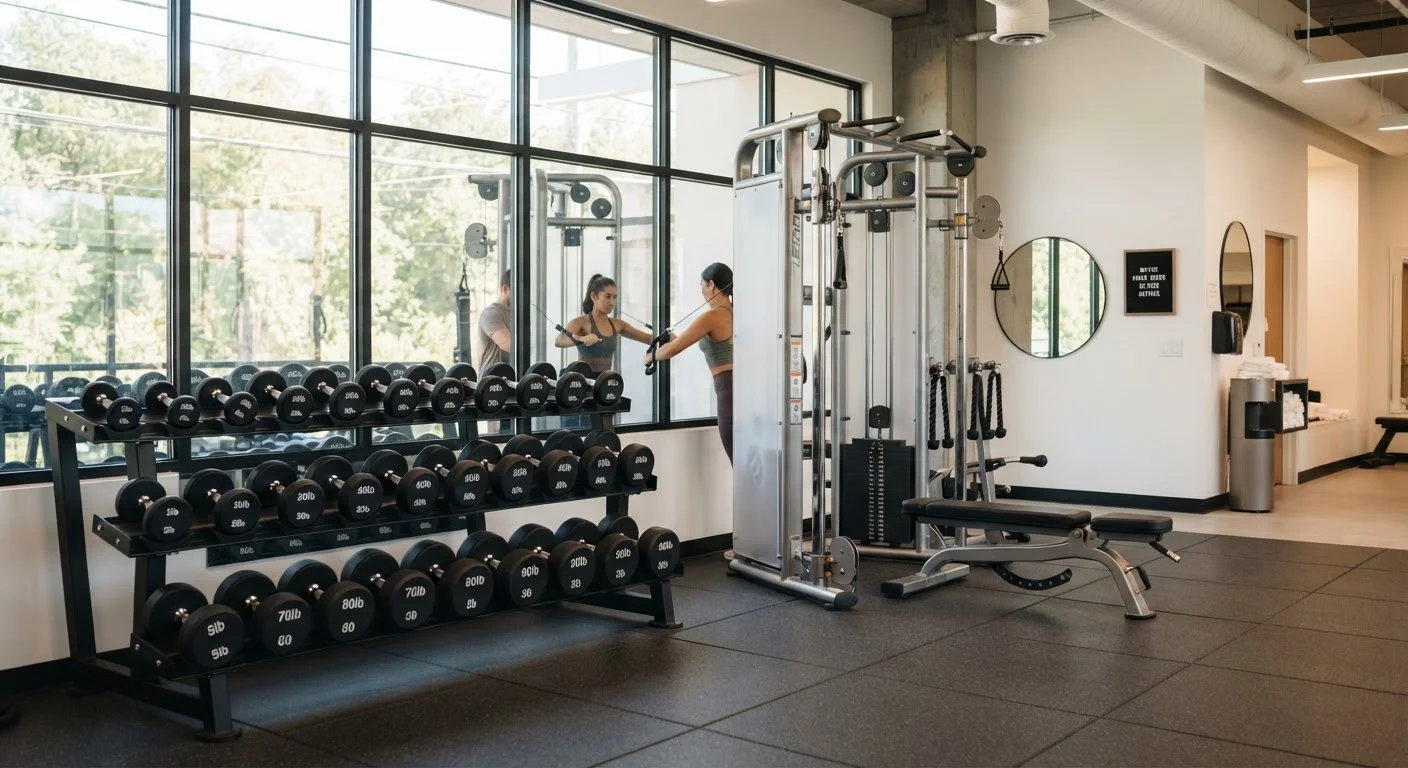
Free weights and machines are complementary tools, not rivals. Free weights tend to offer greater functional carry-over and muscle coordination demands, while machines provide a safer learning environment and effective muscle isolation. The most effective strategy for most people is a thoughtful combination of both, calibrated to individual goals and experience.
| Best for | Recommended |
|---|---|
| Beginners learning movement patterns safely | Machines |
| Those training for functional strength and real-world movement | Free Weights |
| Individuals rehabilitating an injury under professional guidance | Machines |
| Experienced lifters seeking balanced muscle development | Both (combined program) |
What Makes These Two Approaches Different
At their core, free weights (dumbbells, barbells, kettlebells) and resistance machines differ in one fundamental way: how much your body has to stabilize itself during the movement. With free weights, you control the path of the load through space. With machines, a track or cable system defines that path for you.
This distinction shapes nearly everything about how each tool trains your body — which muscles activate, how much skill is required, and what risks and benefits come with each. Understanding this core difference helps you make smarter choices about what belongs in your routine, rather than defaulting to habit or gym availability.
This same kind of nuanced thinking applies in other areas of fitness too. For example, the tradeoffs between informal daily movement and structured gym sessions follow a similar logic — neither is inherently better; context determines value.
The Case for Free Weights
Free weights demand that your stabilizer muscles — the smaller muscles that support your joints and maintain posture — work alongside the primary movers. A dumbbell bench press, for instance, recruits your rotator cuff and scapular muscles in ways a machine chest press typically doesn't.
This broader muscle recruitment can contribute to functional strength: the kind that translates to real-world activities like carrying groceries, lifting a child, or recovering your balance. Many exercise scientists consider free weights better at developing intermuscular coordination — the ability of multiple muscle groups to work together efficiently.
Free weights also offer greater versatility. A single set of dumbbells can train virtually every muscle group through hundreds of movement variations. This pairs well with compound movements like squats and rows, which load multiple joints simultaneously for efficient full-body development.
The trade-off is that free weights require more technique. Poor form under load increases injury risk, making coaching or a learning period important — especially for beginners.
| Free Weights | Machines | |
|---|---|---|
| Stabilizer muscle recruitment | High — you control the movement path | Low — machine guides the movement |
| Learning curve | Steeper — technique is critical | Gentler — guided range of motion |
| Functional carry-over | Strong — mimics real-world demands | Moderate — more isolated activation |
| Muscle isolation | Harder to achieve precisely | Easier — designed for targeting |
| Injury rehabilitation suitability | Requires professional guidance | Often preferred for controlled loading |
| Versatility | Very high — many movement options | Limited to machine's design |
| Accessibility for beginners | Moderate — coaching recommended | High — intuitive setup |
The Case for Machines
Resistance machines reduce the stabilization demand, which is precisely their advantage in certain situations. When you're new to strength training, fatigued, or recovering from an injury, a machine allows you to load a muscle effectively without requiring the same technical skill as a free weight movement.
Machines also make it easier to isolate specific muscles. A leg extension machine, for example, targets the quadriceps in a way that's difficult to replicate with free weights alone. This targeted loading is useful for rehabilitation protocols and for addressing strength imbalances between muscle groups.
For older adults or those with balance challenges, machines can provide a safer entry point into resistance training — an important consideration given how well-established the benefits of strength training are for healthy aging. If you're thinking through exercise options for aging bodies more broadly, a comparison of low- and high-impact exercise after 65 offers useful context.
How to Think About Combining Both
Most fitness professionals don't advocate an either/or approach. A well-designed strength program often uses machines to warm up specific muscles or finish a session with targeted isolation work, while free weights anchor the main compound lifts.
Think of machines as a scaffold and free weights as the structure. Early in a training career — or when returning from time off — machines help you build a baseline of strength and body awareness. As your technique improves, free weights progressively become a larger part of your training.
Your goals matter too. If you're training primarily for health and everyday function, free weight-dominant programs tend to offer more carry-over. If you're working toward specific aesthetic goals or managing a physical limitation, machines may be weighted more heavily in your plan.
Regardless of which tools you use, the same principles that make any exercise program effective — progressive overload, consistency, and adequate recovery — apply equally. And just as walking and running both deliver genuine fitness benefits depending on the person and context, both free weights and machines can meaningfully improve your strength and health when used appropriately.
This article is for general informational purposes only and does not constitute medical or exercise prescription advice. Consult a qualified healthcare provider or certified fitness professional before beginning or modifying any strength training program, particularly if you have an existing health condition or injury.
The content on this site is for informational purposes only and is not a substitute for professional advice. Always consult a qualified professional for guidance specific to your situation.