

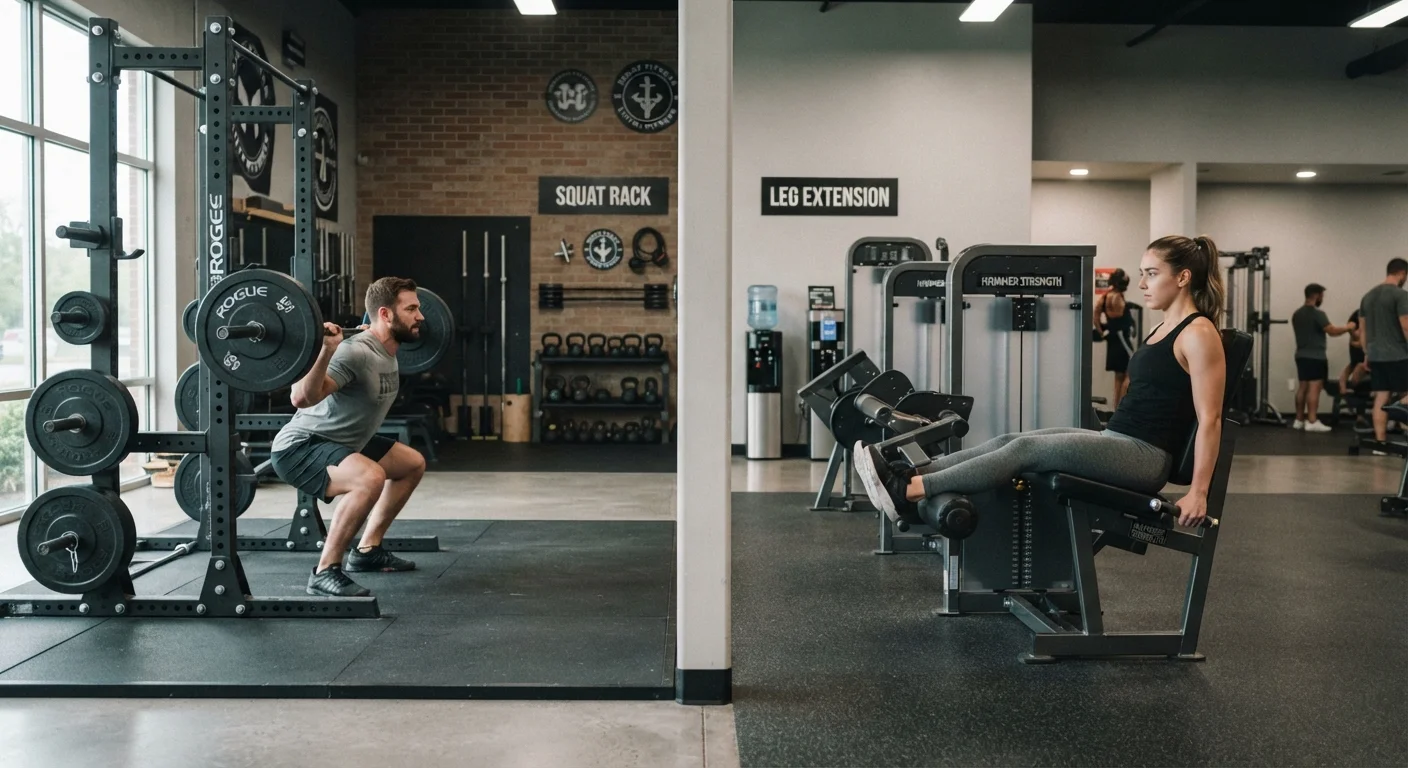
Option A
Compound Movements
The multi-joint, high-efficiency foundation of most effective programs.
Best for: Building overall strength, burning more calories, and maximizing training efficiency in less time.
Option B
Isolation Exercises
The targeted, single-joint tool for precision and balance.
Best for: Addressing weak links, rehabbing specific muscles, and adding volume to lagging body parts.
What Makes a Movement 'Compound' or 'Isolation'?
The difference comes down to how many joints are moving. A compound movement involves two or more joints working together — think of a squat, where your hips, knees, and ankles all flex and extend at once. Dozens of muscles activate simultaneously to execute that single pattern.
An isolation exercise, by contrast, pins the movement to one joint. A leg extension straightens only the knee, targeting the quadriceps almost exclusively. A bicep curl flexes only the elbow. Everything else stays stationary.
Neither label makes an exercise inherently good or bad. What matters is understanding what each type does well — and where it falls short.
| Criterion | Compound Movements | Isolation Exercises |
|---|---|---|
| Joints involved | Two or more joints | One joint |
| Muscles trained | Multiple groups at once | One primary muscle |
| Training efficiency | High — more work per set | Lower — narrow focus |
| Skill and coordination required | Higher — complex patterns | Lower — simpler motion |
| Best placement in session | Beginning (primary lifts) | End (accessory work) |
| Rehab / injury use | Limited — loads multiple joints | Preferred — controlled, targeted |
| Examples | Squat, deadlift, bench, row | Curl, leg extension, lateral raise |
The Case for Compound Movements
Compound lifts — squats, deadlifts, bench press, overhead press, rows, pull-ups — are the backbone of most evidence-supported strength programs. Their efficiency is hard to overstate: one set of deadlifts trains your hamstrings, glutes, lower back, traps, and grip simultaneously. That multi-muscle recruitment also means a higher metabolic demand, which contributes to calorie expenditure during and after training.
Beyond efficiency, compound movements train patterns the body actually uses. Hinging, squatting, pushing, pulling, and carrying are how humans move through daily life. Practicing these patterns under load builds functional strength that transfers beyond the gym.
For tips on executing these movements safely, see principles of safe exercise form — proper technique matters as much as exercise selection.
Where Isolation Exercises Earn Their Place
Isolation work is often dismissed as vanity training, but that misses its legitimate role. When a particular muscle is underdeveloped, injured, or simply not activating well during compound lifts, targeted isolation can fill the gap.
Common examples include lateral raises to develop the medial deltoid (a muscle the bench press barely touches), hamstring curls to complement quad-dominant squatting, and calf raises for lower-leg development. Rehabilitation contexts also rely heavily on isolation movements — controlled, single-joint loading allows a muscle to be strengthened without stressing structures that need rest.
The key limitation: isolation exercises don't build the same neuromuscular coordination or systemic strength as compound lifts. A program built entirely on curls and extensions is far less effective than one anchored by rows and squats.
8+
Muscle groups activated in a deadlift
Exercise science textbooks consistently identify the deadlift as one of the most systemically demanding movements, engaging the posterior chain, core, and grip simultaneously.
~30%
Greater acute calorie burn with multi-joint exercise
Research published in the Journal of Strength and Conditioning Research has found multi-joint exercises produce meaningfully higher acute energy expenditure compared to single-joint alternatives of equal effort.
1–2
Isolation exercises per muscle group is typically sufficient
Most evidence-based programming guidelines suggest one to two accessory isolation movements per session is enough to supplement compound work without excessive volume.
How to Combine Both in Your Routine
The practical answer for most people is straightforward: lead with compound movements, finish with isolation work. Start your session with the exercises that demand the most coordination and energy — squats, presses, rows — while your nervous system is fresh. Then use isolation exercises at the end to add volume to specific muscles without taxing your system further.
A simple structure might look like: squat pattern → hinge pattern → upper-body push → upper-body pull → 2–3 isolation accessories. This mirrors how most well-structured programs are designed, from beginner strength templates to intermediate bodybuilding splits.
If you're weighing whether to train with free weights or machines for either type of exercise, the free weights vs. machines trade-offs breakdown can help clarify your options.
This article is for general informational and educational purposes only and is not a substitute for professional medical or fitness advice. If you have an injury, chronic condition, or specific health concern, consult a qualified healthcare professional before beginning or modifying any exercise program.
The content on this site is for informational purposes only and is not a substitute for professional advice. Always consult a qualified professional for guidance specific to your situation.